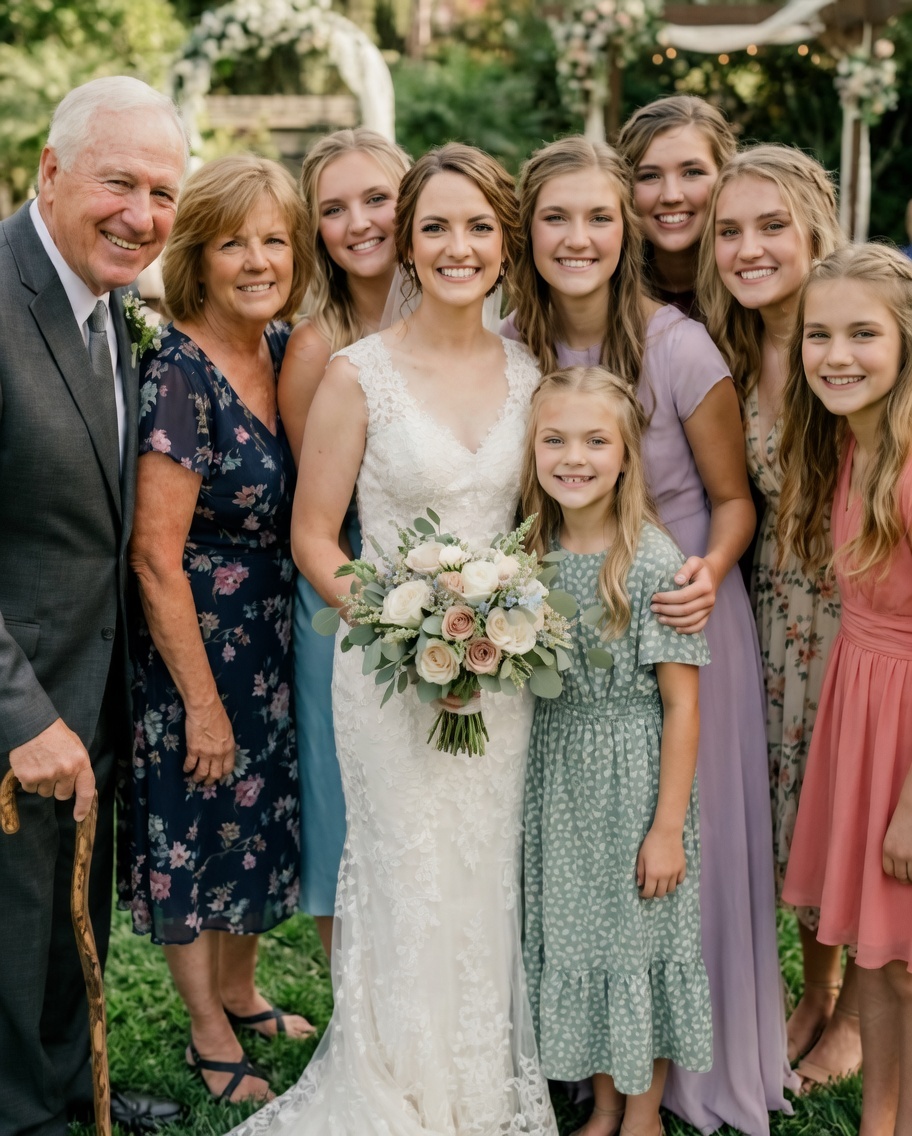
When you get the call that your husband has terminal cancer and less than a year left, the world doesn’t stop — it just keeps moving while you try to catch your breath. Thomas and I had been married thirty-three years. Seven daughters. A house full of noise, laughter, pink dresses, school concerts, late-night talks, and the kind of ordinary chaos that makes life beautiful. Thomas always called them his seven miracles. He’d come home from the factory, tired and greasy, and still find energy to dance with whichever little girl tugged on his hand first. When the doctor sat us down and said the chances of recovery were almost zero, I forgot how to inhale. Thomas just reached for my hand under the desk and squeezed. “We’ve had a good run,” he said quietly. “Let’s make whatever’s left count. ”
Emily, our oldest, was already planning her wedding. She’d been engaged for a year, and the date was set for six months after the diagnosis. Thomas had always said he wanted to walk all seven girls down the aisle someday. Now we knew he might not make it past the first. Emily started acting strange — canceling dinners, barely answering calls, making last-minute changes to the venue, the flowers, the guest list. I asked if she was okay. She blamed wedding stress and work pressure. I didn’t push. My mind was on Thomas — chemo appointments, nausea, weight loss, trying to keep him comfortable while pretending everything was fine for the younger girls.
The wedding day arrived too fast. Thomas had lost so much weight his suit hung loose. He could barely stand without help. But that morning he looked at me with clear eyes and said, “I will walk my little girl down the aisle. Nothing will stop me. ” I helped him dress. We drove to the church in silence. He held my hand the whole way. When we got there, he took Emily’s arm. She looked beautiful — white dress, soft veil, eyes shining. The music started. The guests rose. Thomas took one step, then another. Halfway down the aisle, the music suddenly stopped. Dead silence. Thomas froze. I saw his shoulders tense. I thought he was in pain, that he couldn’t go on.
Then I followed his gaze. At the altar, instead of just the groom waiting, stood all six of our other daughters — dressed in matching soft blue gowns, holding white roses. They had formed two lines, creating an honor guard down the final stretch of the aisle. But that wasn’t all. Behind them, on either side of the groom, were seven empty chairs — one for each daughter — with framed photos of Thomas at different ages: holding newborn Emily, teaching toddler Sophie to ride a bike, dancing with middle-school Grace at her first recital, carrying little Hannah on his shoulders. The photos faced the aisle so Thomas could see them as he walked. A banner hung above the altar, simple white letters on navy: “Dad, we’re walking with you too. ”
Thomas stopped breathing for a second. His knees buckled slightly. Emily tightened her grip on his arm. The guests were silent — many crying already. Our daughters began singing — soft, a cappella — the lullaby Thomas used to sing to them every night when they were small. “Hush little baby, don’t say a word…” Their voices trembled but stayed strong. Thomas looked from one daughter to the next — seeing the life he’d built, the love he’d poured into them, reflected back at him in that moment. Tears streamed down his face. He couldn’t speak. He just kept walking — slower now, leaning on Emily, but moving forward because his girls were carrying him the rest of the way.
When he reached the altar, all seven daughters surrounded him. They each kissed his cheek, whispered something private, then stepped back to let Emily finish the walk with him. The groom was crying too — he’d been in on the plan. The officiant waited until Thomas caught his breath. Thomas looked at me in the front row — I was sobbing openly — and mouthed, “I love you. ” Then he placed Emily’s hand in her groom’s and stepped back. The music started again — the same lullaby, now instrumental. The ceremony continued, but no one was really watching the vows. We were all watching Thomas — standing tall in his suit that was too big now, surrounded by every daughter he’d ever raised, knowing he’d made it to this moment against every odd.
After the ceremony, Thomas sat in a chair off to the side during the reception. Each girl came to him one by one — long hugs, quiet words, more tears. Emily knelt in her dress and said, “We didn’t want you to walk alone, Dad. We wanted you to know you’re carrying all of us with you — always. ” He pulled her close and whispered something I couldn’t hear. Later he told me it was, “You gave me the best day of my life. ”
Thomas lived four more months. Long enough to see Emily’s wedding photos framed on our wall. Long enough to meet his first grandchild — Emily’s little boy, born early but healthy. Long enough to tell each daughter, one by one, how proud he was. When he passed, it was peaceful — at home, surrounded by all seven girls and me. No one was alone. No one had to wonder if he knew how much he was loved.
Emily’s wedding wasn’t just a wedding. It was a promise kept. A gift given. A final walk down an aisle that mattered more than any other. Our daughters didn’t wait for the world to give Thomas his flowers. They brought them to him — right there, halfway down the aisle, when he needed them most. And in that moment, with the music stopped and seven daughters singing their father home, we all understood what love really looks like: showing up, even when time is running out, and carrying each other the rest of the way. I’ll never forget the look on his face when he realized what they’d done. Pure, overwhelming joy — the kind that makes even the hardest goodbye feel bearable. That’s the moment that stays with me now. Not the diagnosis. Not the loss. But the love that refused to let him walk alone.