The sun filtered warm lemon-yellow through the maple trees, dancing across the sidewalk. It was a crisp Saturday afternoon, the kind where kids dashed barefoot through sprinklers and neighbors waved over lawnmowers.
Sixteen-year-old Emily Reese checked the clock on her phone: 2:42 p.m. She paced the living room, nervously glancing outside. She had been watching 4-year-old Mason for three hours. His mom had left her with a packed snack tray, board games, and clear instructions. Emily had followed them to the letter.
But Mason wasn’t in the playroom anymore.
He had been pushing a plastic firetruck just minutes ago. Then the front door had creaked. Just a moment—Emily had stepped into the kitchen to grab apple slices.
Now the house was too quiet.
Emily’s chest tightened. “Mason?” she called, her voice catching. She checked each room. The bathroom. His tiny bed. Backyard. Nothing. Not even a giggle.
Her hands were shaking by the time she rang Mason’s mom, Olivia Trent.
“What do you mean, he’s gone?” Olivia’s voice sliced like glass. “You were supposed to keep him safe!”
The sirens came next.
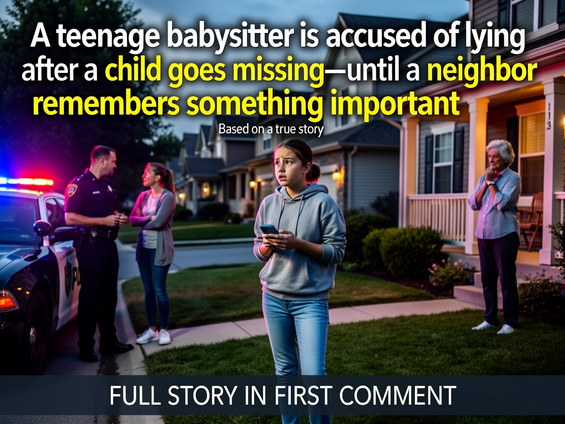
Neighbors gathered as the police pulled up, lights flashing. Emily stood frozen by the porch, her braid unraveling, palms damp. Guilt twisted in her belly.
“She doesn’t even know what happened,” Olivia sobbed to the officer. “This girl. She just looked away, and now my baby is missing.”
A man in a gray windbreaker stepped forward—Kevin Miller, Olivia’s brother. Fire flared in his eyes. “You had one job!” he barked at Emily. “You think you can scroll on your phone while a kid disappears? Liar!”
People murmured, stepping back. Someone gasped. Others whispered. Eyes bore into Emily like a thousand tiny needles.
“I—I didn’t…” Her voice cracked. “He was just here. I didn’t leave the door open—I swear.”
“Oh really?” Kevin shouted, “Then where is he?!” He jabbed a finger at her chest. “You’re hiding something.”
“That’s enough.”
The words rang out firm and calm.
Everyone turned.
Mrs. Dorothy Kingston stood on the sidewalk, gripping her cane, her wiry frame straight with purpose. The 82-year-old widow had lived on the block for fifty years—and missed nothing.
“She said that’s enough,” Dorothy repeated, stepping forward. “Yelling won’t bring him back. And you, sir, should be ashamed.”
Kevin bristled. “She left him alone!”
“Listen,” Dorothy interrupted. Her voice softened. “I know what it’s like to lose someone. My grandson drowned a decade ago. He was five. No one was watching. We blamed the babysitter too… until we found out the truth.”
She turned to the nearest cop. “I might have seen something. About twenty minutes ago, I spotted that blue ice cream van—the one that doesn’t play music. It was parked at the corner where the hedges hide most of the street. Then it sped off.”
Kevin blinked. “What?”
Olivia’s knees nearly gave way. “Oh God…”
The officer radioed in. “Be on the lookout for an unmarked ice cream-style van, blue with peeling paint…”
Dorothy placed a hand on Emily’s trembling shoulder. “You didn’t lie, sweetheart. You were here. The rest of us weren’t.”
Less than an hour later, another call came in.
The van had been found three streets over—its driver detained. And inside, wrapped in a faded red blanket, was Mason.
Alive. Crying—but safe.
Olivia collapsed in tears as officers led her son into her arms. Kevin stood frozen, jaw slack, his outrage dissolving into pale guilt.
“I—I thought…”
“You accused her,” Dorothy said coldly. “You nearly destroyed her.”
Kevin stepped toward Emily, who stood beside her parents now, eyes rimmed with red.
“I’m sorry,” he whispered. “I got scared and… I blamed you because it was easier than looking at myself.”
Emily nodded slowly, swallowing the lump in her throat. “I understand. But it still hurt.”
The crowd began to disperse. A few came over, patting Emily on the back. Others apologized for their silence.
That night, lanterns flickered on porches. Mason snuggled home in superhero pajamas, unaware his neighborhood had nearly shattered.
A week later, something new appeared on Mrs. Kingston’s lawn.
A wooden bench—painted sky blue—was nestled beneath the oak tree. A small brass plaque read: “To Emily Reese: For standing in the storm and telling the truth.”
Every Saturday thereafter, Emily and Mason would sit on that bench eating popsicles, giggling about firetrucks and frogs. Sometimes Dorothy would join them, handing out lemon cookies.
And though Emily never said it aloud, whenever she felt doubt creeping in, she looked at that bench—and remembered:
Being believed is a kind of justice too.