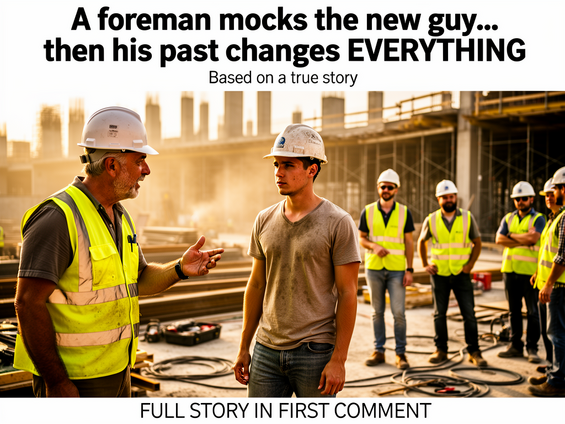
The morning sun beat down hard on the jobsite, warming the metal scaffolding and bouncing light off the naked frames of half-built townhomes. Hammers tapped rhythmically. Someone’s radio played a classic rock station low under the noise. It was just another Tuesday.
Eli was new, still getting his bearings. Thin from a recent illness and quiet, he moved with cautious care, his name scribbled in Sharpie across a fresh hard hat. He was decades younger than most of the rough-handed crew, and you could see it in his wide eyes. Today, he’d been tasked with loading plywood onto the hoist. Basic stuff.
Only—it jammed. The platform stuck halfway up, sagging at an awkward angle. Eli hit the emergency stop, checked the chains. He was troubleshooting, not panicking. But that was all the opening Foreman Rick needed.
The man stormed over, red-faced and glaring. “You trying to kill someone, rookie?” Eli swallowed hard. “I think it’s just—” “Think less, load more,” Rick barked, loud enough to stop hammers mid-swing. “That’s what happens when we hire charity cases with soft hands. You’ve been here a week and already screwing up basic operations. Can’t even get a lift running without breaking it. Pathetic.”
The whole site went still. A few guys shifted awkwardly. One spat into the dirt. Someone else looked away. Eli’s face burned red. He bit his lip, said nothing. The silence hummed like a live wire.
Then, from near the trailer, a calm voice broke through. “That’s enough.” Rick turned, scowl locked and loaded. It was Carmen—the crane operator, nearly fifty, with a streak of silver in her ponytail and a reputation for not suffering fools. She jumped down from her perch, safety vest flapping. “Don’t you talk to him like that,” she said, coming toe to toe with Rick. “You don’t know his story.”
Rick laughed, derisive. “Ain’t got time for sob-stories. This is a worksite, not a therapy circle.” Carmen’s voice didn’t shake. “Last year,” she said, nodding toward Eli, “he was working in Ukraine. With Engineers Without Borders. Helping rebuild destroyed schools.” Murmurs rippled through the crew. “He was disarming mines so kids could walk to class safely,” she added, her hands trembling just slightly. “He saw his best friend blown apart by shrapnel. Two weeks later, he was back out there, rebuilding walls with his bare hands.”
Rick blinked. Eli didn’t move. His jaw was tight now, lips pressed together not from shame—but restraint. “I know because my nephew was with him. Eli pulled him out of a collapsed building after a shelling—broke his arm doing it,” she said. “He’s alive because of this ‘charity case’ with soft hands.” The site was dead silent but for the wind rustling a plastic tarp dragging on rebar. Rick’s mouth opened. No words came. His chest rose once—twice. And then it all crumbled. His face, always hard as steel, flexed. Eyes glossy. His voice cracked the way metal would under pressure. “I—” he started. “I didn’t know.” “No,” Carmen said. “You didn’t care.” He backed up a step. Swallowed so hard it was audible. “I lost my brother in Afghanistan,” Rick murmured. “He was EOD. I just… this worksite’s all I have now. I get controlling.” “You crossed a line,” Carmen said flatly, then turned and walked back to her rig.
Rick stood frozen. Eyes on the gravel. Then slowly, almost too quietly to hear— “I’m sorry.” He looked up at Eli. “I’m really sorry, son. I had no right.” Eli stared at him for a long moment. His lip quivered—not with fear, but release. “It’s okay,” he said softly. “Just don’t talk to anyone like that again.” The next morning, something had changed. Rick handed Eli his coffee—black, two sugars. No bark. Just a nod. By the week’s end, Rick was asking Eli’s input on blueprint details. He’d even apologized to the crew. “I forgot people carry more than what’s on their résumé,” he told them. “I was wrong.” Nobody cheered. But the nods ran deep. A month later, they finished the build—a row of homes meant for displaced veterans. On move-in day, the crew gathered under a new sign, riveted to the final beam which Eli had laser-inscribed himself. It read: “Built with Honor — For the Ones Who Never Quit.” Every Friday since, a few of the crew meet for breakfast—sometimes just coffee, sometimes stories about those they’ve lost. Rick comes early. Eli brings the bagels. The cranes still swing and hammers still fall. But now, they build more than houses. They build each other.