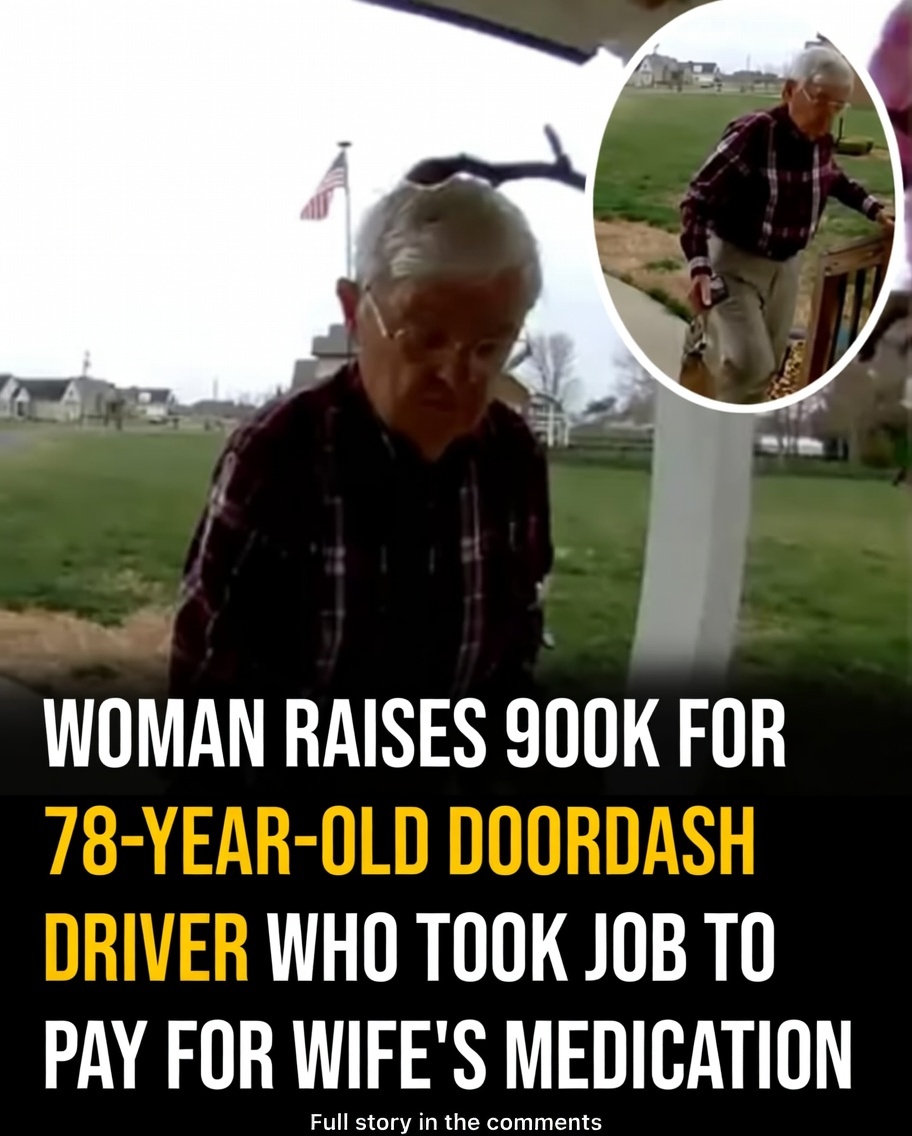
The Ring notification pinged at 8:17 p.m. Brittany Smith glanced at her phone expecting another porch pirate or a neighbor’s dog. Instead she saw an elderly man in a thin jacket, breath fogging in the cold Tennessee air, carefully balancing a food bag while gripping the porch rail. His hands shook as he set the order down, then straightened slowly, wincing. She watched him shuffle back to his small car, shoulders rounded, headlights cutting through the dark. Something about the way he moved—determined but exhausted—made her replay the clip. She noticed the DoorDash bag, the delivery app sticker on his windshield. At 78, he was still working nights to make ends meet. Brittany posted the video with a caption: “This man is delivering food in freezing weather at 78 to pay for his wife’s medicine. Can we help him?”
Within hours the clip spread. Friends shared it, then strangers, then local news picked it up. People saw their own grandparents in Richard’s face—the stubborn pride, the quiet dignity, the refusal to quit even when the body begged to stop. Comments poured in: “My dad worked until 82 because he had to.” “This is what real love looks like.” Donations started small—$10, $25, $50—then snowballed as the story reached national outlets. Brittany set up a GoFundMe titled “Help Richard Keep His Promise to His Wife.” The goal was $10,000 to cover a few months of medication and give him a break. It blew past that in 36 hours.
Richard and his wife, Mary, had been married 52 years. She was diagnosed with a rare autoimmune disorder three years earlier; the medication kept her stable but cost $3,200 a month without insurance assistance. Social Security and his small pension barely covered rent, utilities, and food. DoorDash let him work flexible hours, so he took every shift he could. He never complained, never asked for help. Mary tried to stop him, worried he’d collapse on the road, but he kissed her forehead and said, “We’ve made it through worse, sweetheart. We’ll make it through this too.” He kept the car heater off to save gas, wore the same jacket year-round, and smiled at every customer like they were doing him a favor.
The complication arrived when the money hit $900,000. Brittany and Richard met at a local diner to discuss the funds. He sat across from her in his usual flannel, hands folded, eyes wide with disbelief. “I just wanted enough for her next refill,” he said quietly. “This… this is more than I ever dreamed.” Brittany explained the donations came from strangers moved by his story—nurses, truck drivers, grandparents, young parents who saw their own loved ones in him. Richard listened, then asked the only question that mattered: “Can we use some of it to help other families with medicine costs?” Brittany promised they could set up a foundation in Mary’s name.
The turning point came when Richard and Mary appeared on local news together. She sat in her wheelchair, oxygen tube in her nose, holding his hand. Richard spoke simply: “I never wanted pity. I just wanted to take care of my wife the way she took care of me for 52 years.” Mary wiped tears and added, “He’s the strongest man I know. This money means he can finally rest a little.” The clip went viral again, donations slowed but didn’t stop. The total reached $912,000. Richard paid off their house, covered Mary’s medication for life, set up college funds for their grandchildren, and created a small fund for other seniors struggling with prescription costs.
The hidden truth emerged in quiet moments after the cameras left. Richard never saw himself as a hero. He was just a husband keeping a promise. But his determination—delivering food in freezing rain at 78—touched something universal. People saw their parents, their grandparents, themselves someday. Brittany learned that one video, one act of sharing, could change lives. She stayed in touch with the couple, visiting on holidays, watching Richard push Mary’s wheelchair around the yard now that he no longer drove at night.
The immediate aftermath rippled outward. Richard retired from DoorDash, though he still volunteered at the senior center twice a week. Mary’s health stabilized with consistent medication; she started painting again, small landscapes of the mountains they used to hike. The foundation grew slowly, helping dozens of families with co-pays and prescriptions. Brittany kept the GoFundMe open for emergencies, turning a single moment into ongoing good.
In the reflective close, Richard and Mary’s story offers gentle hope. Love doesn’t shout; it shows up in small, stubborn ways—delivering one more order, holding a hand through pain, refusing to quit. At any age—whether planning retirement, updating a will, or simply checking on an elderly neighbor—small acts matter. Richard never asked for help, but when it came, he used it to lift others too. As you think about your own loved ones, ask yourself: What quiet promise are you keeping? What small kindness could change someone’s tomorrow? Share your story of unexpected generosity or a loved one who never gave up in the comments below.
Most Popular!
-
 The Ultimate Wedding Revenge: When the Mother Who Abandoned Her Six Daughters Showed Up with Her Millionaire Boss, the Bride Opened a Box That Destroyed Lives Forever
-
The Beach Shaming Disaster: What My 8-Year-Old Said to the Prying Stranger Left Everyone Speechless
-
My Husband Abandoned Me With Twin Babies for a Luxury Fishing Trip — When He Returned, I Had Already Packed His Bags
-
The Three-Dollar Miracle: How a Dust-Covered Vase Revealed a Heartbreaking Decades-Old Secret
-
The $80,000 Battle to Erase a Birthmark: Why One Mother Risked Everything for Her Daughter’s Future
-
The Silent Thief: Why Millions of Men Are Living with a Time Bomb They Can’t See
-
The Final Curtain Falls: Beloved Sanford and Son Legend Hal Williams Gone at 91
-
Found at a Yard Sale: This “Useless” Vintage Contraption Is Actually a Forgotten Piece of Human History