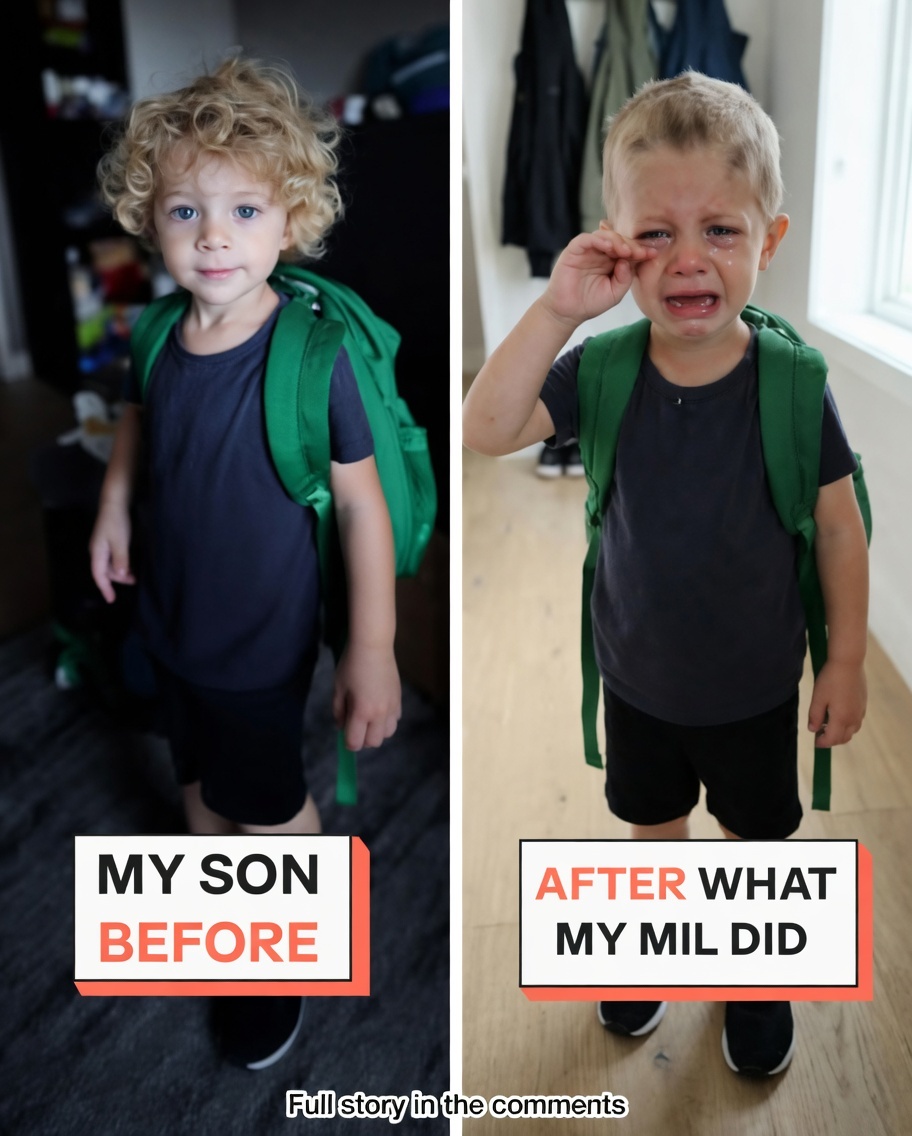
The car door opened and Leo stumbled out, face streaked with tears, his head a ragged patchwork of buzzed stubble where soft golden curls had been just that morning. You dropped to your knees on the driveway, arms open, but he buried his face in your shirt and cried harder. Brenda stepped out behind him, keys jingling, expression calm and almost proud. “There,” she announced. “Now he looks like a real boy.” The words hit like cold water. For months she’d made the same snide comments—“He looks like a little girl,” “Boys shouldn’t have hair like that”—and every time you or Mark shut it down firmly. Leo’s curls were part of who he was, part of the angel face that made strangers smile at the grocery store. She’d always smiled tightly and changed the subject. Until she didn’t.
The kindergarten call came at noon on Thursday. The secretary’s voice was hesitant: “Your mother-in-law picked Leo up early for a family emergency. We just wanted to confirm everything’s okay.” Your heart slammed against your ribs. Lily, your three-year-old daughter, had been battling a high fever and ear infection for days; the phrase “family emergency” sent you spiraling. You dialed Brenda over and over. No answer. Two hours later her car rolled up. Leo’s sobs explained everything before she could open her mouth. She’d signed him out, driven him to a barber, and had his hair shaved off without a single call to you or Mark. “He’ll thank me one day,” she said, as if she’d done him a favor.
Mark walked through the door that evening and froze when he saw Leo’s head. The color drained from his face. He knelt, ran his hand gently over the prickly stubble, and pulled his son close. Leo whispered, “Grandma said you’d be mad, but she said it was okay.” Something in Mark shifted—quiet, controlled fury mixed with heartbreak. He didn’t yell. He simply held Leo until the crying slowed, then looked at you and said, “This ends now.” Brenda texted the next day inviting everyone to her traditional Sunday family dinner. She sounded cheerful, like nothing had happened. You almost declined, but Mark shook his head. “We’re going,” he said. “And I’m bringing something she needs to see.”
Sunday arrived heavy with tension. The extended family gathered around Brenda’s long dining table—cousins, aunts, uncles, the usual chatter about work and weather. Brenda presided at the head, passing dishes with that same satisfied smile she’d worn in the driveway. She even reached over to ruffle Leo’s shorn head, murmuring, “Much better, isn’t it?” Mark stayed silent through the main course. When dessert plates were cleared, he reached for the briefcase he’d carried in without comment. The room quieted as he set it on the table and clicked the latches open.
Inside lay a thick manila envelope. Mark slid it across to Brenda without a word. She opened it slowly, curiosity turning to confusion, then shock. Her hand flew to her mouth. The papers were legal documents—petitions prepared by Mark’s attorney over the frantic 48 hours since Thursday. Temporary restraining order against unsupervised contact with the grandchildren. Modification of visitation rights. Documentation of the unauthorized removal of a child from school, the emotional distress to a five-year-old, photos of Leo’s tear-streaked face and ruined haircut timestamped the day it happened. Mark had spoken to the kindergarten, gathered witness statements from the secretary and teacher, even included a note from Lily’s pediatrician about the added stress on a sick toddler’s household. Every page was dated, notarized, ready to file if needed.
Brenda’s eyes darted around the table. The family had gone silent, forks hovering. “Mark, no… please tell me that’s not what I think it is,” she whispered. He met her gaze steadily. “It’s exactly what you think it is. You crossed a line. You took our son without permission, altered his appearance against our explicit wishes, and caused him real harm. This isn’t about hair. It’s about respect, boundaries, and the fact that you don’t get to make decisions for our children.” His voice stayed calm, almost gentle. “Sign the agreement today—supervised visits only, no more comments about appearance, no more unscheduled pickups—or we file tomorrow and let a judge decide how often you see them.”
The hidden truth landed hard in the quiet dining room. Brenda had always believed her old-school views were harmless tradition, that pushing “proper” boyhood was her right as a grandmother. She’d underestimated how far Mark would go to protect his family. The emotional toll showed on her face—shock giving way to dawning realization that her actions had consequences she couldn’t charm away. Leo, sitting on your lap, reached up to touch his short hair, then leaned into you as if sensing the shift. The family exchanged glances; some looked uncomfortable, others quietly approving. No one spoke up to defend her.
The immediate aftermath stretched across the table like a held breath. Brenda’s hands trembled as she scanned the pages again. She tried to protest—“It was just hair, it grows back”—but Mark cut in softly. “It wasn’t just hair to him. It was part of who he is, and you took that without asking.” She looked at Leo, really looked, and for the first time seemed to see the hurt she’d caused. Tears welled up. She signed the agreement in front of everyone, pen scratching across the lines. Mark collected the papers, closed the briefcase, and stood. “We love you,” he told her. “But love doesn’t mean no boundaries. We’ll see you next month—supervised, like we agreed.”
In the reflective close, the whole ordeal carries a hard-won lesson. Grandparents can love deeply and still overstep; parents can forgive while still protecting what matters most. Leo’s curls will grow back, softer and perhaps even brighter, but the real regrowth happened around the table that Sunday—respect rebuilt one firm boundary at a time. As you think about your own family—grandchildren who deserve to feel safe in their skin, retirement savings set aside for their future, a will that spells out your values—remember that love sometimes requires the courage to say no and mean it. Forgiveness followed, slowly, but only after accountability paved the way. What boundary have you had to set with family that changed everything for the better? Share in the comments below.
Most Popular!
-
 The Ultimate Wedding Revenge: When the Mother Who Abandoned Her Six Daughters Showed Up with Her Millionaire Boss, the Bride Opened a Box That Destroyed Lives Forever
-
The Beach Shaming Disaster: What My 8-Year-Old Said to the Prying Stranger Left Everyone Speechless
-
My Husband Abandoned Me With Twin Babies for a Luxury Fishing Trip — When He Returned, I Had Already Packed His Bags
-
The Three-Dollar Miracle: How a Dust-Covered Vase Revealed a Heartbreaking Decades-Old Secret
-
The $80,000 Battle to Erase a Birthmark: Why One Mother Risked Everything for Her Daughter’s Future
-
The Silent Thief: Why Millions of Men Are Living with a Time Bomb They Can’t See
-
The Final Curtain Falls: Beloved Sanford and Son Legend Hal Williams Gone at 91
-
Found at a Yard Sale: This “Useless” Vintage Contraption Is Actually a Forgotten Piece of Human History