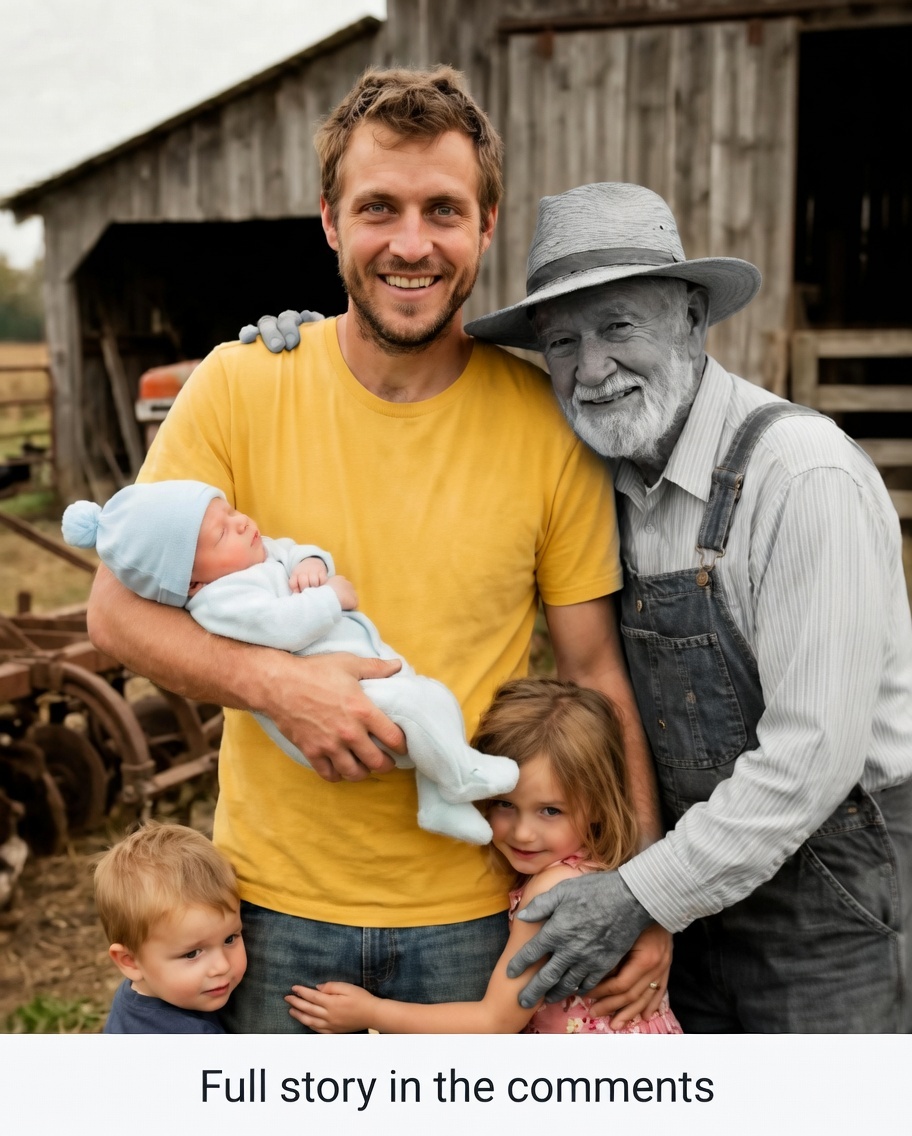
When my parents died in a car crash, I was 12. My grandfather took me in without hesitation. He raised me on that 80-acre farm in rural Ohio — taught me how to drive a tractor before I could drive a car, how to mend fences, how to read the sky for rain. It wasn’t always easy. Money was tight. Winters were long. But it was home. When Grandpa’s health started failing ten years ago, I stayed. I took over the day-to-day: harvests, repairs, bills, doctor visits. I was 32 by then, widowed after my wife died giving birth to our third child. Three kids under 10, a dying farm, and a grandfather who needed round-the-clock care. I didn’t complain. That land was all we had left of him — and of the life we’d built together.
My Aunt Linda — Grandpa’s only other child — left for the city twenty years ago. She rarely visited. Calls were short, always ending with a request for money. She didn’t come when Grandpa went into hospice. She didn’t sit by his bed. She didn’t say goodbye. But the morning after he passed, her shiny black Mercedes rolled up the gravel drive. Designer sunglasses. Perfect hair. Not a tear in sight. She walked the property like she was appraising real estate, pointing at the barn (“That can go”), the old oak by the porch (“Outdated”), the fields (“We’ll subdivide”). She never once looked at my children — Emma (12), Caleb (9), and little Sophie (6) — except to step around them like they were obstacles. For three days she stayed in a hotel nearby, coming and going, measuring windows, taking photos, talking on the phone about “groundbreaking next week.”
On the third day she cornered me in the kitchen while the kids were outside playing. “You have three days,” she said with a thin smile. “I already have a developer lined up. It’s just business.” Three days. Every dollar I’d earned in the last decade had gone back into the farm — new equipment loans, seed costs, repairs after storms. I had less than $800 in the bank. No place to take three children. No family to call. I nodded, numb, and watched her leave in her Mercedes, already planning how to turn my grandfather’s legacy into condos.
The will reading was held in the lawyer’s office the following week. Linda arrived early, radiant, like she’d already won. She slid an eviction notice across the table before Mr. Henderson even opened the envelope. “Just getting the unpleasantness out of the way,” she said sweetly. I sat there with nothing — no lawyer, no plan, three kids waiting at home with a neighbor. Mr. Henderson adjusted his glasses, glanced at the paper she’d pushed forward, then set it aside without reading it. “Actually,” he said calmly, “we won’t be discussing the property today.”
Linda laughed — a sharp, confident sound. “I’m his only child. It’s mine. Read it.” Mr. Henderson didn’t flinch. He pulled out a second document — dated three days before Grandpa died, when he was still lucid enough to sign. “Three days ago… your father didn’t own the farm anymore.” The room went silent. Linda’s smile froze. He continued, voice steady: “He transferred full ownership to his granddaughter Emma, with you named as trustee only until she turns 18. The deed is recorded. The trust is ironclad. And the farm is protected from any debts or claims against his estate — including the ones you’ve been trying to create.”
Linda went pale. The color literally drained from her face. She stared at the paper he slid across the table — the quitclaim deed Grandpa had signed in his hospital bed, witnessed by two nurses and the hospital chaplain. He hadn’t told me. He hadn’t told anyone. He’d quietly deeded the entire property to Emma — my oldest, the one who loved the farm the way he did, who helped with chores without being asked, who cried when the old tractor finally died. The trust named me as guardian and manager until she was of age, with strict rules: the land could never be sold or developed without her written consent after 18, and no portion could go to anyone else in the family unless all three grandchildren agreed. Linda had no claim. Not even a fraction.
She stood up so fast her chair scraped. “This is fraud,” she hissed. “He wasn’t of sound mind.” Mr. Henderson shook his head. “He was. I spoke with him myself. He knew exactly what he was doing. He wanted the farm to stay in the hands of the people who actually loved it.” Linda looked at me then — really looked — and for the first time I saw something like fear in her eyes. She grabbed her purse and left without another word. The Mercedes peeled out of the parking lot.
I drove home shaking. The kids were waiting on the porch. Emma ran up first. “Mom? What happened?” I knelt down, pulled all three of them into my arms, and told them the truth: “Grandpa made sure we never have to leave. The farm is yours, sweetheart. It’s always going to be ours.” Emma’s eyes filled with tears. Caleb asked if we could get a new tractor. Sophie just hugged me tighter. That night we sat on the porch swing Grandpa built, watching the sun set over the fields he loved. I thought about the man who raised me, who never said much but always did the right thing quietly. He hadn’t forgotten me. He hadn’t forgotten us. He’d protected us the only way he knew how — by giving everything to the next generation.
Linda never came back. No calls. No more threats. The developer’s plans vanished. The farm is ours — still hard work, still long days, still uncertain harvests — but it’s home. My kids run the same fields I did as a child. They know every inch of it the way Grandpa taught me. And every time I look at Emma — my quiet, steady girl who now carries the deed in her name — I see him. I see the love that doesn’t shout, doesn’t demand, doesn’t disappear. It just stays. It just protects. It just gives — even when no one is watching.
At 71 I thought my story was mostly written. Turns out Grandpa had one last chapter left to write — and he wrote it for us. One sentence from a lawyer was all it took to end Linda’s victory and begin our future. Sometimes justice isn’t loud. Sometimes it’s a quiet signature on a deed, signed in a hospital bed, meant to outlast betrayal. And sometimes, when the rain finally stops and the fields turn green again, you realize the person who loved you most never really left. They just made sure you’d always have a place to come home to.
Most Popular!
-
 The Ultimate Wedding Revenge: When the Mother Who Abandoned Her Six Daughters Showed Up with Her Millionaire Boss, the Bride Opened a Box That Destroyed Lives Forever
-
The Beach Shaming Disaster: What My 8-Year-Old Said to the Prying Stranger Left Everyone Speechless
-
My Husband Abandoned Me With Twin Babies for a Luxury Fishing Trip — When He Returned, I Had Already Packed His Bags
-
The Three-Dollar Miracle: How a Dust-Covered Vase Revealed a Heartbreaking Decades-Old Secret
-
The $80,000 Battle to Erase a Birthmark: Why One Mother Risked Everything for Her Daughter’s Future
-
The Silent Thief: Why Millions of Men Are Living with a Time Bomb They Can’t See
-
The Final Curtain Falls: Beloved Sanford and Son Legend Hal Williams Gone at 91
-
Found at a Yard Sale: This “Useless” Vintage Contraption Is Actually a Forgotten Piece of Human History