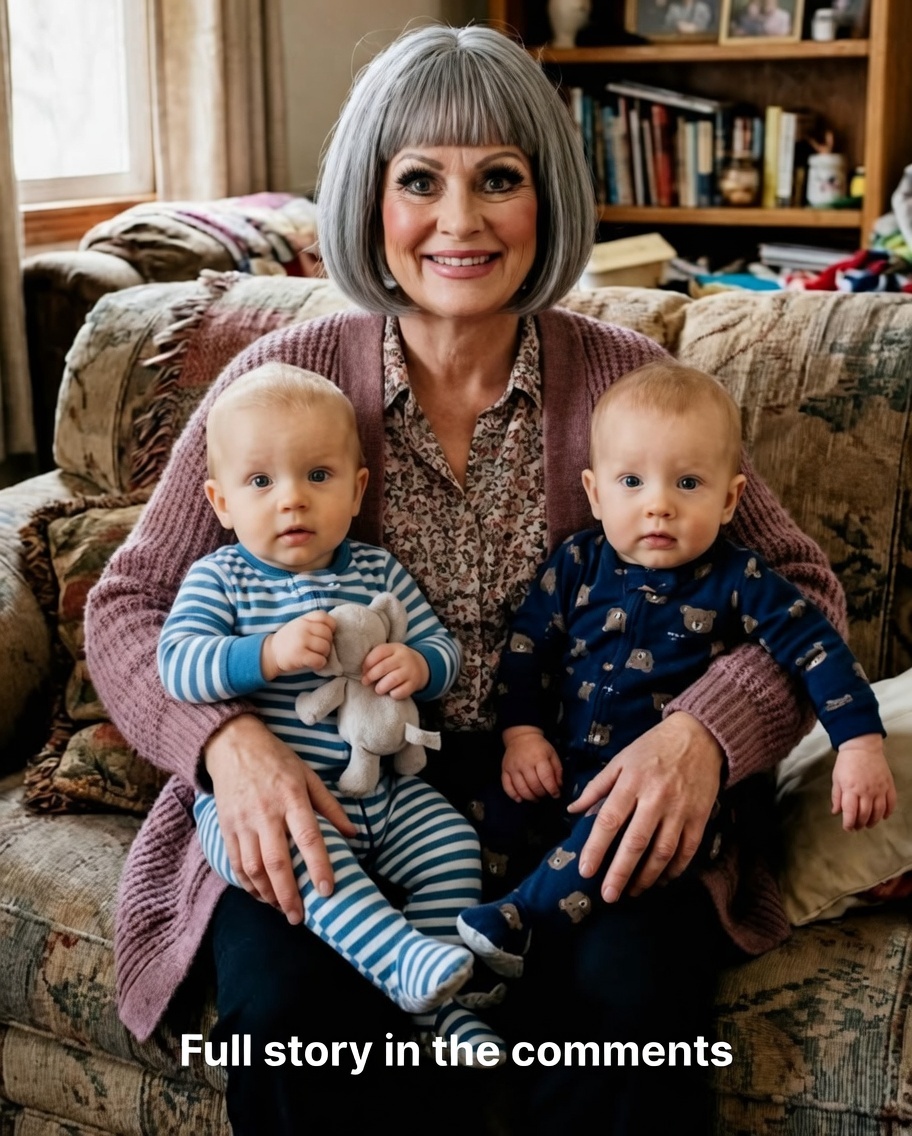
Sleep deprivation with newborn twins turns you into someone you barely recognize — short-tempered, foggy, constantly on the edge of tears. My 11-month-old boys, Liam and Noah, were finally sleeping through longer stretches, but I still hadn’t had more than three consecutive hours in almost a year. My husband Mark travels constantly for work. We have no family nearby — my parents passed years ago, and Mark grew up in foster care with no stable relatives to call on. We were drowning. Two weeks ago, I hit my breaking point. I couldn’t keep pretending I was okay. We contacted a licensed agency, went through every background check, reference call, and CPR certification they offered. They sent us Mrs. Higgins.
She arrived at our door looking exactly like the grandmother every exhausted parent dreams of: soft gray bun, cardigan that smelled like lavender and fresh-baked cookies, gentle voice, warm smile. The boys — who usually scream at anyone new — crawled straight into her lap within minutes. She warmed bottles without being asked, changed diapers with practiced ease, folded laundry so neatly it looked hospital-issued, and even reorganized our linen closet exactly the way Mark prefers. She called the twins “my little darlings” and sang old lullabies I hadn’t heard since childhood. For the first time in months, I felt like I could breathe. When Mark surprised me with a one-night spa stay — just the two of us — I cried actual tears of gratitude. Mrs. Higgins insisted we go. “You deserve rest,” she said, squeezing my hand. “The boys will be fine with me.”
We left at 6 p.m. I kissed the twins’ heads a hundred times. Mark had to practically pull me out the door. The spa was only twenty minutes away, but I still checked the nanny cam app at 8:45 p.m. — just to be safe. I had installed the small hidden camera months earlier, tucked high on a bookshelf, pointed at the living room and nursery doorway. The boys were asleep in their cribs. Mrs. Higgins sat on the couch, hands folded in her lap. Everything looked peaceful. Then she glanced around the room — slowly, carefully, like she was making sure no one was watching. My stomach tightened.
She reached up with both hands and lifted off her gray bun. It came away in one smooth piece — a wig. Underneath was short, dark hair streaked with only a few grays. She looked maybe 35, 40 at most. I stared at the screen, frozen. Mark leaned over my shoulder. “What the hell…?” he whispered. She stood, walked to the bathroom mirror in view of the camera, and grabbed a pack of makeup wipes from her purse. She scrubbed her face in quick, practiced strokes. The heavy foundation smeared away. The drawn-on wrinkles vanished. The fake age spots disappeared. The mole on her cheek wiped clean. She wasn’t elderly. She wasn’t even middle-aged. She was young. And she had been pretending the entire time.
Mark grabbed the phone from my hand. We watched in horror as she walked to the living room window, pulled aside the curtain, and retrieved a large black duffel bag she had hidden there before we left. It had been sitting in our house the whole time — unnoticed. My blood turned to ice. She carried the bag straight to the nursery. The camera angle caught her silhouette in the doorway. She unzipped it slowly. My heart slammed against my ribs. I screamed at Mark to drive. We were already running for the car, spa robes forgotten, hearts in our throats. I dialed 911 while Mark floored it. The operator stayed calm, told us units were en route, instructed us not to confront her if we arrived first.
We burst through the door seventeen minutes later — shaking, breathless. The house was silent. Mrs. Higgins stood in the nursery between the cribs, the open duffel at her feet. She looked up, startled, no longer bothering with the elderly disguise. Her real face was pale, eyes wide. Inside the bag: stacks of cash rubber-banded together, fake IDs, burner phones, a small laptop, several passports, and — most chilling of all — two tiny sets of children’s clothes that weren’t ours. Not pajamas. Not play clothes. Brand-new outfits in the boys’ sizes, tags still on, folded neatly like she had planned to dress them and take them somewhere.
Police arrived seconds behind us. Mrs. Higgins didn’t run. She raised her hands slowly and said, “You weren’t supposed to come back yet.” The officers cuffed her while we checked the boys — they were still asleep, safe, untouched. She had been standing there, staring down at them, as if deciding what to do next. The investigation unfolded quickly after that. Her real name was Vanessa Reed. She had no record with the agency because she had used stolen credentials — forged references, a fake CPR certificate, a background check report doctored with someone else’s clean history. She had been targeting families with young twins for months, gaining trust, waiting for the right moment to disappear with the children. The cash and documents suggested she was part of a larger network — possibly selling the boys or holding them for ransom. We’ll never know for sure; she lawyered up and stopped talking.
We moved houses within weeks. New security system, new nanny vetted through multiple sources, no more trusting first impressions. The boys are safe, but the fear lingers — in the way I check the locks three times every night, in the way Mark now works from home whenever possible, in the way I wake up gasping from dreams where the cribs are empty. Mrs. Higgins — Vanessa — is in custody awaiting trial on charges including identity theft, fraud, child endangerment, and attempted kidnapping. The agency that sent her is under investigation; they claim they were duped, but that doesn’t erase the terror.
At 34, I thought the hardest part of parenting twins was the sleep deprivation. I was wrong. The hardest part is realizing how easily someone can walk into your home, earn your trust, and stand over your sleeping children with plans you’ll never fully understand. We are healing — slowly. The boys laugh again, crawl again, reach for us without hesitation. But every time I look at the nanny cam app — now triple-encrypted and monitored 24/7 — I remember how close we came to losing them. And I remember that sometimes the greatest danger doesn’t look like a stranger in the dark. Sometimes it wears a gray bun, smells like lavender, and calls your babies “my little darlings” while secretly planning to take them away forever.
We survived. But we will never be the same. And we will never stop being grateful that one small hidden camera — the one I almost didn’t install — showed us who she really was before it was too late. If you have little ones, if you use sitters, if you’ve ever felt that flicker of doubt but pushed it away because someone seemed “perfect” — trust that flicker. Check the camera. Ask the hard questions. Because real monsters don’t always look scary. Sometimes they look exactly like the help you’ve been praying for.
Most Popular!
-
 The Ultimate Wedding Revenge: When the Mother Who Abandoned Her Six Daughters Showed Up with Her Millionaire Boss, the Bride Opened a Box That Destroyed Lives Forever
-
The Beach Shaming Disaster: What My 8-Year-Old Said to the Prying Stranger Left Everyone Speechless
-
My Husband Abandoned Me With Twin Babies for a Luxury Fishing Trip — When He Returned, I Had Already Packed His Bags
-
The Three-Dollar Miracle: How a Dust-Covered Vase Revealed a Heartbreaking Decades-Old Secret
-
The $80,000 Battle to Erase a Birthmark: Why One Mother Risked Everything for Her Daughter’s Future
-
The Silent Thief: Why Millions of Men Are Living with a Time Bomb They Can’t See
-
The Final Curtain Falls: Beloved Sanford and Son Legend Hal Williams Gone at 91
-
Found at a Yard Sale: This “Useless” Vintage Contraption Is Actually a Forgotten Piece of Human History