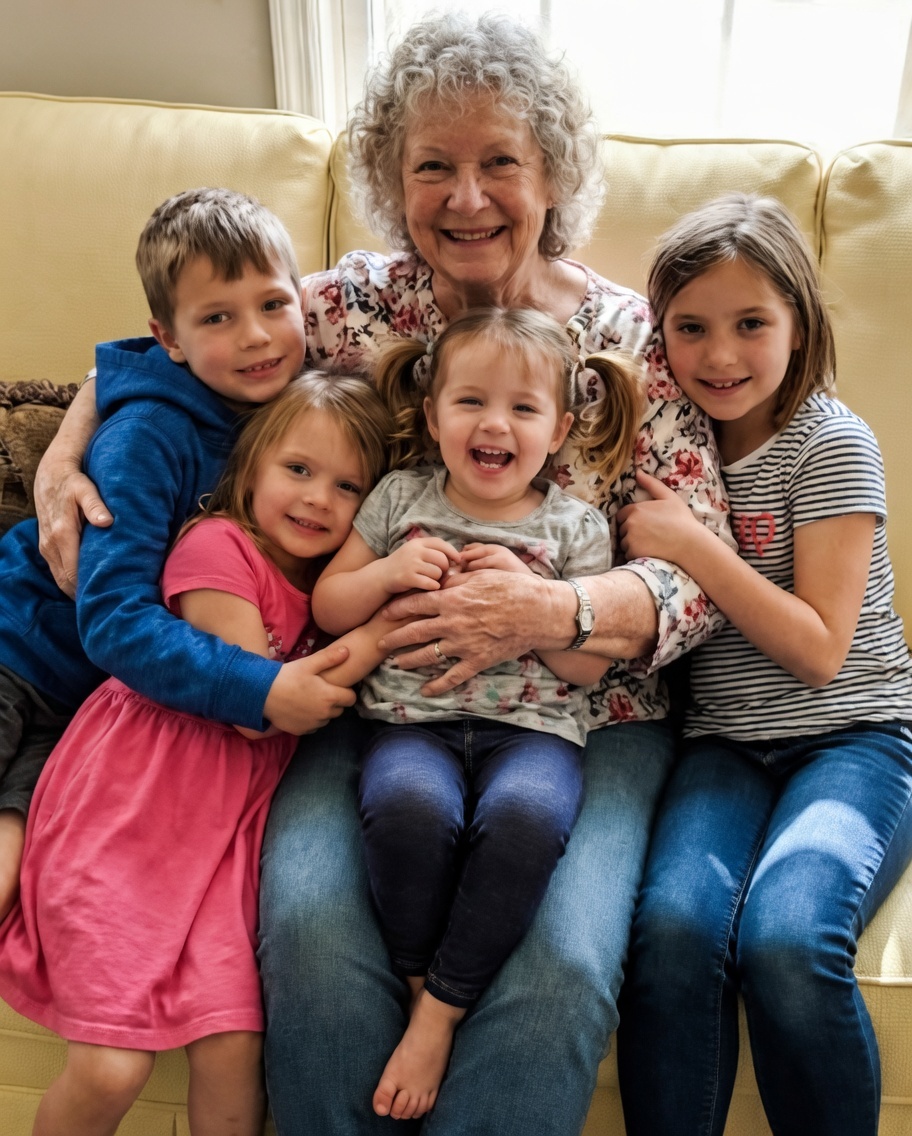
Losing a child is a pain no parent is ever prepared for. When my daughter and her husband died in that plane crash six months ago, the world didn’t just stop — it shattered into fragments so small I wasn’t sure I’d ever piece them back together. She was 42, full of life, laughter, and plans for the future. Their four children — my grandchildren — were suddenly orphans, and at 71, with aching joints and a fixed pension that barely covered groceries for one, I became their mother, father, grandmother, and everything in between. The oldest, nine-year-old Ethan, understood too much. The twins, seven, asked endless questions. Little Grace, just four, still looked for her mommy behind every door. We cried together, laughed through tears, and slowly built a fragile new normal. I went back to part-time work at the library to make ends meet. Every penny went to them — clothes, school supplies, therapy sessions, the basics of keeping four growing children fed and safe.
I thought the worst was over. Grief doesn’t disappear, but it learns to sit quieter some days. Then came the morning that changed everything again. The children were at school and daycare. I was sipping weak coffee, steeling myself for another shift, when the doorbell rang. A courier stood there with three men behind him and a crate the size of a small refrigerator. “Delivery for you, ma’am. Very heavy. We’ll bring it inside?” I nodded mutely. No return address. Just a plain label in black marker: “To My Mom” and my street number. My hands shook as I signed. They maneuvered the box through the doorway, set it in the living room, and left. The house felt too small suddenly.
I stared at it for a long minute. Then I grabbed the box cutter from the kitchen drawer. The cardboard gave way easily. On top — a thick white envelope. My daughter’s handwriting. The same looping letters she’d used since she was ten. My knees nearly buckled. I sank onto the couch, tore it open, and began to read.
“Mom, If this box has reached you, it means I’m no longer here. I’m so sorry. I never wanted you to find out this way. There are things I never told you — things I kept hidden because I thought it was the only way to keep us all safe. You’ll understand when you see what’s inside. Please don’t hate me. I did what I did out of love. The children… they’re going to need you more than ever. And there’s something I left for all of you. Forgive me. I love you more than words. Always, Your girl.”
My chest hurt so badly I thought I was having a heart attack. I kept reading, but the rest blurred through tears. She had known. Somehow, she had known something might happen. The letter went on to explain that she’d arranged this package years ago, updated it quietly every year, and left instructions with a trusted attorney to deliver it only if she and her husband both passed before the children were grown. She called it her “just in case” box.
Hands trembling, I pushed aside the packing paper. Inside were layers of carefully wrapped items. First — a thick folder of legal documents. Bank statements. Investment accounts. Life insurance policies I never knew existed. One policy alone was worth enough to pay off the mortgage, cover college for all four grandchildren, and leave a monthly stipend so I could stop working and stay home with them full-time. She had been quietly building this safety net for years, funneling money from her freelance writing, her husband’s side business, even small inheritances — never telling me because she didn’t want me to worry or refuse help.
Deeper in the box: photo albums I thought were lost. Baby pictures of my daughter. Our family vacations. Letters she’d written to the children when they were babies — one for each birthday up to age 21. She wanted them to have her words even if she couldn’t be there to say them. There were USB drives labeled with dates — home videos, voice messages, stories she recorded for them to hear when they were older.
But the item that made me sob out loud was at the very bottom, wrapped in her favorite soft blue scarf. A small wooden box. Inside: her wedding ring, my late husband’s wedding ring (she’d asked for it after he passed), and four tiny gold pendants — one for each grandchild, each engraved with a different initial and the words “Mom is always with you.” She had planned to give them on their 13th birthdays. She never got the chance.
I sat on the floor surrounded by her love, crying until I had nothing left. All those nights I’d lain awake wondering how I’d afford braces, school trips, a bigger house so they each had their own room — she had already taken care of it. All those times I felt like I was failing them because I was old and tired — she had made sure I wouldn’t have to carry it alone. She protected us the way only a mother can, even from beyond.
When the children came home that afternoon, I didn’t tell them everything. Not yet. They’re too young for the full weight. But I showed them the pendants. I let them hold the letters with her handwriting. Grace clutched hers to her chest and whispered, “Mommy sent me a hug.” Ethan read the first line of his birthday letter and started crying — happy tears, I think, mixed with missing her. We sat together on the couch, the box open between us, and for the first time since the crash, the house felt a little less empty.
At 71, I thought my story was mostly written. I thought the hardest chapters were behind me. But my daughter reminded me: love doesn’t end. It just changes shape. It becomes pendants around tiny necks, envelopes with instructions for a future she wouldn’t see, a safety net woven in secret so her babies — and their grandmother — could keep going.
I still cry every night after they’re asleep. But now the tears are mixed with something new: gratitude so deep it hurts. She gave me back my strength when I thought I had none left. She gave our grandchildren a future. And she gave me the chance to keep being their mom — not just their grandma — for as long as I’m here.
If you’re raising grandchildren, if you’ve lost a child, if you’re carrying more than you think you can handle — please know this: you’re not alone. And sometimes, the people we love most find ways to reach back, even after they’re gone, and remind us we’re still strong enough to keep going.
I open that box every few weeks just to smell her scarf. To read her words again. To remember that love like hers doesn’t disappear. It waits — patient, quiet, and fierce — until the moment we need it most. And when it arrives, it changes everything.
Most Popular!
-
 The Ultimate Wedding Revenge: When the Mother Who Abandoned Her Six Daughters Showed Up with Her Millionaire Boss, the Bride Opened a Box That Destroyed Lives Forever
-
The Beach Shaming Disaster: What My 8-Year-Old Said to the Prying Stranger Left Everyone Speechless
-
My Husband Abandoned Me With Twin Babies for a Luxury Fishing Trip — When He Returned, I Had Already Packed His Bags
-
The Three-Dollar Miracle: How a Dust-Covered Vase Revealed a Heartbreaking Decades-Old Secret
-
The $80,000 Battle to Erase a Birthmark: Why One Mother Risked Everything for Her Daughter’s Future
-
The Silent Thief: Why Millions of Men Are Living with a Time Bomb They Can’t See
-
The Final Curtain Falls: Beloved Sanford and Son Legend Hal Williams Gone at 91
-
Found at a Yard Sale: This “Useless” Vintage Contraption Is Actually a Forgotten Piece of Human History