Parenting a child in middle school already comes with enough worries — friendships shifting, homework pressure, the first hints of teenage attitude. But nothing prepares you for the phone call every parent dreads: your straight-A, gentle daughter has been accused of starting a fight. When Stella’s teacher called me in a panic, insisting my quiet 12-year-old had “beaten up” another girl, my heart dropped. Stella had never raised her voice, let alone her hand. Something was very wrong. When she walked through the door that afternoon, pale and trembling but with a spark of defiance in her eyes, she looked me straight in the face and said, “I don’t regret what I did.” Those words from my golden child shook me more than any teacher’s accusation ever could.
Stella sat me down and told the real story. There was a girl in her class — Lucy — who targeted anyone who seemed vulnerable. She stole lunches, spread cruel rumors, shoved kids in the hallway when teachers weren’t looking. That day, Lucy had snatched another girl’s lunch bag and dumped the contents on the floor for laughs. Stella, who’d been quietly watching this pattern for weeks, finally spoke up: “Give it back. That’s not yours.” Lucy turned on her, shoved her hard, then tripped over her own feet in the scuffle and fell. The teacher walked in at the exact moment Lucy hit the ground and assumed Stella had pushed her. No one asked the other kids what really happened. No one listened to Stella. Lucy cried, pointed, and the teacher believed her instantly.
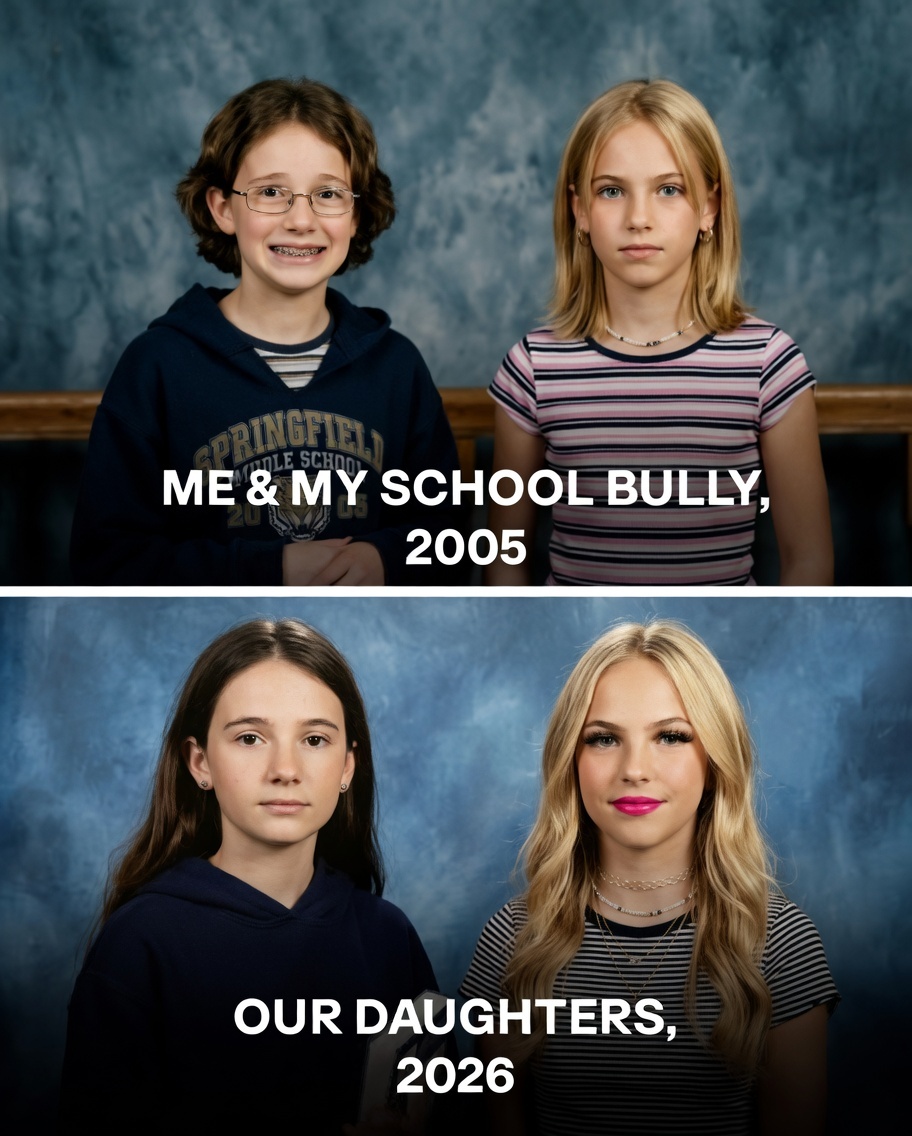
When Stella whispered Lucy’s last name — Nines — a cold wave washed over me. I hadn’t heard that name in thirty years, but I’d never forgotten it. Back in middle school, a girl named Vanessa Nines had singled me out every single day. She stole my lunch money, poured juice on my new backpack, stuck gum in my hair during assemblies and laughed while I tried to hide my tears in the bathroom. Teachers called it “kids being kids.” I learned to keep my head down, eat alone, avoid hallways where she might be. The humiliation shaped me — made me quieter, more cautious, determined never to let anyone feel that powerless again. And now, somehow, her daughter was doing the same thing to mine.
The next morning, Stella and I walked into the principal’s office hand in hand. She was nervous but held her chin high. Moments later, the door opened and in walked Lucy — and her mother. Time froze. Vanessa Nines looked almost exactly the same: same sharp eyes, same smirk. She hadn’t aged in the way that softens people; she still carried that air of untouchable confidence. When she saw us, her lips curled. “Oh, so this is who’s causing trouble for other kids,” she said in that syrupy-sweet tone I remembered too well. “No wonder a little hooligan was born to a mother like THAT.” Lucy giggled and added, “Mom, her mom is as ugly as Stella.” The words landed like a slap, but this time they didn’t break me. They lit something.
The principal arrived, reviewed the incident report, and asked both sides to speak. Lucy repeated her tearful version: Stella attacked her unprovoked. Vanessa nodded along, arms crossed, already looking victorious. When it was Stella’s turn, my daughter spoke clearly, voice steady: “I told her to stop stealing someone’s lunch. She pushed me first. I didn’t push back — she tripped.” The principal sighed, said it was “he said, she said,” and suggested both girls apologize and move on. That’s when I raised my hand.
“I’d like to speak privately with Mrs. Nines for a moment,” I said. The principal hesitated but agreed, stepping out with the girls to give us space. Vanessa rolled her eyes but stayed. Once the door closed, I looked her in the eye — the same way she used to look down at me in the cafeteria. “You don’t remember me,” I said quietly, “but I remember you. Every day you made sure I felt small. You took things that weren’t yours, humiliated me in front of everyone, and no one stopped you. And now your daughter is doing exactly the same thing to mine — and to other kids in that classroom.”
Vanessa laughed softly. “Kids fight. Get over it.” I didn’t flinch. “No. This stops today. Because I’m not that scared girl anymore. And I’m not going to let your daughter turn my daughter — or anyone else — into who I used to be.”
I pulled out my phone and opened a folder I’d prepared the night before. Thirty years ago, a few classmates had quietly taken photos of the things Vanessa did — gum in my hair, spilled food on my clothes, cruel notes slipped into my locker. I’d kept them all these years, not out of bitterness, but because I never wanted to forget how powerless I felt. I showed her the images. Her smirk faded. “I’m not posting these,” I said. “I’m not threatening you. But I am telling you: if Lucy doesn’t stop targeting other kids — if I hear one more story about her stealing, shoving, or mocking — these photos go to the principal, the school board, and every parent in that class. Not to ruin you. To protect the children. Including yours.”
Vanessa stared at the screen, then at me. For the first time, she looked uncertain. “You wouldn’t,” she whispered. “I would,” I said. “Because no child deserves what you did to me. And no child deserves what your daughter is doing now. Teach her better. Or I will make sure everyone knows exactly where she learned it.”
Silence stretched between us. Then Vanessa swallowed hard and nodded once. When the principal returned, Vanessa spoke first: “Lucy has something to say.” Lucy, eyes wide, mumbled an apology to Stella and admitted she’d taken the lunch and started the shove. The principal looked stunned but relieved. No suspensions, just a promise of better behavior and a meeting with the counselor for Lucy. As we left, Vanessa caught my arm in the hallway. “I’m sorry,” she said — the words I never thought I’d hear. “For back then. And… thank you for not making this worse.”
I looked at her. “I’m not doing this for you. I’m doing it for Stella. And for the girl I used to be. Make sure Lucy understands kindness isn’t weakness. It’s strength.”
Stella walked out holding my hand, taller somehow. That night she hugged me longer than usual and whispered, “Thanks for believing me, Mom.” I held her tight and realized something powerful: the scared girl in the back of the classroom had finally stood up — not with fists, but with truth, evidence, and the fierce love only a mother can carry.
We don’t always get to rewrite the past. But sometimes, when the past tries to hurt our children, we get to stand in its way and say, “Not this time. Not my daughter.” And that, I think, is the greatest lesson of all.
Most Popular!
-
 The Ultimate Wedding Revenge: When the Mother Who Abandoned Her Six Daughters Showed Up with Her Millionaire Boss, the Bride Opened a Box That Destroyed Lives Forever
-
The Beach Shaming Disaster: What My 8-Year-Old Said to the Prying Stranger Left Everyone Speechless
-
My Husband Abandoned Me With Twin Babies for a Luxury Fishing Trip — When He Returned, I Had Already Packed His Bags
-
The Three-Dollar Miracle: How a Dust-Covered Vase Revealed a Heartbreaking Decades-Old Secret
-
The $80,000 Battle to Erase a Birthmark: Why One Mother Risked Everything for Her Daughter’s Future
-
The Silent Thief: Why Millions of Men Are Living with a Time Bomb They Can’t See
-
The Final Curtain Falls: Beloved Sanford and Son Legend Hal Williams Gone at 91
-
Found at a Yard Sale: This “Useless” Vintage Contraption Is Actually a Forgotten Piece of Human History