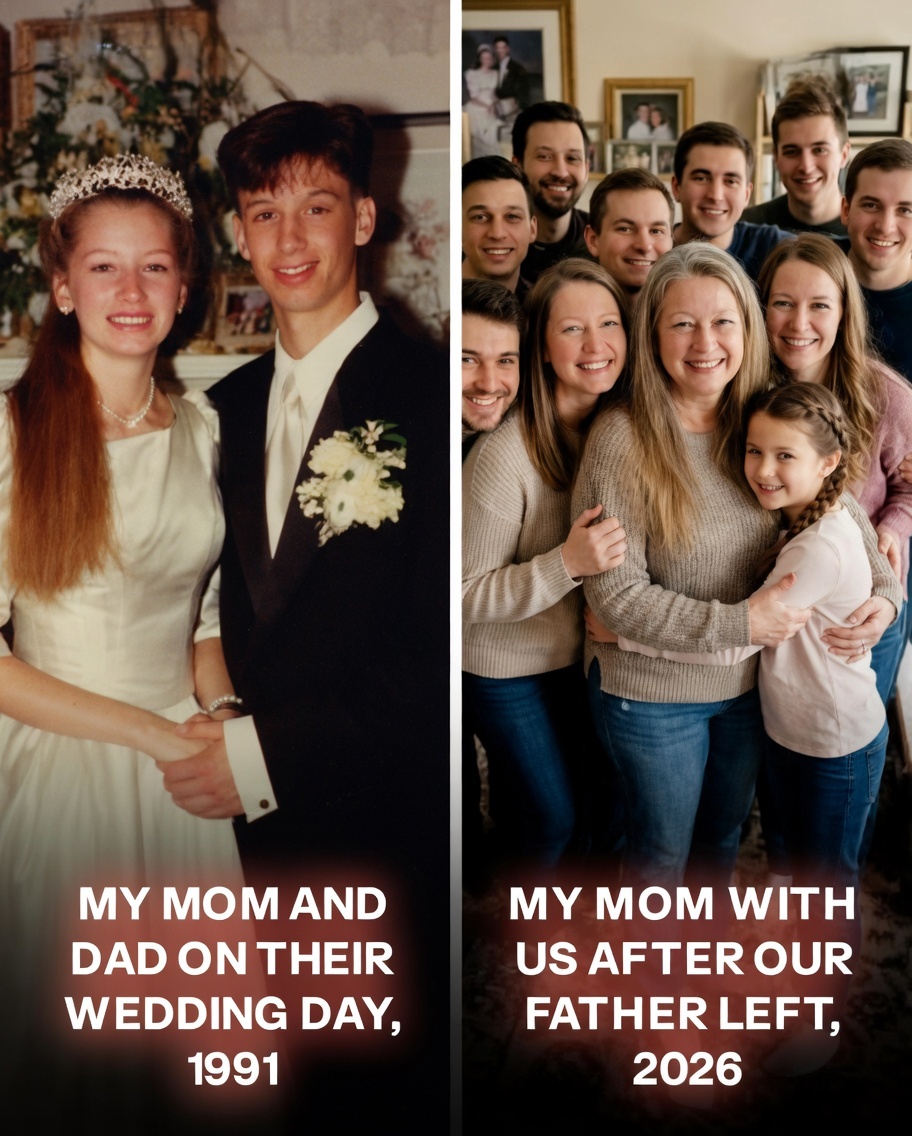
Raising ten children alone after your husband leaves you for a younger woman from church is not a story most people survive with grace. My mom did. She didn’t just survive — she thrived. She worked double shifts as a nurse’s aide, went back to school at night for her RN degree, kept the house clean, kept us fed, kept us laughing. She never spoke ill of my father, Henry, in front of us. She just quietly became both parents. We never went hungry. We never felt unloved. We never doubted we were enough.
Henry left when I was 15, my youngest sibling was 2. He said he’d “fallen out of love” and that the younger woman — someone we all knew from Sunday service — “understood him better.” He packed a suitcase while we were at school and left a note on the kitchen table. No goodbye. No explanation to the little ones. Just gone.
He sent child support for about six months — the court-ordered minimum. Then the checks stopped. We moved to a smaller house. Mom sold her wedding ring to pay the electric bill. We learned to shop sales, share clothes, make do. We watched him post pictures online: new car, new vacations, new life with his new wife. He looked happy. We looked like survivors.
Ten years passed. Mom finished her degree. Became an RN. Bought us all Christmas presents every year without going into debt. My siblings graduated high school, some went to college on scholarships she fought for. I became a paralegal — ironically, specializing in family law. I saw enough deadbeat dads in court to know exactly what kind of man my father had become.
Then the call came.
Mom’s voice was shaking when she left the voicemail: “He called. Your father. He wants to talk. Can you come over?”
I drove straight there. She was sitting at the kitchen table — the same table he left the note on — staring at her phone like it had bitten her. She played the message on speaker.
Henry’s voice — older, softer, but still the same man:
“Hi… it’s me. I know it’s been a long time. I’ve been thinking about you a lot. About the kids. I made a terrible mistake. I want to come home. I want us to be a family again. Please… just talk to me.”
Mom looked at me with eyes I hadn’t seen since the day he left.
“What do I do?” she whispered.
I didn’t hesitate.
“You don’t do anything. Let me.”
I took her phone and called him back. He answered on the first ring, voice hopeful.
“Emma? Is that you?”
“Yeah,” I said. “It’s me.”
He started talking fast — apologies, regrets, how he’d “changed,” how he wanted to make amends, how he missed us, how he’d send money, how he’d be better.
I let him talk until he ran out of breath.
Then I spoke. Calm. Clear. Cold.
“You left us with ten kids under 15, a mortgage you stopped paying, and a note on the table. Mom worked herself to the bone while you started a new family. You never called on birthdays. Never sent a card. Never asked how we were. You disappeared. And now you want back in because… what? Your new life didn’t work out? Your new wife got tired of you? Or did you just run out of money?”
Silence.
Then he whispered, “Emma, please—”
“No,” I said. “You don’t get to come back. You don’t get to play dad now. You lost that right the day you walked out. Mom doesn’t want you. The kids don’t want you. I don’t want you. You’re a stranger. And strangers don’t get to come home.”
He started crying. Real sobs. Begging.
“I’m dying, Emma. Cancer. Stage four. I don’t have long. I just want to see you all one more time. To say I’m sorry. To make it right.”
I let him cry for a moment.
Then I said the one sentence he never saw coming:
“Good. Then die knowing you lost the best family you ever had. And you did it to yourself.”
I hung up.
Mom stared at me. Then she started crying too — not sad tears, but release. The kind of tears you cry when a weight you carried for a decade finally lifts.
We never heard from him again. No more calls. No letters. Nothing.
A few months later a lawyer contacted us. Henry had died. He left nothing to us — no apology letter, no inheritance, no final message. Just silence. The same silence he gave us for ten years.
Mom framed the last family photo we ever took with him — the one from before he left. She put it in the hallway. Not out of love, but as a reminder: we survived him. We thrived without him.
My siblings and I are closer than ever. We check on Mom daily. We celebrate every birthday, every graduation, every small win like it’s a miracle — because it is. We didn’t need him. We never did.
And when people ask how we made it through, we tell them the truth:
We had each other. We had Mom’s unbreakable love. And we had the strength to walk away from someone who chose to walk away first.
Family isn’t who shares your blood. It’s who stays when the world falls apart. And who never makes you beg to be loved.
We’re okay. We’re better than okay. We’re free.
Most Popular!
-
 The Ultimate Wedding Revenge: When the Mother Who Abandoned Her Six Daughters Showed Up with Her Millionaire Boss, the Bride Opened a Box That Destroyed Lives Forever
-
The Beach Shaming Disaster: What My 8-Year-Old Said to the Prying Stranger Left Everyone Speechless
-
My Husband Abandoned Me With Twin Babies for a Luxury Fishing Trip — When He Returned, I Had Already Packed His Bags
-
The Three-Dollar Miracle: How a Dust-Covered Vase Revealed a Heartbreaking Decades-Old Secret
-
The $80,000 Battle to Erase a Birthmark: Why One Mother Risked Everything for Her Daughter’s Future
-
The Silent Thief: Why Millions of Men Are Living with a Time Bomb They Can’t See
-
The Final Curtain Falls: Beloved Sanford and Son Legend Hal Williams Gone at 91
-
Found at a Yard Sale: This “Useless” Vintage Contraption Is Actually a Forgotten Piece of Human History