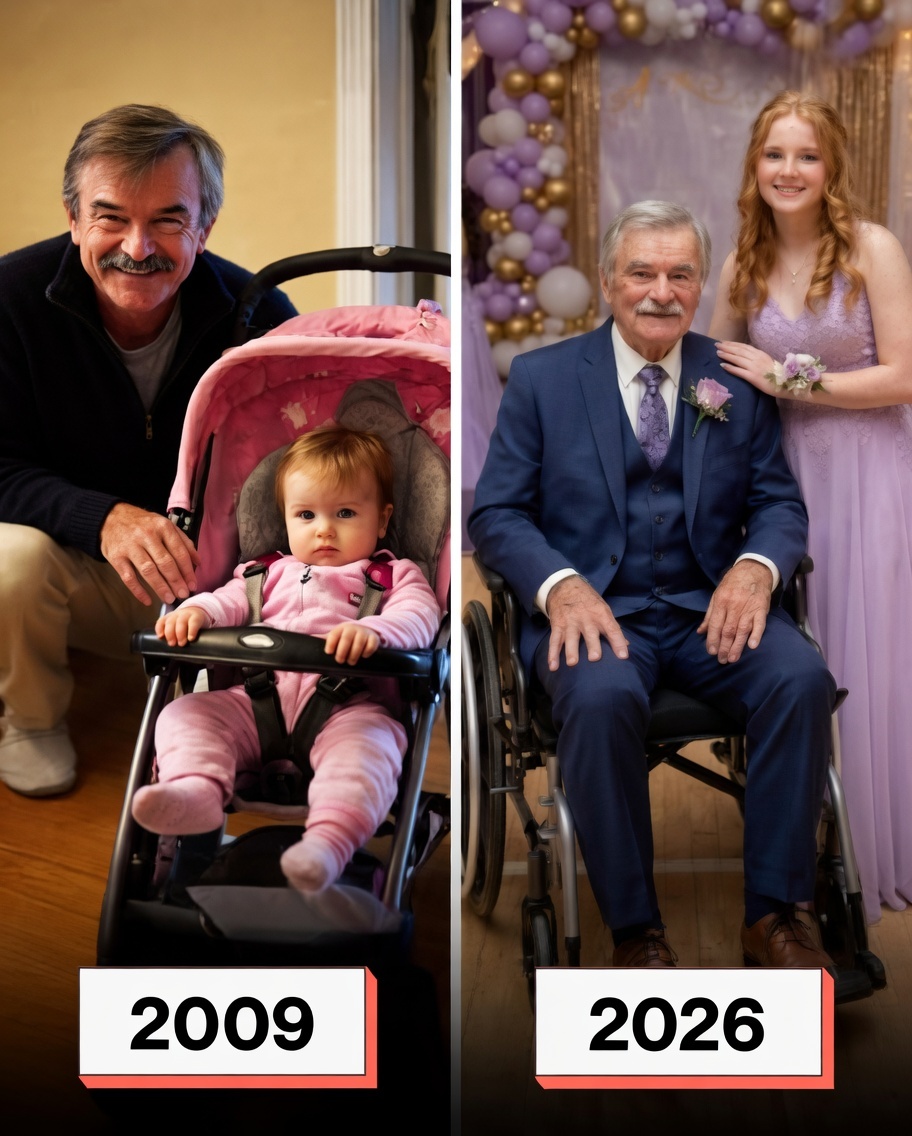
Some people become parents not by choice, but by necessity—and they rise to it in ways that leave a mark on generations. For one young woman, her grandfather became that person the night a house fire took her parents when she was only one year old. He ran back into the flames, carried her out through smoke and heat, and from that moment forward, he became her entire world. Late sixties, widowed, grieving, and suddenly raising an infant alone—he never hesitated. He learned to braid hair, pack lunches, cheer at school plays, and dance in the kitchen when no one else was there to teach her. He was her dad in every way that mattered.
As she grew, so did his health challenges. Three years ago, a stroke paralyzed the right side of his body. Doctors said walking again was impossible. He moved to a wheelchair, but his presence in her life never wavered. He still showed up—for parent-teacher conferences, for late-night talks, for every milestone. When prom season arrived and classmates talked about fancy dates and limos, she knew exactly who she wanted by her side. She asked her grandpa.
At first he refused. He worried his wheelchair would embarrass her, that kids would stare or whisper. She reminded him of the words he had told her since she was little: “You don’t leave family behind.” He cried when she said it. Then he agreed.
Prom night came. She wore a simple but beautiful dress she had saved for. He wore his old navy suit, pressed carefully, tie knotted with her help. She pushed his wheelchair through the high school gym doors. Heads turned. Some smiled. Many clapped—genuine, warm applause for a girl brave enough to bring the man who raised her. For a moment, it felt perfect.
Then Amber saw them.
Amber had been her rival since freshman year—competing for grades, scholarships, attention. She walked over with her group of friends, looked down at the wheelchair, and laughed loud enough for the whole gym to hear. “Wow. Did the nursing home lose a patient?” Her friends snickered. “Prom is for dates… not charity cases.”
The laughter spread like wildfire. The clapping stopped. The girl’s hands tightened on the wheelchair handles. She felt heat rise in her face—anger, shame, the sudden urge to turn and leave. She was ready to push her grandpa back out the doors and forget the whole night.
But before she could move, her grandpa slowly rolled forward. He maneuvered to the DJ booth, reached up with his good hand, and took the microphone. The music cut. The gym went silent—every phone, every whisper, every breath held.
He looked straight at Amber, then at the crowd, voice steady despite the tremor in it.
“You don’t get to laugh at my daughter.”
Five words.
The gym stayed quiet, but the air changed. Amber’s smirk vanished. Her face drained of color. She took a step back. No one moved. No one spoke.
Grandpa continued, quieter now, but every word carried. “This girl lost her parents in a fire when she was one. I carried her out. I raised her. I changed her diapers, taught her to read, held her when she cried for a mom and dad she never got to know. I’ve watched her grow into someone stronger and kinder than I ever was. Tonight she chose me—me—to be her date. Not because she had to. Because she wanted to. Because she loves me. And I love her more than anything in this world.”
He paused. Looked around the room.
“So if anyone here thinks it’s funny that an old man in a wheelchair gets to dance with his granddaughter… that’s your problem. Not hers. Not mine.”
He handed the mic back to the DJ. The silence held for another heartbeat.
Then the applause started—slow at first, then building, then roaring. Kids stood up. Teachers wiped their eyes. Even some of Amber’s friends looked away, ashamed. Amber stood frozen, then turned and walked out without another word.
The DJ put on a slow song. Grandpa looked up at his granddaughter and smiled—soft, tired, proud. “You still want to dance with an old man?” he asked.
She bent down, kissed his forehead, and said, “I’ve never wanted anything more.”
They danced—her holding his good hand, him rolling gently in time to the music. The whole gym watched, many crying, many smiling. Phones captured the moment, but no one posted it mockingly. They posted it with captions like “This is what family looks like” and “Respect.”
After prom, things shifted at school. Amber lost her crowd. People started saying hello to the girl they used to ignore. Teachers pulled her aside to tell her how proud they were. Her grandpa became a quiet legend—proof that love and courage don’t need legs to stand tall.
For her, the night wasn’t about revenge. It was about honoring the man who saved her life twice—once from fire, once from every hard day after. She still pushes his wheelchair, still braids her own hair the way he taught her, still hears his voice in her head saying, “You don’t leave family behind.”
And every time she looks at him now, she sees not just the stroke, not just the wheelchair, but the hero who carried her through smoke and never once let go.
Grandparents who raise grandchildren often do so in silence, without fanfare. They sacrifice retirement dreams, energy, health, and still show up every day. This story reminds us to see them—to thank them, to include them, to let them know their love is not invisible. For anyone who has been raised by someone other than their biological parents, or who has stepped into that role, it’s a quiet celebration of the bonds that choose us when blood alone isn’t enough.
Family isn’t always born. Sometimes it’s carried out of a fire. Sometimes it rolls into a prom gym in a wheelchair. And sometimes, five simple words are all it takes to remind the world what real strength looks like.
Most Popular!
-
 The Ultimate Wedding Revenge: When the Mother Who Abandoned Her Six Daughters Showed Up with Her Millionaire Boss, the Bride Opened a Box That Destroyed Lives Forever
-
The Beach Shaming Disaster: What My 8-Year-Old Said to the Prying Stranger Left Everyone Speechless
-
My Husband Abandoned Me With Twin Babies for a Luxury Fishing Trip — When He Returned, I Had Already Packed His Bags
-
The Three-Dollar Miracle: How a Dust-Covered Vase Revealed a Heartbreaking Decades-Old Secret
-
The $80,000 Battle to Erase a Birthmark: Why One Mother Risked Everything for Her Daughter’s Future
-
The Silent Thief: Why Millions of Men Are Living with a Time Bomb They Can’t See
-
The Final Curtain Falls: Beloved Sanford and Son Legend Hal Williams Gone at 91
-
Found at a Yard Sale: This “Useless” Vintage Contraption Is Actually a Forgotten Piece of Human History