I still catch myself reaching for the lotion bottle on the nightstand every morning. The same one I used to rub on my husband’s dry skin when he could no longer reach his own back. Now I use it on the angry red patches that cover my own arms and neck, and the memory hits me like a wave.
My name is Patricia “Patty” Reynolds. I am 69 years old. For 47 years I was married to the kindest man I ever knew — Thomas Reynolds, my Tommy. He worked as a mail carrier, I was a bookkeeper at the local elementary school. We raised two daughters in our modest split-level home in suburban Indianapolis. Life was ordinary and beautiful.
In 2015 Tommy started forgetting things. Small things at first. Then he got lost driving home from the grocery store we had visited for 30 years. The diagnosis was early-onset Alzheimer’s. The doctor said it would progress slowly at first, then faster. I looked at Tommy and promised, “We’re in this together, sweetheart. I’ll take care of you.”
I kept that promise for nine years.
I learned to manage medications, to gently guide him when he wandered at night, to feed him when his hands shook too much, to change adult diapers with love instead of shame. The girls helped when they could, but they lived in other states with young families. The daily work fell on me.
The caregiving costs crept up quietly. Extra cleaning supplies. Special no-slip socks. The hospital billing departments when he fell and needed stitches. Medicare Part B costs rose every year. I stopped buying new clothes for myself so I could pay for the in-home aide who came twice a week. I sold my mother’s silverware set to cover the gap when the aide hours increased.
I never complained. Tommy had been my rock for nearly five decades. This was my turn.
Then, in the spring of 2024, Tommy passed peacefully in his sleep. The house became too quiet. The grief hit me like a truck. I cried for weeks. I barely ate. I slept only a few hours a night.
Six weeks after the funeral, the rash started.
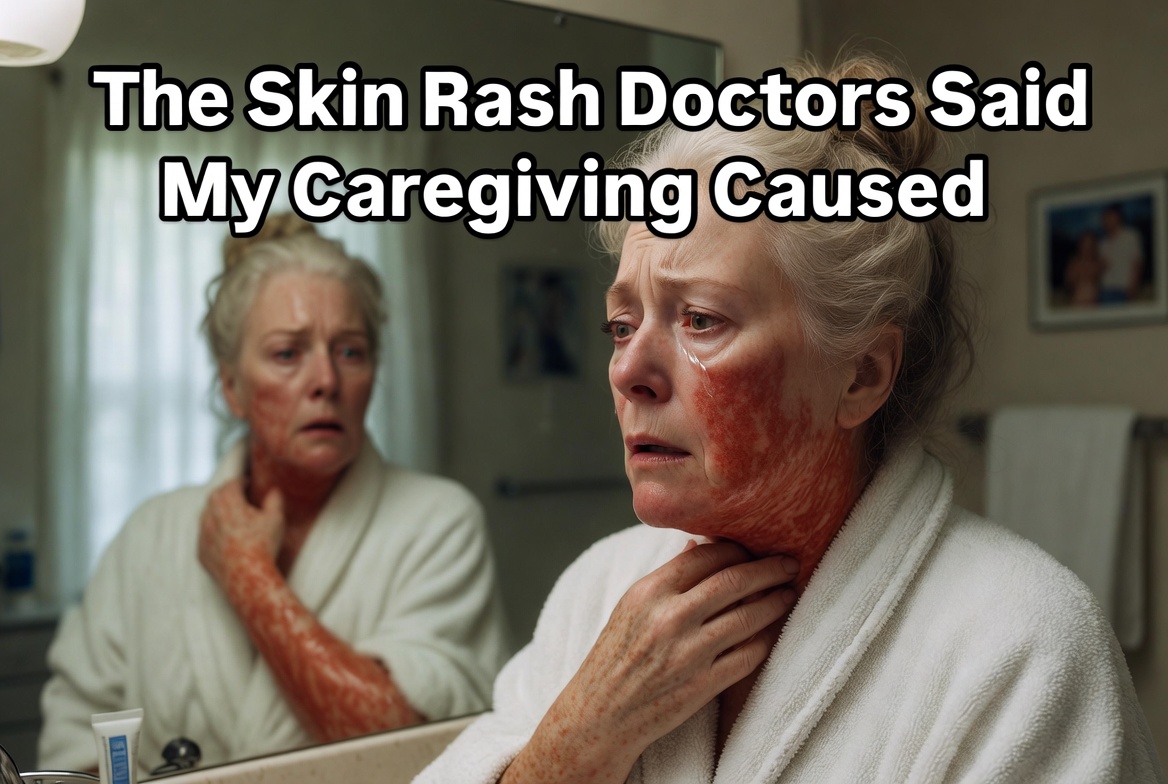
It began as small red patches on my forearms. I thought it was dry skin from all the handwashing over the years. Then it spread to my neck, my cheeks, even my eyelids. The itching was relentless. At night I would scratch until I bled. The pain was constant.
I finally went to the dermatologist. She took one look at my skin, listened to my story, and said the words that still echo in my head:
“Patty, this is a severe flare of psoriasis triggered by extreme chronic stress. The years of caregiving, the grief, the lack of sleep and self-care — your body has been screaming for years. The stress hormones kept it suppressed while you were in survival mode. Now that the immediate crisis is over, it’s exploding.”
I sat there in the exam room and cried. Not from the pain of the rash, but from the realization that even my body had paid the price for loving Tommy so completely.
The treatment was expensive. Topical steroids, light therapy, oral medications. Medicare Part B costs covered some, but the specialty creams were $480 a tube after insurance. I had to choose between groceries and medicine some months.
The worst part was the shame. The rash was visible on my face and neck. I stopped going to church. I canceled lunch with old friends. I couldn’t bear the way people’s eyes lingered on the red patches. My daughters begged me to come visit, but I was terrified the grandkids would be scared of “Grandma’s boo-boos.”
I felt so alone.
One afternoon I sat on the edge of the bed holding Tommy’s favorite sweater and whispered, “I gave everything to take care of you, and now I can’t even look at myself in the mirror.”
The turning point came when my oldest daughter flew in unannounced. She took one look at me and said, “Mom, you have to let someone help you now.” She made me call the long-term care insurance company we had bought policies for in 2015 (the one I almost canceled in 2020 when the premium increased). The policy I had kept for myself finally kicked in after the elimination period.
It pays for a home health aide three mornings a week so I can rest. It covers the extra creams and the light therapy sessions. Because of that policy, I didn’t have to sell the house Tommy and I paid off together.
The rash is slowly improving. The redness is fading. The itching is less constant. But the emotional scars remain. I still wear long sleeves even in summer. I still hesitate before looking in mirrors.
Yet every time I apply the cream, I remember the doctor’s words: “This rash is your body’s way of saying you carried too much for too long.”
She was right. I did carry too much. And I would do it again for Tommy in a heartbeat.
If you are over 50 and caring for a loved one, please hear me: your body is keeping score. The stress, the sleepless nights, the constant worry — it shows up. Sometimes as a rash, sometimes as high blood pressure, sometimes as something even harder.
Look at your own long-term care insurance coverage today. Don’t wait until your own health breaks the way mine did.
I still set out two coffee mugs every morning. I still talk to Tommy while I rub the cream into my arms. The rash is fading, but the love that caused it never will.
Some days I look in the mirror and the red patches are a little lighter. On those days I whisper to my reflection, “You did your best, Patty. You loved him well.”
And that, I have decided, is enough.
Most Popular!
-
 The Ultimate Wedding Revenge: When the Mother Who Abandoned Her Six Daughters Showed Up with Her Millionaire Boss, the Bride Opened a Box That Destroyed Lives Forever
-
The Beach Shaming Disaster: What My 8-Year-Old Said to the Prying Stranger Left Everyone Speechless
-
My Husband Abandoned Me With Twin Babies for a Luxury Fishing Trip — When He Returned, I Had Already Packed His Bags
-
The Three-Dollar Miracle: How a Dust-Covered Vase Revealed a Heartbreaking Decades-Old Secret
-
The $80,000 Battle to Erase a Birthmark: Why One Mother Risked Everything for Her Daughter’s Future
-
The Silent Thief: Why Millions of Men Are Living with a Time Bomb They Can’t See
-
The Final Curtain Falls: Beloved Sanford and Son Legend Hal Williams Gone at 91
-
Found at a Yard Sale: This “Useless” Vintage Contraption Is Actually a Forgotten Piece of Human History