At first, she thought it was a maintenance issue. Maybe algae. Maybe a chemical imbalance. But when the hotel pool suddenly turned a bright, unnatural green, Cassandra Woolston felt something was very wrong. Then staff spotted something sitting quietly at the bottom of the water — a small object that didn’t belong there. What investigators would uncover next turned an ordinary summer morning into a bizarre case involving drones, dye packs, and criminal charges — and left business owners everywhere asking how far a feud can go.
A Pool Problem That Made No Sense
Cassandra Woolston, the general manager of the Quality Inn in Galloway Township, says the trouble began back in June.
“I walked out and saw the pool totally green,” she recalled. “And I was like, ‘Oh wow… what is going on?’”
This wasn’t the cloudy green that comes with algae growth. This color was intense. Uniform. Artificial.
Staff immediately shut down the pool and began investigating.
That’s when they found it.
The Dye Pack at the Bottom
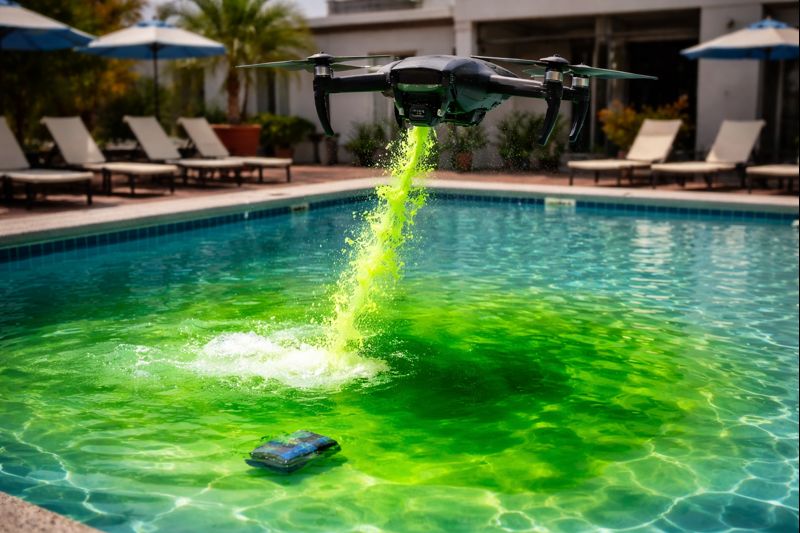
Lying at the bottom of the pool was a dye pack — the kind often used in tracking or security applications. Hotel staff had no idea how it got there.
“It didn’t belong to us,” Woolston said. “We didn’t know what it was or how it got into the pool.”
The discovery raised disturbing questions. The pool is fenced. Locked. Monitored. No one reported seeing anyone throw anything into it.
So how did the dye get there?
The Answer Was in the Sky
Investigators soon uncovered a shocking method: a drone.
Authorities allege that a nearby business owner used a drone to drop dye packs into neighboring swimming pools, including the one at the Quality Inn. Surveillance footage and witness accounts reportedly showed drone activity in the area around the time the pool was contaminated.
The revelation stunned Woolston and her staff.
“You don’t expect something like this,” she said. “You don’t think someone would go that far.”
A Costly and Dangerous Prank
This wasn’t harmless mischief.
The dye rendered the pool unusable for guests, forcing the hotel to:
- Drain the pool
- Rebalance chemicals
- Conduct inspections
- Close the amenity during peak season
Beyond the financial hit, Woolston says the incident raised serious safety concerns.
Guests include families, children, and elderly travelers. Introducing unknown substances into a pool could have caused health reactions if someone had entered the water.
“That’s the scariest part,” she said. “Someone could’ve been hurt.”
Charges Filed, Questions Remain
Authorities say the suspect — a local business owner — now faces charges related to the drone use and property damage. Investigators believe multiple pools may have been targeted.
While officials have not released all details about motive, sources indicate the incident may stem from a business dispute or personal grievance.
Whatever the reason, prosecutors say the act crossed a clear legal line.
Using drones to interfere with private property — especially in ways that could endanger public health — carries serious consequences.
Why This Case Is Alarming Experts
Drone technology has become cheaper, quieter, and more accessible. While drones are widely used for photography, inspection, and recreation, experts warn they can also be misused in ways property owners are unprepared for.
“This case shows how vulnerable businesses can be,” one security expert said. “A drone can bypass fences, locks, and cameras in seconds.”
Hotels, apartment complexes, and private homeowners may not even realize something has happened until damage appears.
A Wake-Up Call for Businesses
Woolston says the incident has changed how she thinks about security.
“We worry about theft, vandalism, trespassing,” she said. “But we never thought about drones.”
Now, the hotel is reviewing additional surveillance measures and working with local authorities to prevent future incidents.
The Bigger Issue No One’s Talking About
This case isn’t just about one green pool.
It’s about how emerging technology is changing the landscape of crime — and how laws, security systems, and businesses are struggling to keep up.
A drone, a dye pack, and a grudge were all it took to disrupt a business, risk guest safety, and spark a criminal investigation.
The Question That Won’t Go Away
A locked pool. A fenced property. No intruders on the ground.
And yet — sabotage still happened.
As drones become more common, one unsettling question now hangs over business owners everywhere:
If someone can damage your property without ever setting foot on it… how do you stop them before it happens again?
Most Popular!
-
 Eggs, Cholesterol, and Timing: What Actually Matters for Most People
-
When a Partner Leaves With More Than a Suitcase: Protecting Yourself From Financial Betrayal
-
When Financial Support Meets Contempt: Recognizing Exploitation Inside a Marriage
-
Why Some Sensory Toys and Household “Hacks” Do Not Belong in the Microwave
-
When Grief Clouds Judgment: Misreading Silence and the Quiet Ways People Show Care
-
When One Partner Does All the Hosting: Recognizing Imbalance Before Resentment Takes Over
-
How Many Holes Are in a T-Shirt? What a Simple Puzzle Reveals About How We See
-
The Quiet Stories Inside Secondhand Objects: When a Thrift-Store Find Carries Someone Else’s History