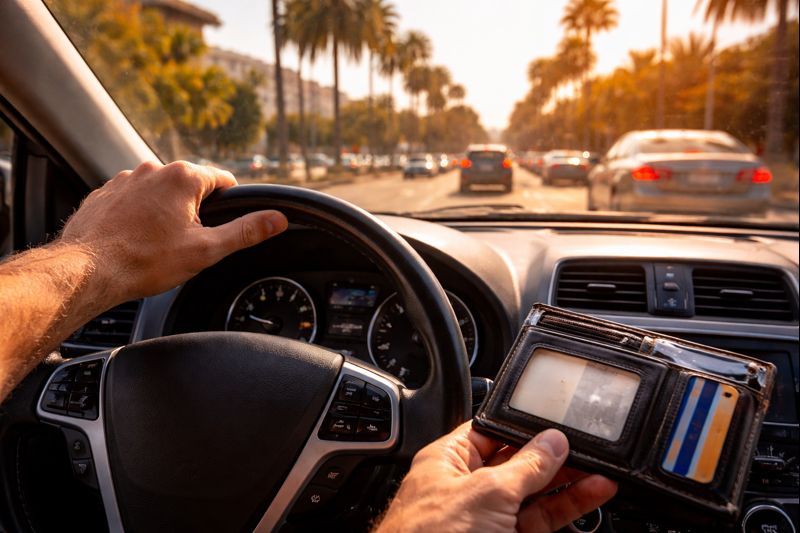
The headline exploded across social media: “Driving without a license will be completely legal in the United States starting January 1, 2026.” No arrests. No jail. Just a ticket, like a parking violation. Some posts even claimed that Donald Trump had already made it happen through something called the Road Freedom Act. It sounded radical. It sounded shocking. And for a moment, it sounded real.
But when you follow the trail past the viral posts and into actual law, the story takes a very different — and far more important — turn.
Where This Claim Came From
The rumor spread fast on short-form video platforms and messaging apps, often framed as “breaking news.” The claim was simple and dramatic: starting in 2026, unlicensed driving would no longer be a criminal offense anywhere in the U.S. Instead, police would issue a ticket — no arrest, no jail time.
There’s just one problem.
None of it is true.
There is no federal law called the Road Freedom Act. No executive order. No statute passed by Congress. And no nationwide policy that legalizes driving without a license.
Why This Can’t Happen Nationwide
In the United States, driver licensing is governed by state law, not federal law. That means each state decides who can drive, what licenses are required, and what penalties apply for violations.
A president — any president — cannot unilaterally legalize unlicensed driving across all states. Even Congress would face constitutional limits trying to do so.
So when posts claim a single federal change will “make everything legal,” that’s a red flag.
What Is Actually Changing in Some Places
Here’s where the confusion begins.
Over the past few years, some states and cities have reclassified certain traffic offenses, including driving without a valid license. In limited cases, lawmakers have reduced penalties — shifting some violations from criminal misdemeanors to civil infractions.
That can mean:
- Fines instead of arrest
- No jail time for first-time offenses
- Court appearances replaced with citations
But that does not mean unlicensed driving is legal. It still violates the law. It can still result in fines, vehicle impoundment, higher penalties for repeat offenses, and serious consequences if an accident occurs.
Why States Are Rethinking Penalties
Lawmakers pushing these changes often cite concerns about:
- Overcrowded jails
- Disproportionate impact on low-income drivers
- People losing jobs due to minor traffic arrests
The goal in these jurisdictions is penalty reform, not legalization.
In fact, in most states, driving without a license can still escalate quickly — especially if combined with speeding, DUI, or reckless driving.
The Trump Angle — And Why It’s Misleading
Claims tying this rumor to Donald Trump rely on a familiar viral tactic: attaching a dramatic policy shift to a high-profile figure. But there is no verified statement, proposal, or document from Trump supporting a nationwide move to legalize unlicensed driving.
Fact-checking organizations and legal experts have repeatedly confirmed that the claim is false.
Attaching a specific date — January 1, 2026 — adds urgency, but not credibility.
What Happens If You’re Caught Unlicensed Today
As of now, in every U.S. state:
- Driving without a valid license is illegal
- Penalties vary by state
- Repeat offenses often carry harsher consequences
- Insurance coverage may be invalid
- Accidents can lead to criminal charges
Even in states that have reduced penalties, enforcement still exists.
Why This Rumor Is Dangerous
Experts warn that believing this claim could lead people to:
- Drive without a license, risking fines or arrest
- Lose insurance coverage
- Face severe legal consequences after accidents
- Put themselves and others at risk
Misinformation doesn’t just confuse — it can cost people money, freedom, and safety.
How to Spot Similar False Claims
Watch for these warning signs:
- Vague laws with dramatic names
- No links to official government sources
- Claims that override state authority overnight
- Heavy emotional language, light on details
If it sounds too big to be true — it usually is.
The Question That Really Matters
Driving laws are evolving. Penalties are being debated. Reform conversations are happening.
But here’s the real cliffhanger people should be asking — not the viral one:
If a single post can convince millions that traffic laws disappeared overnight… how many people are making real-world decisions based on headlines that were never true to begin with?
Because when it comes to the road, believing the wrong thing can have consequences far more serious than a ticket.
Most Popular!
-
 Eggs, Cholesterol, and Timing: What Actually Matters for Most People
-
When a Partner Leaves With More Than a Suitcase: Protecting Yourself From Financial Betrayal
-
When Financial Support Meets Contempt: Recognizing Exploitation Inside a Marriage
-
Why Some Sensory Toys and Household “Hacks” Do Not Belong in the Microwave
-
When Grief Clouds Judgment: Misreading Silence and the Quiet Ways People Show Care
-
When One Partner Does All the Hosting: Recognizing Imbalance Before Resentment Takes Over
-
How Many Holes Are in a T-Shirt? What a Simple Puzzle Reveals About How We See
-
The Quiet Stories Inside Secondhand Objects: When a Thrift-Store Find Carries Someone Else’s History