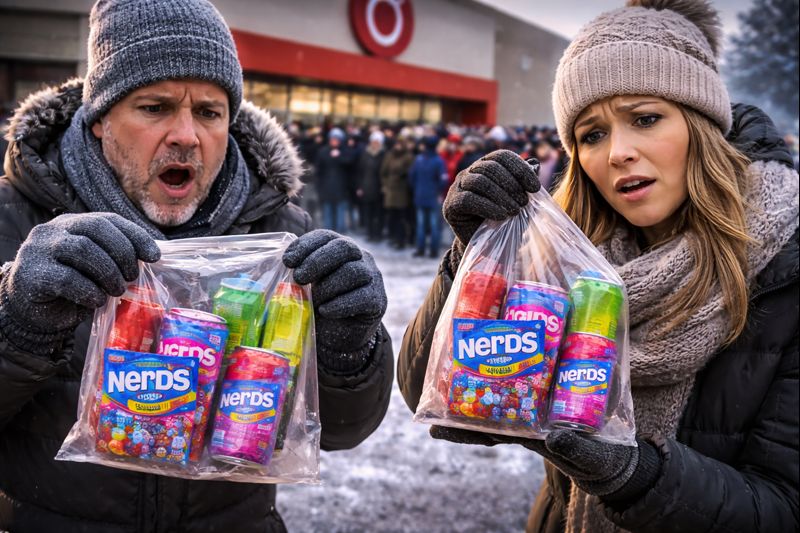
They were shaking. Their hands were numb. Breath hung in the air like smoke. For five long hours, hundreds of people stood outside a Target store in freezing, sub-zero temperatures, convinced the reward waiting inside would be worth it. Some brought blankets. Some brought coffee. Others brought pure determination. But when the doors finally opened and the first 100 shoppers received their “exclusive” swag bags… disbelief turned into anger almost instantly.
Many asked the same question: Was this seriously it?
The Line That Wouldn’t End
The scene unfolded outside a Target store hosting a limited-time promotional event. The promise was simple but powerful: the first 100 customers would receive a limited-edition swag bag tied to a popular candy brand promotion.
Word spread fast online.
By the time the sun rose, the line was already wrapped around the building.
Temperatures were brutal. Some customers said they stood outside for up to five hours in below-freezing weather, believing the reward would be something rare, valuable, or at least memorable.
No one expected what happened next.
“We Thought It Would Be Something Big”
Customers who waited in line said the hype set expectations high. Limited edition. First 100. Exclusive.
That combination usually means one thing: something special.
Instead, shoppers were handed swag bags containing NERDS candy and drink packs — items many described as low-value, widely available, and not remotely worth hours of suffering in extreme cold.
One customer summed it up bluntly:
“I can buy this stuff for a few dollars. I froze for nothing.”
Another added, “It felt insulting.”
From Excitement to Outrage in Minutes
What shocked many wasn’t just the contents — it was how quickly the mood shifted.
Moments before opening, the crowd buzzed with excitement. People laughed, took photos, and celebrated making it into the first 100.
Minutes later, frustration took over.
Several customers said they felt misled, arguing that the promotion failed to clearly explain what the swag bags contained. Others pointed out that no candy is worth risking hypothermia.
Social media posts from attendees began circulating almost immediately, showing disappointed reactions and sarcastic comments about the “reward.”
Why People Still Showed Up
Marketing experts say events like this tap into powerful psychological triggers:
- Scarcity (“first 100 only”)
- Exclusivity (“limited edition”)
- Social proof (long lines create urgency)
“When people see a crowd, they assume value,” one retail analyst explained. “Even if the prize is small, the hype does the heavy lifting.”
In this case, the hype worked — too well.
Target’s Role in the Backlash
While the promotion was tied to a candy brand, many customers placed blame on Target for allowing the event to unfold without better communication.
Some argued the retailer should have:
- Clearly disclosed what the swag bags contained
- Limited wait times in extreme weather
- Provided better crowd management
Target did not immediately issue a public apology, but the backlash highlights how quickly goodwill can disappear when expectations aren’t managed.
“Never Again,” Say Some Shoppers
Several attendees said the experience changed how they view promotional events altogether.
“I won’t ever stand in line like that again,” one shopper said. “Not for Target. Not for anyone.”
Others said the experience felt like a lesson learned the hard way: just because something is ‘free’ doesn’t mean it’s worth the cost.
The Bigger Lesson About Hype Culture
This incident taps into a growing frustration among consumers who feel brands increasingly rely on hype while delivering minimal value.
Free giveaways, influencer-driven promotions, and limited drops create massive attention — but when the payoff disappoints, the backlash is louder than ever.
In an age where everything is shared online, a single poorly executed promotion can overshadow years of brand trust.
The Question Everyone Is Asking
Five hours. Freezing temperatures. Hundreds of people.
All for candy most people already have at home.
So the real question isn’t why people lined up.
It’s this:
When did “free” stop being worth it — and how many brands are about to learn that lesson the hard way?
Most Popular!
-
 Eggs, Cholesterol, and Timing: What Actually Matters for Most People
-
When a Partner Leaves With More Than a Suitcase: Protecting Yourself From Financial Betrayal
-
When Financial Support Meets Contempt: Recognizing Exploitation Inside a Marriage
-
Why Some Sensory Toys and Household “Hacks” Do Not Belong in the Microwave
-
When Grief Clouds Judgment: Misreading Silence and the Quiet Ways People Show Care
-
When One Partner Does All the Hosting: Recognizing Imbalance Before Resentment Takes Over
-
How Many Holes Are in a T-Shirt? What a Simple Puzzle Reveals About How We See
-
The Quiet Stories Inside Secondhand Objects: When a Thrift-Store Find Carries Someone Else’s History







