The assembly floor at Marlowe Manufacturing rang with mechanical rhythms—clanks, hums, and the occasional hiss of pressurized air. Workers stood shoulder-to-shoulder, moving swiftly along the conveyor belts. Steel parts clattered into bins. Protective goggles fogged with effort.
Kenny Wells stood at Station 12, wrists tight with tension, hands slightly trembling as he struggled to keep pace. The 58-year-old wiped sweat from his brow with a sleeve. He wasn’t fast—but he was precise. Six bolts per panel. No shortcuts.
That morning, his gloved fingers fumbled with a stripped screw. It didn’t quite seat. He backed it out, started again. Thirty seconds passed.
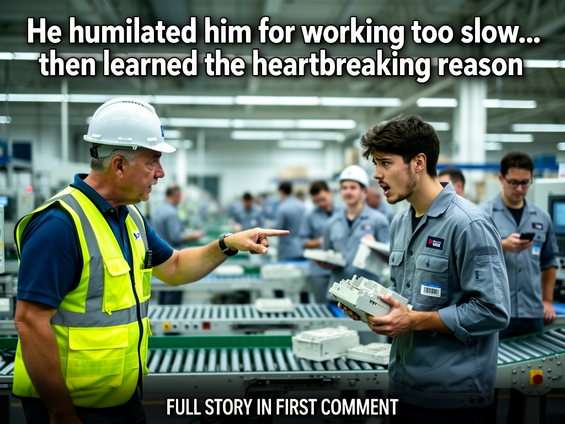
Danny McCall, the floor supervisor, saw it. “Come on, Kenny!” Danny’s voice cracked over the noise. Heads turned. Hammers paused midair. “You holding lunch hostage or what? If you were any slower, we’d be building pyramids instead of trailers!” A ripple of awkward laughter passed down the line, but most workers looked away. The smile on Danny’s face never touched his eyes.
Kenny flinched. His shoulders slumped. “I—I’ll speed up,” he mumbled. Danny stormed down the aisle, steel-toed boots slamming against the concrete. “Speed up? You’ve been dragging down production all quarter! I should get you reassigned to sweeping floors!”
“Hey.” The voice came from the breakroom door. All heads swiveled. Jen Martinez stepped out holding a clipboard. Mid-40s, safety manager. Usually quiet. Today, her eyes didn’t blink. “That’s enough, Danny.” He scoffed. “I don’t recall inviting a hall monitor.” Jen walked toward Kenny, stood beside him like a shield. “Let me tell you something about Kenny,” she said softly. “A few weeks ago, while we were all watching football and drinking beer, Kenny was holding his wife’s hand at Riverwest Hospice. She passed away that night.”
Silence fell like a dropped wrench. “She fought pancreatic cancer for two years. And Kenny didn’t miss a single day of her care. He worked nights. Brought her to appointments. Sold his truck to pay for meds. Never once complained here.” Kenny turned away, blinking into his sleeve. Jen’s voice cracked. “He’s only slow because he’s tired, Danny. He sits alone in that empty house now, remembering thirty-six years of marriage.” Danny stared her down, arms crossed. But his face changed.
Jen added, “He asked to stay here at work. Said it’s the only place people still speak.” Now Danny’s eyes dropped to the floor. “I—I didn’t know…” he muttered. His bravado folded like tin foil. Jen didn’t raise her voice. She didn’t need to. “You didn’t care to ask,” she said. “You saw numbers. Not a man.” Danny turned to Kenny. His jaw worked, but no words came. Until they did. “I’m sorry, Kenny,” he said low, voice hoarse. “I was wrong.” Kenny nodded but said nothing. The line stood still. And no one minded.
The next day, something unexpected happened. Danny arrived early. Brought two coffees to Station 12—no word, just a nod. Kenny blinked in surprise. Took the cup with trembling fingers. Within the week, Danny posted a clipboard at the office titled “Stories Matter.” He asked workers to write about someone they’d admired, or lost, or loved. Kenny’s name appeared again and again.
On Friday, Kenny found a photograph taped to his locker: his wedding portrait, taken from the company Christmas party twenty years ago. Jen had tracked down the negatives. He stared at it for a long time. Every Friday since, just before shifts begin, the factory observes a single minute of silence—not for speed or profits, but for the quiet battles no one sees. And Kenny? He trains the rookies now. Never rushes. Shows them where to pause, how to breathe, when to care. As for Danny—he doesn’t interrupt anymore. In fact, he listens more than most. Because sometimes, justice doesn’t come in lawsuits or sirens. Sometimes, it walks in quietly, says “That’s enough,” and changes everything.
Most Popular!
-
 The Ultimate Wedding Revenge: When the Mother Who Abandoned Her Six Daughters Showed Up with Her Millionaire Boss, the Bride Opened a Box That Destroyed Lives Forever
-
The Beach Shaming Disaster: What My 8-Year-Old Said to the Prying Stranger Left Everyone Speechless
-
My Husband Abandoned Me With Twin Babies for a Luxury Fishing Trip — When He Returned, I Had Already Packed His Bags
-
The Three-Dollar Miracle: How a Dust-Covered Vase Revealed a Heartbreaking Decades-Old Secret
-
The $80,000 Battle to Erase a Birthmark: Why One Mother Risked Everything for Her Daughter’s Future
-
The Silent Thief: Why Millions of Men Are Living with a Time Bomb They Can’t See
-
The Final Curtain Falls: Beloved Sanford and Son Legend Hal Williams Gone at 91
-
Found at a Yard Sale: This “Useless” Vintage Contraption Is Actually a Forgotten Piece of Human History