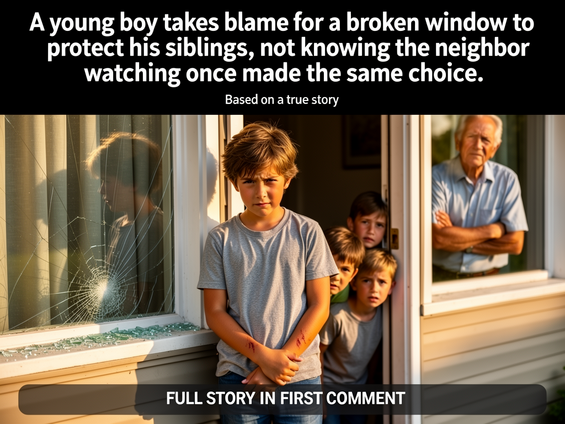
The brick lay quiet in the garden bed, half-submerged in damp soil, as if trying to bury its shame. The shattered window glimmered in the late afternoon sun, jagged edges catching the light like guilt frozen in glass.
Inside the small blue house on Maple Street, ten-year-old Eli Morgan stood trembling in the kitchen, fingers clenched around the hem of his hoodie. His younger siblings—Lily, age six, and Max, barely four—huddled wordless on the bottom step of the stairs, eyes wide with fear.
“I did it,” Eli whispered when his mother emerged from the laundry room and gasped at the sound of crunching glass. “I threw the ball too hard. It crashed through old Mr. Campbell’s front window.”
His mother stared at him, then the broken pane outside. Her voice wavered. “You know how he gets. He’s been waiting for a reason…”
They both jumped at the knock on the door. Mr. Campbell didn’t wait. The door swung open, his massive frame blocking the last of the sunlight. His gray eyebrows stabbed downward. “Which one of you little delinquents did it?” he snarled, voice full of venom and old anger.
“I said it was me,” Eli repeated, louder this time, stepping forward. Campbell’s finger stabbed the air an inch from Eli’s nose. “You think it’s funny? Destroying people’s property? You little—” He stopped himself, but his fists clenched. “You’re gonna pay for that. Every damn cent. I’m calling the police.” Lily started crying, her tiny hands over her mouth. Campbell turned, his voice rising, echoing across the quiet street. “This is what comes from parents who can’t control their kids!” A few neighbors poked their heads out. “Little criminals, that’s what they are!”
Across the street, an old screen door creaked open. Henry Dawson, a quiet man with the kind of eyes you avoid and respect at the same time, stepped onto his porch. He wore a faded Army jacket and carried a mug that read “World’s Okayest Grandpa.” He didn’t raise his voice. He didn’t have to. “That’s enough.” The tension snapped like a rubber band. Campbell froze. Even Lily stopped sniffling.
Henry’s boots crunched on the gravel as he walked slowly across the street, his gaze never leaving the boy. “You said he broke your window,” Henry said. “That true, Eli?” Eli nodded, lip trembling. “I didn’t mean to.” Henry glanced at the house. “Ball go wild?” “Yes,” Eli said. “But… it wasn’t my ball.” Campbell scoffed. “I don’t care whose ball it is. He took credit, didn’t h—” Henry raised a hand. Quiet resumed. “I know why you did it,” Henry said softly, kneeling to Eli’s height. “Because once, a long time ago, I did the same damn thing.” Eli blinked.
Henry turned to the gathering crowd, his voice suddenly loud and measured. “I once took the heat for breaking a greenhouse window. I was fourteen. My younger brother had a mean arm and a worse temper. I knew he’d catch hell for it. So I claimed it. Even paid for it with my lawn-mowing money.” Campbell rolled his eyes, but it didn’t stop Henry. “The man who owned that greenhouse was like you. Mean. Bitter. Lost too much in life to hold his heart open anymore.” Campbell narrowed his eyes. “You don’t know anything about me.” Henry’s stare was steady. “I know your wife passed four years ago. I know you stopped planting flowers after she died. I also know, from what this boy just did, that there’s still good in this neighborhood.” And then—like marrow being exposed—Henry turned to the window. “But there’s another detail. The brick. I saw it roll from the fence line. That’s too high for Eli to have thrown it clear through. My guess? Somebody else didn’t come forward. Maybe Max there. Or maybe it just bounced wrong. Point is—Eli doesn’t deserve your wrath. He took blame to protect the others. That’s courage.”
Something cracked—not glass this time, but in Campbell’s voice. His hands went to his face. His shoulders shook. When he finally looked up, his red eyes weren’t angry. They were empty. “I—” he started hoarsely. “My grandson used to do that. Protect his little sisters. Before… before the crash.” No one spoke. Campbell looked at Eli. “I’m sorry,” he said. “You’re a good brother. And better than I gave you credit for.” Eli blinked. His mother exhaled for the first time. “I’ll fix the window,” Campbell said. “No charge. I shouldn’t have… I’m sorry.” His voice cracked. “To all of you.” Henry helped him up. “It’s never too late, neighbor.” The next weekend, Campbell stood with a tool belt and a patch of new glass, but that wasn’t all he brought. He also had a box of baseballs, a mitt, and a weathered smile. “Let’s build you a backstop,” he said. “So no more wandering pitches.” Eli grinned. Max clapped. They spent the day hammering scrap wood behind the garage—Campbell laughing for the first time in years when Max swung and missed every pitch spectacularly. From then on, it became a ritual. Every Sunday afternoon, old Mr. Campbell—now “Grandpa C” to the kids—hosted “Backyard Ball” sessions. Other kids joined. So did Henry, with stories you only believed halfway. The repair to the window remained visible—a patch just slightly tinted green. Campbell left it that way on purpose. A reminder. Of courage. Of regret. Of the glass-shattering moments that somehow put lives back together. Justice, after all, isn’t always about right and wrong. Sometimes, it’s about who we choose to stand up for—and who we become because of it.
Most Popular!
-
 Eggs, Cholesterol, and Timing: What Actually Matters for Most People
-
When a Partner Leaves With More Than a Suitcase: Protecting Yourself From Financial Betrayal
-
When Financial Support Meets Contempt: Recognizing Exploitation Inside a Marriage
-
Why Some Sensory Toys and Household “Hacks” Do Not Belong in the Microwave
-
When Grief Clouds Judgment: Misreading Silence and the Quiet Ways People Show Care
-
When One Partner Does All the Hosting: Recognizing Imbalance Before Resentment Takes Over
-
How Many Holes Are in a T-Shirt? What a Simple Puzzle Reveals About How We See
-
The Quiet Stories Inside Secondhand Objects: When a Thrift-Store Find Carries Someone Else’s History