The Tuesday afternoon sun slanted through the tall windows of the Oakview Public Library, casting golden rectangles across worn carpet and scattered notebooks. The air smelled faintly of paper and time. It was quiet—aside from the occasional rustle of a turning page or the humming radiator beneath the window.
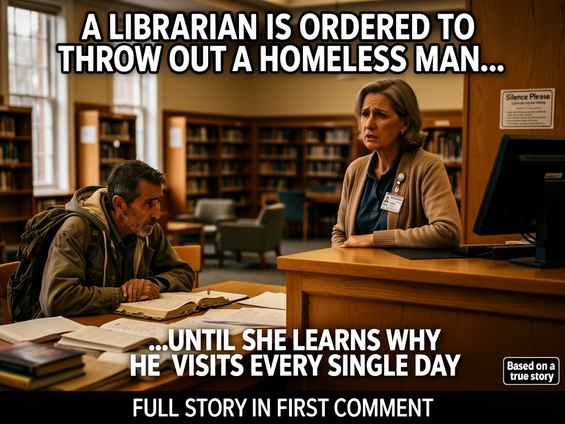
At the back corner of the reading room, Thomas Whitaker sat in his usual chair. His coat was old, navy blue dulled to ashen gray, and his boots were cracked along the seams. A threadbare duffle bag rested against the table leg. He kept to himself. Never spoke unless spoken to. Every day, he arrived when the doors opened and stayed until they closed.
No one seemed to mind—except Mr. Carlsen.
The new assistant branch manager bustled in that day like a storm front. Clipboard in hand, tie crisply knotted, his eyes darted like a hawk with something to prove.
“Excuse me,” he said, stopping at librarian Marla Jensen’s desk. “There’s a… vagrant… in the back. Again. He’s been here all week.”
Marla looked over her glasses. “You must mean Mr. Whitaker. He’s been coming here for months.”
Carlsen’s mouth twisted. “I don’t care if he’s been coming here for years. This isn’t a shelter. We can’t allow the place to become a lounge for the homeless. Patrons have complained.”
She blinked. “Which patrons?”
“Anonymous ones,” Carlsen snapped. “Honestly, I shouldn’t have to explain this. Get him out. Now.”
Marla hesitated, heart pounding. She hated confrontations. But she also cared deeply about her patrons—all of them.
Still, she nodded and crossed the reading room slowly, dreading what she had to do.
Thomas looked up gently as she approached. His eyes, the kind that hid stories, met hers with quiet understanding.
Before she could speak, Carlsen followed behind her like judgment itself.
“You,” he barked. “Sir. I’m afraid we’re going to have to ask you to leave. This facility isn’t designed for loitering.”
Conversation ceased. A mother froze by the children’s fiction. An older gentleman dropped his newspaper to his lap. Even the clock on the wall seemed to pause.
Thomas sat there, stunned, then began to gather his few belongings without a word.
“That’s enough,” Marla said quietly.
Her voice cut the tension like a bell in fog.
Everyone turned toward her, including Carlsen. The color rose in his face.
She drew a breath, steeling herself.
“Mr. Whitaker,” she said loudly enough so the room could hear, “comes here every day at precisely 9:05. He checks out a different book on classical piano, and then he spends all day copying sheet music by hand.”
She reached down and lifted a dog-eared spiral notebook from the table: page after page of delicately transcribed staff lines and notes.
“He does this,” she said as her voice trembled, “because six months ago, his teenage daughter was killed by a drunk driver. She used to play. Every Saturday at the community center.”
Marla glanced at Thomas. Grief sat on his shoulders like winter snow.
“She was going to teach him. But he never got the chance. Now he’s teaching himself. Because when he plays, even badly, it’s like she’s there… just for a moment.”
A slow exhale rippled through the room. A woman dabbed at her eyes with a tissue.
Carlsen stood frozen.
“I—” he stammered.
But there was nothing more to say. The righteous posture drained from him, replaced by embarrassment. His clipboard quietly slipped to his side.
“I didn’t—know,” he managed, eyes on the floor.
Marla nodded. “Maybe next time, you’ll ask before assuming.”
The quiet buzz of the room returned, now tinged with reverence.
Later that day, Carlsen approached Mr. Whitaker. Humbled. He apologized.
“I’m sorry, sir,” he said, voice shaking slightly. “I was… wrong.”
Thomas offered a faint, forgiving smile. “We’ve all got things we carry.”
From that day forward, he wasn’t just tolerated at the library—he was welcomed.
The branch even found a way to help. Marla organized a fundraiser for new music books and a small keyboard, which they placed gently in the practice room. A new laminated sign appeared above the door:
“This room is dedicated to the memory of Elise Whitaker—whose music still plays.”
Each Saturday now, Marla sits behind her desk and listens.
The notes aren’t perfect.
But somehow, they’re beautiful.
And just before closing time, young kids often wander near the practice room and listen, too.
What started as a tragedy became a hymn of quiet redemption—proof that sometimes, the best chapters begin when someone turns the page for you.
Most Popular!
-
 Eggs, Cholesterol, and Timing: What Actually Matters for Most People
-
When a Partner Leaves With More Than a Suitcase: Protecting Yourself From Financial Betrayal
-
When Financial Support Meets Contempt: Recognizing Exploitation Inside a Marriage
-
Why Some Sensory Toys and Household “Hacks” Do Not Belong in the Microwave
-
When Grief Clouds Judgment: Misreading Silence and the Quiet Ways People Show Care
-
When One Partner Does All the Hosting: Recognizing Imbalance Before Resentment Takes Over
-
How Many Holes Are in a T-Shirt? What a Simple Puzzle Reveals About How We See
-
The Quiet Stories Inside Secondhand Objects: When a Thrift-Store Find Carries Someone Else’s History