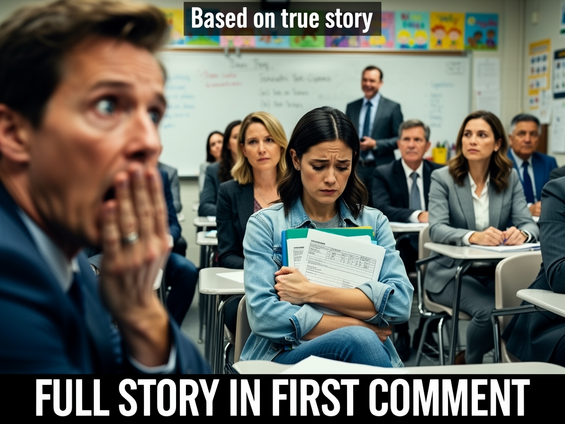
The folding chairs squeaked on the linoleum floor as mothers and fathers shuffled into the overheated library. Fluorescent lights buzzed above, casting sharp shadows over tired faces. The PTA meeting had just started, but already the air felt tight, like something about to snap.
Amanda Dunn sat alone at the edge of the circle, smoothing the hem of her faded jeans. Her hair was pulled back in a messy bun, damp from racing in the rain after her shift at the diner. In her lap, a worn manila folder held notes from teachers about her son, Liam—math improvement, reading goals, classroom behavior.
She listened carefully as the discussions went around, parents chiming in about upcoming bake sales, music room upgrades, soccer uniforms. Amanda nodded quietly. She didn’t raise her hand.
Then it came up.
“I just want to address something uncomfortable,” said Margot Sinclair, standing abruptly. She wore crisp trousers and a pearl necklace that gleamed beneath the overhead light. People quieted. “Several of us have noticed… let’s just say a decline in classroom standards.”
Amanda tensed.
Margot turned her gaze.
“For example, some children come to school without lunch or permission slips signed. One child handed in an ‘All About My Family’ poster with no father listed—just a photo of a waitress and a dog.” Her voice coiled with artificial concern. “Now, I’m not naming names, but we have to maintain dignity in our school.”
A low murmur swept the room. All eyes flickered toward Amanda.
Her throat tightened. Her palms trembled. She opened her folder to say something—to explain that she’d simply been working a double, that Liam’s father had died in Afghanistan when he was four—but the words sat like stones in her mouth.
Margot wasn’t finished. “If we make allowances for every hard-luck case, where does that leave our own children? Struggling because one parent can’t keep up?”
Silence. The heater clicked in the corner. Someone shifted uncomfortably.
Then, a voice cut through the air.
“That’s enough.”
All heads turned.
From the back, a tall man rose. His flannel shirt hung loose over broad shoulders, and his weathered face looked tired, but determined. His name tag read “Dan Hernandez—Father of Ellie, Grade 2.”
He stepped forward.
“Maybe you don’t remember me, Margot. We met a while ago. At a funeral.”
Margot blinked.
Dan’s voice dropped.
“I served with Sergeant Drew Dunn. Your cousin. We both watched each other’s six in Fallujah. He saved my life.”
A gasp rippled.
Dan nodded toward Amanda. “That waitress you’re so worried about? That’s Drew’s wife. She’s raising Liam on her own because Drew didn’t come home.”
The silence turned heavy now, not from offense, but from shame.
“She works double shifts and still makes every parent-teacher night. You talk about dignity? I’ve never seen more of it than in that woman right there.”
Margot’s face drained of color.
Amanda stared at Dan, stunned. She hadn’t recognized him without the uniform. Her lips parted, but no sound came.
Dan reached into his coat. Pulled out a photograph—him and Drew in combat gear, grinning and filthy. He passed it down the row until it reached Margot.
“She ever tell you Liam writes letters to his dad every week? Leaves them under his pillow.”
Margot’s fingers trembled as she took the photo.
Tears welled in her eyes. For the first time that evening, she had no words.
Dan turned to Amanda and gave a small nod—an old soldier’s salute in civilian form.
Amanda exhaled. Her shoulders relaxed just a little.
Principal Monroe, seated beside the library shelves, cleared his throat. “I think we owe Mrs. Dunn an apology. And perhaps a bit more compassion moving forward.”
Margot stood frozen, then slowly stepped forward. Her voice was low, cracked. “Amanda… I didn’t know. I—I’m so sorry.”
“It’s alright,” Amanda whispered. “You weren’t supposed to.”
But something had shifted. Not just in that room, but in the people.
Afterward, parents gathered around Amanda—offering words, numbers, help. Margot hugged her. Real, this time. No pearls. Just a mother saying sorry.
Weeks later, on Veterans Day, a tree was planted in front of the school. A plaque beneath read:
“In memory of Sergeant Drew Dunn. And to all families who serve in silence.”
Amanda stood with Liam beside it, their hands clasped. Dan was there too, holding Ellie’s hand. The two children darted off together under the golden leaves, laughter echoing.
Every Friday now, Dan brings coffee to Amanda at the diner. They sit a few minutes before her shift, catching up. They made it a ritual. “For Drew,” they say. And for all the people who carry things no one else can see.
Because sometimes justice isn’t loud. Sometimes, it arrives quietly—with the truth, a photo, and someone who remembers.
Most Popular!
-
 Donald Trump Releases Shocking Health Report but Critics Point to Hidden Details and Missing Data That Could Change Everything
-
The Unholy War Between the White House and the Vatican: Why JD Vance’s Shocking Accusation Against Pope Leo Has the Entire World Bracing for a Spiritual Collapse
-
Chilling Reports of US and Iran War Send Global Markets into Total Chaos as Truth Behind Downed Fighter Jet Finally Revealed
-
The Truth About What Happens to Your Body When You Eat Walnuts Every Day, According to Top Medical Experts
-
Brandi Passante Sends Internet Into Total Meltdown After Stunning New Beach Photos Go Viral Across Social Media
-
Where Are They Now: The Heartstopping True Story of Britain’s Youngest Parents Who Shocked the Nation at Fourteen Years Old
-
Why You Are Waking Up at One AM Every Night and the Shocking Spiritual Warning Your Body Is Trying to Send You Before It Is Too Late
-
Unprecedented Global Showdown as Trump Unleashes Chilling Two-Word Attack on Pope Leo Amid International Crisis