The hallways of Edison Middle School buzzed with the low hum of lockers slamming and laughter echoing down from classrooms. Another Tuesday. Another morning where no one paid much attention to the quiet man pushing a mop down the corridor—George, the janitor.
George worked quietly, as always, his head down, hat pulled low. A stain on his faded denim shirt matched the scrub bucket at his side. His hands, large and callused, shook slightly. Few knew his last name. Fewer knew he’d arrived an hour before dawn each day for the past six years to mop hallways, fix broken desks, and clean up after kids who’d never know his name.
They definitely didn’t notice the small paper airplane stuck in the hallway clock’s frame.
It was just before lunch when Principal Sharon McKee stormed out of her office. Clipboard in hand, stilettos clacking. She stopped by the cafeteria windows, her eyes scanning the ceiling until she found it—the paper plane.
“Unbelievable,” she huffed. “George!”
The mop paused mid-sweep. George turned slowly, wiping his hands on a gray rag.
“Yes, ma’am?”
“What kind of mess are you running here?” Her voice rose. “This is a place of learning, not a hangar for your little paper fleet.”
He blinked.
“You’ve been here all morning,” she barked, motioning to the clock. “And you didn’t notice that? Not very observant, are you?”
Students outside the cafeteria turned. A few teachers peeked from classrooms.
George opened his mouth. Closed it.
“Well?” she snapped. “Do you plan on doing your job, or just push that mop around like it’s decoration?”
Laughter whispered through the hallway. George nodded slowly and retrieved a ladder.
He climbed carefully. His knees ached with every step.
The principal crossed her arms. “At least pretend you have standards.”
From halfway down the hallway, a voice cut through the silence.
“That’s enough.”
The hallway still. Even the clock seemed to hold its breath.
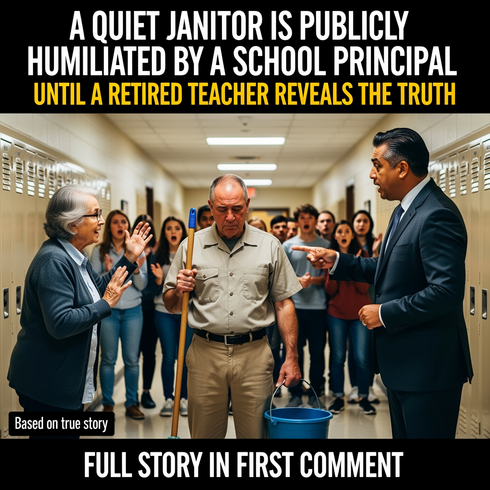
An old woman in slacks and a cardigan stepped forward from the shadows near the trophy case. Ms. Evelyn Harper, retired after 38 years teaching history at Edison. Most figured she’d moved somewhere warm. No one expected her in the middle of the school on a Tuesday afternoon.
Principal McKee blinked. “Evelyn?”
Ms. Harper walked forward slowly. Her voice was calm, but steel threaded every word. “You belittled a good man in front of children.”
“He didn’t—”
“His name is George Lawson,” she said firmly. “And six years ago, he buried his son.”
The silence thickened.
“He was 13,” she continued softly. “Your student. Jamie Lawson. Straight A’s. Loved drawing airplanes. Built one just like the one caught in that clock.”
The paper airplane trembled slightly in the draft above George’s head.
Evelyn looked at the students gathering nearby. “Jamie died in a car accident one February morning.” Her voice caught, but she steadied. “It was his birthday. After the funeral, George took a job here. No one said thank you. He just appeared one day with a mop and a grieving heart.”
The clipboard slipped from Principal McKee’s hands. It clattered to the floor with a hollow thunk.
“He cleans this school like it’s a temple,” Evelyn added, stepping closer. “Because it’s the last place his son ever smiled.”
Eyes welled. A boy near the lockers covered his mouth.
George, still on the ladder, gently unhooked the paper plane. He pressed it against his chest. For the first time in six years, he let his tears fall. Silent, heavy drops landing on the cold tile below.
Principal McKee’s voice cracked. “George… I—I didn’t know.”
“You didn’t ask.” Evelyn’s words stung soft but sharp. “You saw a man with worn boots and assumed he was beneath you.”
“I’m so sorry,” McKee whispered, trembling now. “I—I was unfair. Cruel.”
George climbed down. He nodded once, eyes still shining, the paper plane carefully folded in his hand.
The silence broke with scattered applause. First from Evelyn. Then from the seventh-grade science teacher. A few students joined. By the time George reached the floor, half the hallway stood for him.
Two weeks later, the principal called a staff meeting.
In it, she issued a formal apology in front of the entire student body. She hugged George awkwardly—not performative, but human.
And she handed him something wrapped in tissue: a shadowbox frame.
Inside it sat the paper airplane.
“It should be displayed,” she said, eyes rimmed red. “As a reminder.”
That Monday, she installed a brass plate under the case: “In memory of Jamie Lawson. Loved and remembered. Built to soar.”
George now smiles more. He’s not invisible anymore. Some kids call him “Mr. George.” Others hand him doodles of airplanes.
Every morning, before the bell rings, he walks past the case and touches the glass gently.
On Fridays, Evelyn joins him. They drink coffee from matching thermoses by the vending machines and swap stories while students bustle past.
They call it “Flight Fridays.”
A hallway that once echoed with humiliation now hums with respect.
Even silence, when it happens, feels like reverence.
Because justice doesn’t always arrive with gavel or gun. Sometimes, it rides in on a folded paper wing.
Most Popular!
-
 Eggs, Cholesterol, and Timing: What Actually Matters for Most People
-
When a Partner Leaves With More Than a Suitcase: Protecting Yourself From Financial Betrayal
-
When Financial Support Meets Contempt: Recognizing Exploitation Inside a Marriage
-
Why Some Sensory Toys and Household “Hacks” Do Not Belong in the Microwave
-
When Grief Clouds Judgment: Misreading Silence and the Quiet Ways People Show Care
-
When One Partner Does All the Hosting: Recognizing Imbalance Before Resentment Takes Over
-
How Many Holes Are in a T-Shirt? What a Simple Puzzle Reveals About How We See
-
The Quiet Stories Inside Secondhand Objects: When a Thrift-Store Find Carries Someone Else’s History