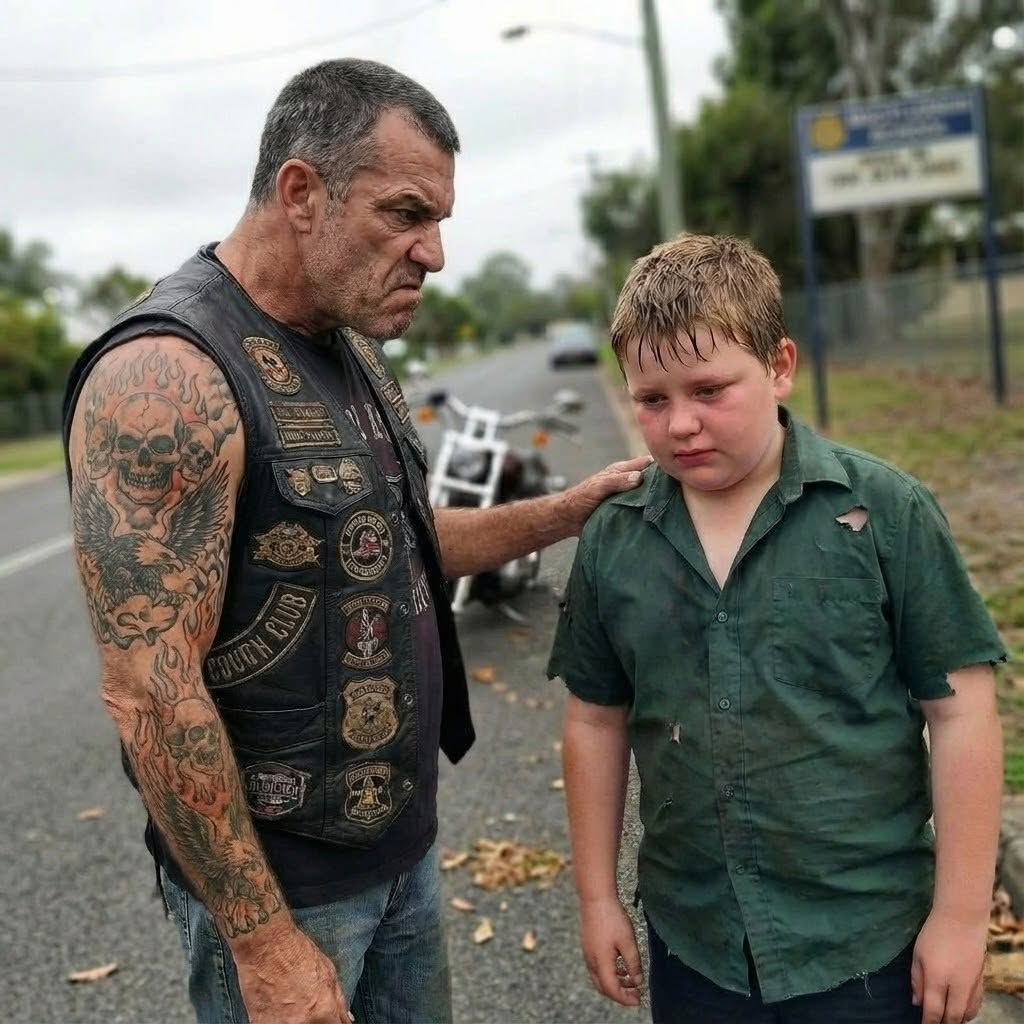
The empty rural road stretched endlessly under the fading afternoon light, the kind of quiet stretch where most people would simply keep riding. But something about the small figure trudging along the shoulder made the biker slow down. The boy couldn’t have been more than twelve, his clothes torn, head bowed low, and hands showing fresh marks of violence he was desperately trying to hide. In that moment, one man’s decision to pull over didn’t just interrupt a lonely walk—it became the turning point that pulled a hurting child out of years of silent nightmare and showed an entire community what real strength looks like.
The biker, a seasoned rider with a group of friends who often traveled these back roads, had seen plenty of strange sights over the years. But the sight of a child walking four miles alone, clearly in pain and defeat, hit differently. When he stopped and approached gently, the boy gave the classic answer children learn too early when they’re scared to tell the truth: “Nothing.” His eyes told a different story—hollow, exhausted, carrying a weight no child should bear. It was the look of someone who had learned to protect others by swallowing his own suffering.
Bit by bit, as they talked on the side of the road, the truth emerged. School, meant to be a place of growth and safety, had become a daily battlefield of systematic bullying. The emotional and physical toll had built up until the boy could no longer endure it in silence. Yet even in his deepest pain, his primary worry wasn’t himself—it was his mother. He didn’t want to add to her already heavy burdens. He believed that hiding his suffering was the loving thing to do, mistaking isolation for strength. It was a heartbreaking maturity born from desperation, the kind that breaks your heart when you realize how many children carry similar loads alone.
When the boy’s mother finally arrived, the intersection of relief and raw truth created a powerful, difficult moment. The conversation that followed wasn’t easy or polished, but it was necessary. For the first time, the weight the boy had carried in silence was shared. Problems don’t magically disappear when voiced, but they become infinitely more manageable when you no longer face them completely alone. That roadside meeting marked the beginning of real change, not just for one child, but for how an entire community chose to respond.
The biker didn’t stop at offering a ride. He and his riding group—tough-looking men on powerful motorcycles—became unexpected guardians. They didn’t storm in with threats or spectacle. Instead, they offered steady, consistent presence. They helped the mother navigate school meetings, supported the boy through difficult conversations, and made sure he knew he was no longer invisible. Their message was clear and calm: this matters, and we are watching. True community isn’t always loud or dramatic. Sometimes it’s simply refusing to look away when a child is suffering.
In the weeks and months that followed, the boy began to smile again—a real, unguarded smile that reached his eyes. The heavy burden that had defined his days lightened. His mother, once isolated in her struggles, found support instead of judgment. The riding community proved that strength isn’t measured by how tough you look or how loud you can be. It’s measured by how you choose to stand up for those who have been forgotten or left behind.
This story carries a profound lesson that extends far beyond one roadside encounter. Every day, children walk through their own silent battles—bullying, family stress, emotional pain—while wearing brave faces and saying “nothing” when asked what’s wrong. Adults often miss the signs because life moves fast and it’s easier to accept easy answers. But one person choosing to stop, listen, and act can break that cycle. It doesn’t require being a hero or having all the answers. It simply requires the willingness to pay attention and care enough to get involved.
For parents, the story is a reminder to create spaces where children feel safe sharing their heaviest truths. For communities, it challenges us to move beyond indifference and actively look out for the vulnerable. Schools, neighbors, and everyday people all have roles to play in ensuring no child has to carry their pain alone. The biker and his friends showed that support can come from unexpected places, and that real change often starts with one person deciding not to drive past.
The boy’s journey from broken silence to healing wasn’t instant or easy. It required courage from him to speak up, strength from his mother to face difficult realities, and commitment from others to provide consistent support. But the transformation was real. What began as a lonely walk on a desolate road ended with a child who knew he was seen, valued, and protected.
In a world that can feel increasingly disconnected, stories like this restore faith in human goodness. They remind us that kindness still exists, often in the most unlikely forms—a stranger on a motorcycle who chose to stop when others might have kept riding. That single decision didn’t just help one boy. It sent ripples through a family and community, proving that presence and compassion are among the most powerful forces we have.
If you ever find yourself in a position to help someone who seems to be struggling in silence, remember this story. Stop. Listen. Act. You may never know the full weight someone is carrying, but your willingness to show up can make all the difference. The biker didn’t set out to be anyone’s savior that day. He simply refused to ignore a child in pain. In doing so, he became part of something much bigger than himself.
For anyone who has ever felt invisible in their suffering, know that there are still people willing to stop and listen. And for those with the power to help, the call is clear: don’t drive past. The smallest act of attention and care can pull someone out of their darkest moment and remind them they are not alone. That’s the true power of choosing to stop on the side of the road when the world needs it most.
Most Popular!
-
 The Heartbreaking Reality: Why Jelly Roll and Bunnie XO’s Fairytale Marriage Has Finally Imploded
-
Is That Tiny Canker Sore Actually a Death Sentence? The Silent Signs of Oral Cancer You’re Likely Ignoring
-
The Indecency Scandal: Why Bianca Censori’s Latest Cat Mask Ensemble Has the Public Demanding Her Arrest
-
The Secret Message from Beyond: Why Cemetery Officials Are Desperate to Destroy This Man’s Final Tribute
-
The Miracle Weed: Why This Common Backyard Menace Is Worth Its Weight in Gold
-
The Innocent Selfie That Ended a Wedding: How One Tiny Detail Destroyed Everything
-
The Secret Whisper That Left a Nation Stunned: What Trump Actually Said to the Fighter Who Insulted Michelle Obama
-
These Mind-Bending Riddles Are Humiliating Millions Online — Can You Solve Them Without Losing Your Mind?