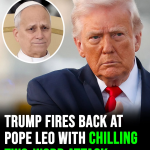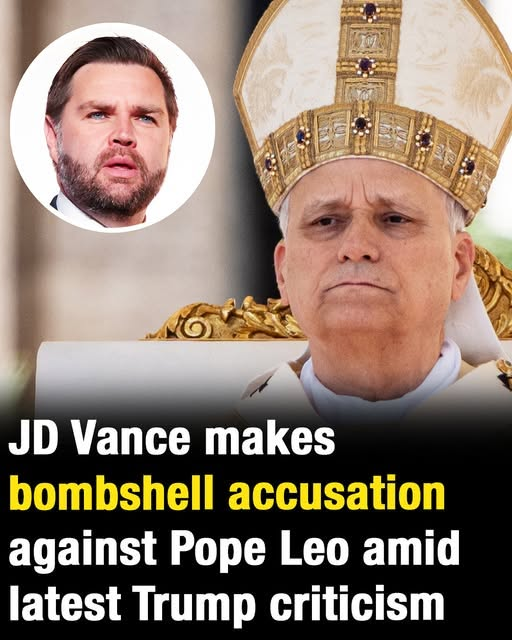
The tension between Washington and the Vatican has rarely felt more electric. When Vice President JD Vance delivered a pointed accusation against Pope Leo during a high-stakes international address, the world took notice in a way few political moments achieve. What began as a policy disagreement over humanitarian corridors, religious freedom, and the handling of the ongoing Iran crisis quickly escalated into something deeper — a public clash between political pragmatism and spiritual authority that has left global leaders, religious communities, and everyday believers bracing for potential fallout. The “unholy war” some are calling it may be dramatic language, but the underlying rift touches on questions of morality, power, and the proper role of faith in modern governance that have been simmering for years. Vance’s words didn’t just challenge a pope — they challenged centuries of carefully balanced influence between church and state.
The accusation itself was delivered with characteristic directness. Vance, speaking on behalf of the administration’s hardline stance on Iran, suggested that Pope Leo’s calls for restraint and diplomatic engagement were undermining efforts to protect innocent lives and maintain regional stability. He accused the Vatican of prioritizing abstract moralizing over the harsh realities of proxy wars, nuclear threats, and the suffering caused by delayed action. For many in the administration’s base, the comments represented long-overdue pushback against what they see as institutional naivety in the face of real evil. For others, including millions of Catholic faithful worldwide, the remarks crossed a dangerous line, appearing to attack the moral voice of one of the world’s oldest institutions during a time when spiritual guidance feels more necessary than ever.
Pope Leo’s response was measured but firm, emphasizing the Church’s long-standing commitment to peace, the protection of civilians, and the belief that military solutions alone cannot resolve deep-rooted conflicts. He reiterated calls for humanitarian access, renewed negotiations, and a focus on the human cost that often gets lost in strategic calculations. The Vatican has historically walked a delicate line in international affairs — offering moral clarity without direct political power. This latest exchange tested that balance, forcing both sides to defend their positions in the glare of global media attention. The result has been a wave of commentary from theologians, diplomats, and ordinary citizens trying to make sense of where politics ends and faith begins.
The timing couldn’t be more charged. The Iran conflict has already claimed thousands of lives, displaced communities, and threatened global energy supplies. Religious leaders have traditionally played important roles in such crises, advocating for ceasefires, protecting holy sites, and reminding warring parties of their shared humanity. Vance’s accusation challenged that role directly, suggesting that spiritual institutions should step back when security decisions are being made. This perspective resonates with those who believe faith should inspire personal morality but not shape national policy. Others argue that removing moral voices from the conversation leaves decisions driven purely by power and self-interest, increasing the risk of unnecessary suffering.
The global reaction has been deeply divided. In the United States, conservative voices largely supported Vance’s stance, seeing it as a defense of strength and realism against what they view as idealistic posturing. Progressive and religious communities expressed concern that politicizing the papacy further erodes trust in institutions and deepens societal divisions. Internationally, European allies found themselves caught between their close relationship with Washington and their respect for the Vatican’s moral authority. Many world leaders issued careful statements calling for unity and de-escalation, recognizing that open conflict between two influential Western powers only benefits adversaries seeking to exploit divisions.
Beyond the immediate political drama, this clash touches on deeper philosophical questions about the role of religion in public life. For centuries, the Vatican has served as a moral compass for billions, offering guidance on issues ranging from poverty to war to human dignity. In an increasingly secular world, some see that influence as outdated or intrusive. Others argue that removing spiritual perspectives leaves societies without a shared ethical framework, making it easier to justify actions that prioritize power over people. Vance’s comments forced this tension into the open, making it impossible to ignore the growing friction between modern governance and ancient institutions of faith.
For ordinary believers, the exchange has been particularly unsettling. Many Catholics find themselves caught between loyalty to their faith and support for strong national leadership. The idea of a public rift between the White House and the Vatican feels uncomfortable, even to those who may disagree with specific papal statements. At the same time, it has prompted deeper reflection about what moral leadership should look like in times of crisis. Should spiritual authorities speak truth to power even when it complicates political strategy? Or should they remain above the fray to preserve unity? There are no easy answers, and the debate itself may be as important as any resolution.
Looking ahead, the hope remains that this public confrontation leads to constructive dialogue rather than lasting damage. Both the United States and the Vatican have historically found ways to work together despite differences, recognizing that shared values around human dignity and peace often outweigh policy disagreements. The current crisis involving Iran provides an opportunity for both sides to demonstrate maturity — maintaining firm positions while keeping channels of communication open. The world needs strong leadership and moral guidance, not an either-or choice between the two.
As the story continues to develop, it serves as a powerful reminder of the complex interplay between faith, politics, and global security. JD Vance’s accusation against Pope Leo may have been shocking in its directness, but it also forced important conversations that had been lingering beneath the surface for years. Whether one agrees with the substance or the tone, the willingness to engage difficult questions openly is part of what keeps democracies and institutions healthy. In the end, the “unholy war” some fear may ultimately lead to greater understanding if both sides approach the moment with wisdom, respect, and a shared commitment to reducing human suffering.
The coming weeks will test the resilience of long-standing relationships and the ability of leaders to navigate disagreement without destroying cooperation. For now, the world watches and waits, hoping that the tension between the White House and the Vatican becomes a catalyst for better solutions rather than deeper division. In times of international crisis, the voices of both political strength and spiritual compassion are needed — perhaps now more than ever. How we balance them may define not just this moment, but the kind of world we leave for future generations.
Most Popular!
-
 Donald Trump Releases Shocking Health Report but Critics Point to Hidden Details and Missing Data That Could Change Everything
-
Chilling Reports of US and Iran War Send Global Markets into Total Chaos as Truth Behind Downed Fighter Jet Finally Revealed
-
The Truth About What Happens to Your Body When You Eat Walnuts Every Day, According to Top Medical Experts
-
Brandi Passante Sends Internet Into Total Meltdown After Stunning New Beach Photos Go Viral Across Social Media
-
Where Are They Now: The Heartstopping True Story of Britain’s Youngest Parents Who Shocked the Nation at Fourteen Years Old
-
Why You Are Waking Up at One AM Every Night and the Shocking Spiritual Warning Your Body Is Trying to Send You Before It Is Too Late
-
Unprecedented Global Showdown as Trump Unleashes Chilling Two-Word Attack on Pope Leo Amid International Crisis
-
The Untold Truth: Eliza’s Mother Finally Breaks 15-Year Silence With Heartbreaking Confession That Changes Everything