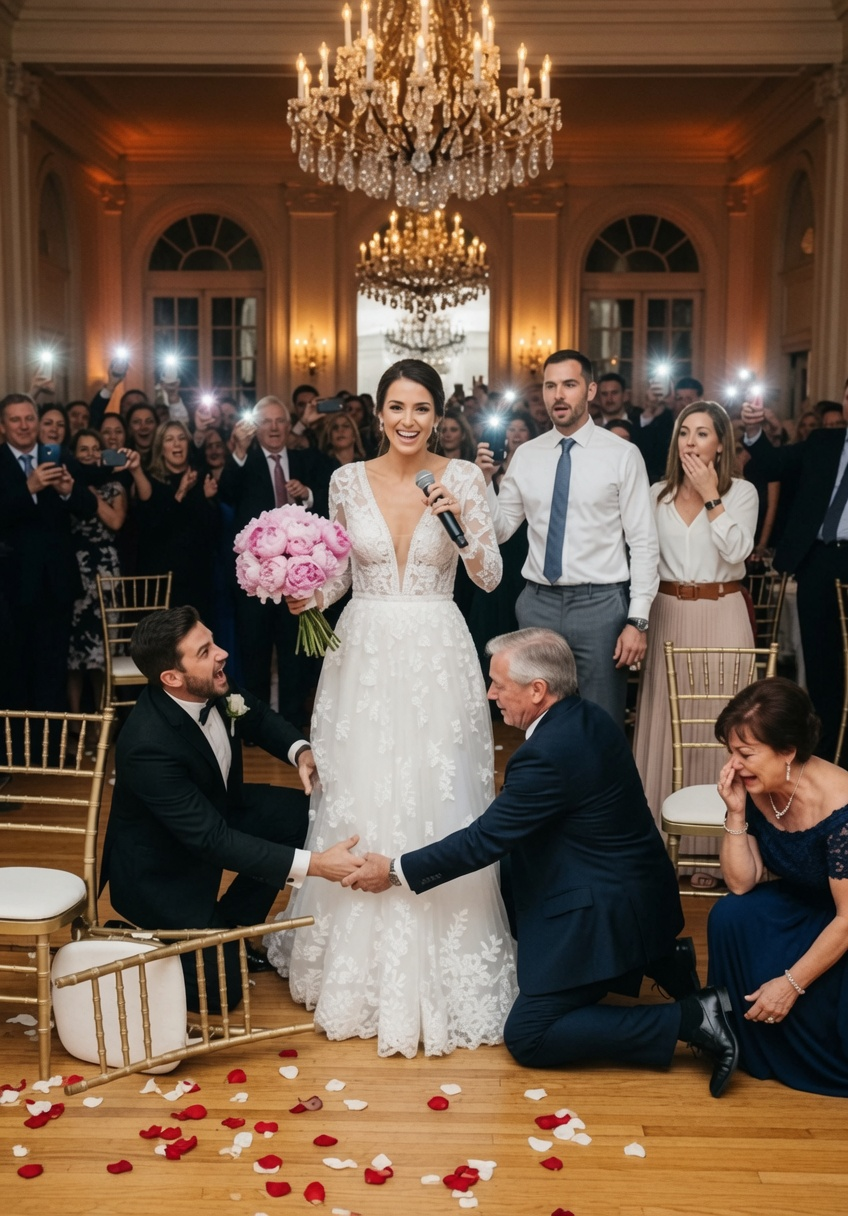
The string quartet had just finished playing as I stood at the entrance of the beautiful garden venue, my heart full of nervous excitement in my custom lace gown. Two hundred guests turned to watch me walk down the aisle toward the man I thought I would spend forever with. But before I could take the first step, my future mother-in-law, Diane, grabbed the microphone from the officiant with a smile that didn’t reach her eyes. What followed wasn’t a warm welcome or a toast to the couple. It was a calculated, public takedown of my parents — their modest jobs, their “simple” background, and how they had “lucked out” that their daughter was marrying into real money. The silence that fell over the crowd was deafening. In that moment, everything I had ignored about my fiancé’s family came rushing to the surface. I walked to the front, took the microphone from her trembling hand, and said the words that changed the course of my life forever.
Mark and I had been together for four years. He was charming, successful, and seemed genuinely different from the entitled world he came from. His mother, however, had always made her disapproval of me clear in subtle ways — backhanded compliments about my style, questions about my parents’ education, and constant reminders of how “fortunate” I was to be joining their family. I brushed it off as class differences and focused on the love I felt for Mark. We planned a beautiful wedding that blended both our worlds, with my hardworking parents contributing what they could with pride. I wanted the day to celebrate unity, not division. I had no idea Diane had been waiting for the perfect stage to remind everyone exactly where she thought I belonged.
The humiliation unfolded in excruciating detail. Diane spoke about how my father’s job as a mechanic and my mother’s work at a local bakery were “quaint,” how they must feel overwhelmed by the “real standards” of the Harrison family, and how lucky they were that their daughter had “climbed so high.” My parents sat frozen in the front row, my mother’s eyes filling with tears while my father stared at the ground in shame. Guests shifted uncomfortably. Mark stood beside the officiant, looking pale but saying nothing to defend us. In that moment, watching the people who had sacrificed everything for me be publicly shamed on what was supposed to be the happiest day of my life, something inside me snapped. I had spent years smoothing things over, making excuses, and hoping love would bridge the gap. I was done.
I walked down the aisle alone, took the microphone from Diane’s hand, and looked out at the stunned crowd. My voice was steady despite the storm inside me. I thanked everyone for coming, acknowledged the love between Mark and me, but then spoke the truth that had been ignored for too long. I spoke about respect, about how family isn’t about money or status but about kindness and dignity. I looked directly at Diane and told her that humiliating my parents on my wedding day showed exactly why I could never fully join a family that valued appearances over humanity. I turned to Mark and said that if he couldn’t stand up for me and my family now, he never would. Then I thanked the guests again, apologized for the pain, and walked out of the garden with my parents on either side of me.
The aftermath was chaotic but liberating. Mark followed me, begging for another chance, promising he would set boundaries with his mother. But the damage was done. I saw clearly how he had always minimized his family’s behavior to keep the peace. I canceled the honeymoon, returned gifts where possible, and moved into a small apartment while figuring out my next steps. Friends and even some of Mark’s relatives reached out with support, admitting they had seen the warning signs but stayed silent. Diane tried to spin the story, but the truth spread quickly through our social circles. The wedding that was meant to unite families instead exposed the deep cracks that had always been there.
In the months that followed, I focused on healing and rebuilding. I reconnected with my parents in deeper ways, appreciating their quiet strength and the values they had instilled in me. I advanced in my career with a new confidence, no longer carrying the weight of trying to prove myself to people who would never see my worth. Mark and I tried counseling, but the patterns were too ingrained. I realized I deserved a partner who chose me without hesitation, especially when it mattered most. The woman who once stayed quiet to keep the peace learned that speaking up wasn’t ruining everything — it was saving herself.
This painful experience taught me several profound lessons about boundaries, self-worth, and family. First, love should never require you to accept disrespect toward the people who raised you. Second, public humiliation on your wedding day is a clear sign of deeper issues that won’t magically disappear. Third, true family is built on mutual respect, not financial status or social climbing. And finally, the courage to walk away from toxicity, even on what should be the happiest day, opens doors to a life of genuine peace and authentic connections.
Today, I am happily remarried to a man who values my family as much as his own. My parents are thriving, surrounded by grandchildren who know the importance of kindness and dignity. Diane and Mark remain distant, a chapter I closed with no regrets. The garden that witnessed my wedding day disaster now hosts joyful family gatherings where everyone is celebrated equally. The bride who took the microphone and ended everything that day found something far better on the other side — freedom, self-respect, and the kind of love that lifts everyone up instead of tearing some down.
For anyone facing family tension, especially around major life events, know that you don’t have to stay silent to keep the peace. Your voice matters. Your parents’ dignity matters. And choosing respect over appearances is never the wrong decision. My wedding day didn’t end with “I do.” It ended with “I choose me.” And that choice became the foundation for the beautiful life I live now. The mother-in-law who tried to humiliate my family on my special day ultimately gave me the clarity I needed to build something real. Sometimes the most painful moments become the greatest turning points. I walked away from that garden with my head high and my parents’ hands in mine. Years later, I’m still grateful I did. The life on the other side was worth every tear and every difficult word spoken that day.
Most Popular!
-
 My Husband Trapped Me in a Frozen Cabin, Collected My Life Insurance, and Held My Funeral — Then I Walked Through the Church Doors Alive
-
She Expected a Simple Birthday Card on Her 50th Birthday — What Her Husband Revealed Instead Left Her in Tears
-
One Teenager Died With a Knife Wound to the Heart — Now a Verdict Has Left an Entire Nation Arguing About Justice
-
Your Electricity Bill Could Double This Summer Unless You Stop Making These Air Conditioner Mistakes
-
The Cop Who Crushed My Son’s Legs Laughed in the ER
-
My Brother Locked His Son Outside All Night as “Consequences” — Then His Wife Revealed the Cameras Hidden in the Boy’s Room
-
My Father-in-Law and His Eight Sons Brutalized My Pregnant Wife So Severely That We Lost Our Unborn Child
-
I Married a Lonely Old Woman for Her Money and a Place to Live — But After Her Funeral, Everything Changed