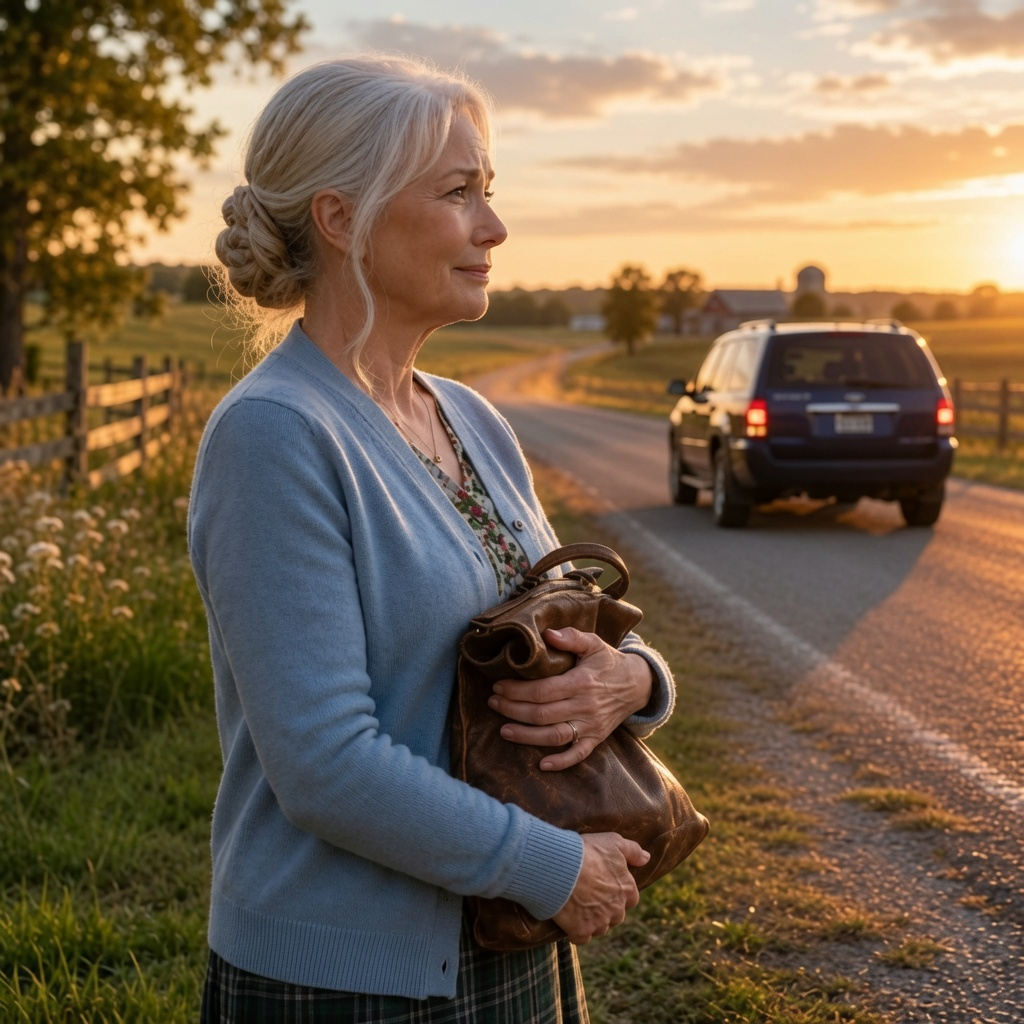
The gravel crunched under the tires as my son’s truck pulled away, leaving me standing alone on the side of a dusty country road with nothing but the clothes on my back and a small suitcase at my feet. I was 68 years old, a widow of just three weeks, and the man I had given birth to — the boy I had rocked to sleep, taught to ride a bike, and sacrificed for — had just abandoned me like I was nothing more than an inconvenience. The sun was setting behind the hills, painting the sky in soft oranges and pinks, but all I could feel was a cold numbness spreading through my chest. This wasn’t how family was supposed to work. This wasn’t the ending I had imagined after fifty years of marriage to the love of my life.
My husband Robert and I had built everything together. We started with almost nothing — a small farm, a modest house we renovated ourselves, and a little feed store that grew into a successful agricultural supply business serving three counties. We raised two children: our daughter Sarah, who moved to the city and built her own life, and our son Daniel, who stayed close but always seemed to want more than he was willing to earn. Robert used to say Daniel had “big ideas but small effort.” I defended him because that’s what mothers do. I believed that with time and guidance, he would grow into the responsible man we hoped he would be. I was wrong. And on that lonely dirt road, I finally understood just how wrong I had been.
The trouble started the moment Robert’s heart gave out one quiet Tuesday morning. He had been working in the garden, something he loved, when he simply sat down on the bench and never got back up. The funeral was beautiful — filled with friends, neighbors, and people whose lives our business had touched over the decades. Daniel stood beside me at the graveside, looking appropriately solemn. But the very next day, his mask slipped. He began talking about “what comes next” and how the house and business should be transferred quickly “to keep things running smoothly.” I told him we would handle everything properly through the lawyer, but he didn’t want to wait. He wanted control. Immediately.
What followed was a nightmare I never saw coming. Daniel changed the locks on the house while I was at the attorney’s office. He transferred business accounts into his name using documents I later discovered he had forged. He even told customers that I had decided to retire and move away. When I confronted him, he looked me in the eye and said, “Mom, you’re getting older. You don’t need all this stress. Let me handle it.” The entitlement in his voice chilled me to the bone. This wasn’t grief talking. This was a man who had been waiting for his father to die so he could finally take what he believed was his.
The breaking point came on a Friday afternoon. I returned from running errands to find a moving truck in the driveway and strangers carrying our furniture out the front door. Daniel stood on the porch with a smug expression, arms crossed. When I demanded to know what was happening, he simply said, “The house is mine now. Dad left it to me.” I knew that wasn’t true. Robert and I had updated our wills together just two years earlier, leaving everything in a trust that protected both children equally while ensuring I had lifetime rights to the house. But Daniel had other plans. He had convinced himself that as the only son who stayed local, he deserved it all.
When I refused to leave, he did the unthinkable. He had me escorted off the property by two men he had hired. They didn’t touch me, but the message was clear: I was no longer welcome in the home I had lived in for forty-eight years. As I stood on the side of the road watching his truck disappear into the distance, I felt something shift inside me. Not just sadness or anger, but a fierce determination. I had spent my entire adult life being the peacekeeper, the supporter, the one who smoothed things over. That version of myself died on that dirt road. A new version was born — one who would fight for what was rightfully hers.
What Daniel never knew — what he never bothered to ask about — was the plan Robert and I had put in place years earlier. While Daniel was busy dreaming about taking over, we had quietly transferred the business into a revocable living trust with strong protections. The house was similarly protected. More importantly, I had something Daniel knew nothing about: a separate investment account in my name only, built from years of careful saving and wise investments Robert had helped me make. That account, combined with the trust documents, gave me the power to take everything back.
The next morning, I met with my attorney. Within forty-eight hours, legal notices were delivered. The bank accounts Daniel had transferred were frozen. The moving company was ordered to return our belongings. And Daniel received a formal letter informing him that he had thirty days to vacate the property or face eviction proceedings. The look on his face when the sheriff delivered the papers must have been something to see. He called me that evening, furious and panicked. “Mom, what have you done? This is my house! Dad wanted me to have it!”
I listened quietly as he raged. When he finally paused for breath, I spoke with a calmness I hadn’t felt in weeks. “Daniel, your father wanted both his children to be taken care of. Not for one to take everything while the other gets nothing. You made your choice when you put me on the side of the road. Now I’m making mine.”
The legal battle was shorter than I expected. The trust documents were ironclad. The forged transfers were thrown out. Within three months, I was back in my home, the business was under proper management again, and Daniel was forced to find somewhere else to live. The relationship between us remains fractured. Some wounds run too deep to heal completely. But I sleep better at night knowing I protected what Robert and I had worked so hard to build — not just for myself, but for my daughter Sarah and for the grandchildren who deserve to inherit something more than debt and bitterness.
This experience taught me lessons I wish every parent would learn before it’s too late. First, never assume your children will do the right thing simply because they share your blood. Love should be unconditional, but financial inheritance should never be. Proper estate planning isn’t about distrust — it’s about protection. Second, never let anyone make you feel guilty for protecting what you’ve earned. Generosity is beautiful, but it should never come at the cost of your own security and dignity. Third, document everything. Have conversations in writing. Update wills regularly. Make your wishes crystal clear so there can be no room for manipulation when you’re gone.
Looking back, I realize that Daniel’s greed didn’t start the day Robert died. The seeds were planted years earlier — in the times I made excuses for his irresponsibility, in the moments I bailed him out financially instead of letting him face consequences, in the way I prioritized keeping peace over teaching accountability. Parents want to believe the best about their children. But sometimes that belief blinds us to the truth. Love doesn’t mean enabling. It means preparing them for life by allowing them to experience its natural lessons.
Today, my house feels like mine again. The garden Robert and I planted together is blooming. The business is stable and serving the community that supported us for decades. Sarah visits often with her family, and we’ve grown closer than ever. We talk openly about money, about boundaries, and about the importance of planning ahead. The grandchildren are learning that hard work and honesty matter more than entitlement.
As for Daniel, he eventually moved to another state. We exchange polite texts on holidays, but the warmth is gone. Some relationships cannot be repaired once trust has been completely shattered. I’ve made peace with that. Not every story needs a perfect ending. Some simply need an honest one.
If you’re a parent reading this, please take this story to heart. Have the difficult conversations now. Update your estate plans. Teach your children responsibility rather than entitlement. Show them through your actions that love includes boundaries and accountability. Don’t wait until you’re gone for them to learn these lessons the hard way.
And if you’re an adult child who recognizes yourself in Daniel’s behavior, I urge you to pause and reflect. The legacy you leave isn’t measured by how much you inherit. It’s measured by how you treat the people who gave you life. Greed might feel good in the moment, but it leaves you poorer in every way that truly matters.
Standing on that dirt road that day, watching my son drive away, I felt abandoned and betrayed. But I also felt something else — a quiet strength rising from deep within. I realized I wasn’t just fighting for my house or my business. I was fighting for the dignity Robert and I had earned together. For the right to grow old in the home we built. For the peace of knowing I had protected what mattered most.
That fight changed me. It made me stronger, wiser, and more determined to live the rest of my life on my own terms. The dirt road wasn’t the end of my story. It was the beginning of a new chapter — one written with courage, clarity, and the deep satisfaction that comes from refusing to let anyone take what you’ve rightfully earned.
If you’re facing your own family struggles, remember this: you are allowed to protect yourself. You are allowed to say no. You are allowed to choose peace over pretense. And sometimes, the greatest act of love you can offer your children is teaching them that actions have consequences — even when those actions come from your own flesh and blood.
I stood on that dirt road and chose myself. And I’ve never regretted it for a single day since.
Most Popular!
-
 Eggs, Cholesterol, and Timing: What Actually Matters for Most People
-
When a Partner Leaves With More Than a Suitcase: Protecting Yourself From Financial Betrayal
-
When Financial Support Meets Contempt: Recognizing Exploitation Inside a Marriage
-
Why Some Sensory Toys and Household “Hacks” Do Not Belong in the Microwave
-
When Grief Clouds Judgment: Misreading Silence and the Quiet Ways People Show Care
-
When One Partner Does All the Hosting: Recognizing Imbalance Before Resentment Takes Over
-
How Many Holes Are in a T-Shirt? What a Simple Puzzle Reveals About How We See
-
The Quiet Stories Inside Secondhand Objects: When a Thrift-Store Find Carries Someone Else’s History