It was a cold Tuesday morning in early November when I heard the heavy rumble of engines outside our apartment building. I had been awake since 5 a.m., trying to figure out how to stretch the last $47 in my checking account until my next paycheck on Friday. My four-year-old daughter Sofia was still asleep on the couch, wrapped in the blanket I had crocheted for her last winter. My seven-year-old son Michael was hiding behind my legs, clutching my pajama pants like he already knew something terrible was coming.
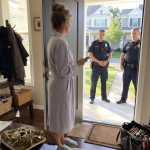
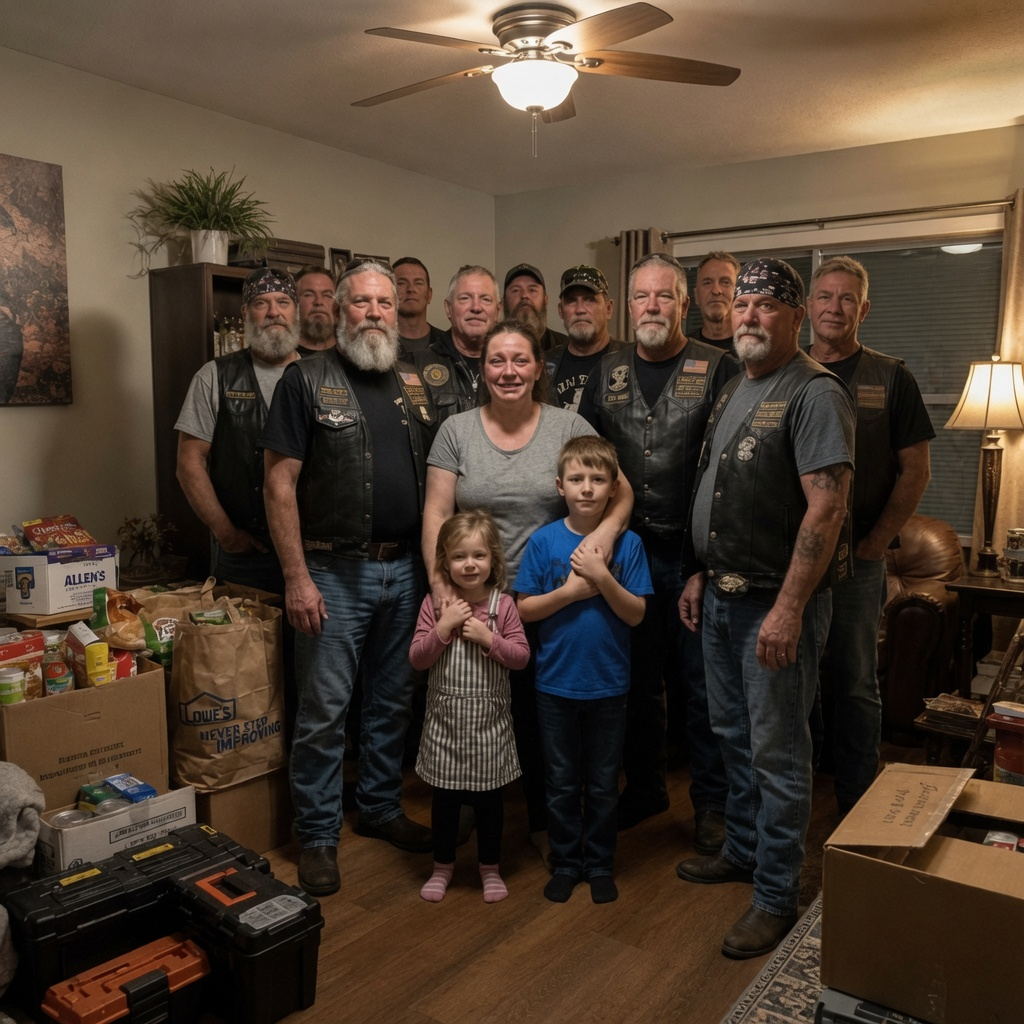
I opened the door just as my landlord Rick reached the top of the stairs, flanked by thirty men in leather vests. Their motorcycles filled the parking lot below like a scene from a movie I never wanted to live in. Rick looked almost smug, like he had finally won the long battle we had been fighting for months. “Time’s up, Rebecca,” he said flatly. “These gentlemen are here to make sure your things get moved to the curb. You’ve got ten minutes.”
Sofia woke up at the sound of his voice and started crying. Michael’s small fingernails dug into my leg through the thin fabric. I had known this day might come. After my husband’s death two years earlier from a training accident at Fort Bragg, the military survivor benefits had helped for a while, but medical bills, rising rent, and the cost of raising two children alone had slowly buried me. I had begged Rick for extensions, explained the situation, and promised half-payments until my new job at the hospital started. He had always said no with the same cold finality he showed now.
The lead biker stepped forward. His vest read “Marcus” and “President.” He was massive, probably 6’4”, with a gray beard that reached his chest and arms covered in tattoos that told stories I could only guess at. “Ma’am,” he said in a surprisingly gentle voice, “we need you to step aside. We’ve got a job to do.”
Before I could respond, Michael broke away from me and ran straight to Marcus. He wrapped his tiny arms around the biker’s leg and looked up with tears streaming down his face. “Please don’t take our home! My daddy’s gone, and my mommy tries so hard! Please!”
The entire group went still. Marcus looked down at my son, then past me into the living room. His expression changed instantly. He stepped inside without asking permission, and the other bikers followed. Rick started shouting from the hallway, but no one paid him any attention.
They were all staring at the wall.
It wasn’t fancy. Just a simple memorial I had created in the corner of our small living room. Photos of my husband in uniform, smiling proudly at basic training, then later holding Michael as a baby. Crayon drawings from the kids that said “Daddy is my hero” and “We miss you every day.” A folded American flag in a triangular case. A few medals and a photo of him with his unit during deployment. It was the only space in our home that still felt sacred, where I let myself cry when the kids were asleep and where I told them stories about the father they barely remembered.
Marcus walked closer and studied the photos carefully. One by one, the other bikers gathered around him. Their hard expressions softened. Several had tears in their eyes. These were men who had probably seen and done things most people couldn’t imagine, yet they stood quietly in my living room, honoring a fallen brother they had never met.
Rick pushed his way inside, annoyed. “What’s the problem? Let’s get this done.”
Marcus turned to him slowly. “You see that wall?”
Rick glanced at it dismissively. “Yeah. Pictures. So what?”
Marcus pointed to one of the photos of my husband in full dress uniform. “That man served. These kids lost their father serving this country. And you brought us here to throw their things on the curb like trash?”
The room went completely silent. Rick tried to argue about contracts and money owed, but his voice sounded smaller now. Marcus didn’t raise his voice or threaten him. He simply said they would not be moving anything that day. Then he looked at me and asked if we had somewhere safe to go.
I shook my head. The truth was we had nowhere. My family lived across the country, and most of our friends had slowly drifted away after my husband’s death as grief made me withdraw from the world.
What happened next still feels like a miracle.
Marcus and his brothers didn’t just refuse the eviction. They decided to help. One of them made phone calls while another went downstairs and returned with coffee and donuts for the kids. Within an hour, they had arranged temporary housing through a veterans’ support network they were connected to. They loaded our belongings carefully into their trucks — not to throw them away, but to move them to a safe storage unit they paid for themselves. They worked efficiently but gently, treating our things with respect.
Before they left, Marcus pulled me aside. He told me his own brother had come home from deployment changed and eventually took his own life. He said no veteran’s family should end up on the street because of hard times. Then he handed me a card with a number on it and told me to call if we needed anything — ever. No strings attached.
In the weeks that followed, the bikers didn’t disappear. They checked in regularly. They helped Michael with his homework one afternoon when I had to work late. They brought groceries when money was tight and quietly covered part of our first month’s rent at the new place. Most importantly, they treated my children with the same respect they would give any veteran’s kids. Michael started smiling again. Sofia stopped having nightmares about losing our home. The fear that had lived in our house for months slowly began to fade.
Rick eventually apologized, though it felt hollow. The real change came from the men who had shown up ready to evict us and instead chose to see the human beings behind the debt. They saw a wall full of love and loss, and they decided that mattered more than a paycheck.
I still keep one of the drawings Michael made that morning. It shows a big biker with a beard standing next to our family, with the words “Thank you for not taking our home” written across the top in bright crayon. Every time I look at it, I remember how close we came to losing everything — and how a group of strangers chose compassion instead of cruelty.
That day taught me something I carry with me now. People can surprise you when they’re given the chance to see the full picture. Sometimes the toughest-looking individuals have the softest hearts, especially when they recognize pain they’ve seen before. And sometimes the smallest voice in the room — a seven-year-old boy hugging a stranger’s leg — can change the entire outcome.
We’re in a better place now. Not perfect, but stable. Michael talks about becoming a firefighter one day, like the “biker heroes” who helped us. Sofia still asks about “the big guys with the vests” sometimes, and I tell her they were angels who showed up wearing leather instead of wings.
I don’t know what would have happened if Marcus and his brothers hadn’t looked past the eviction notice and seen the wall. I only know that one moment of hesitation, one decision to look closer, gave us a second chance we desperately needed. And for that, I will always be grateful.
The experience also taught me about assumptions. I had been terrified of the bikers when I first saw them climbing the stairs. I assumed the worst because of how they looked. They could have assumed the worst about us — a single mother behind on rent, kids crying, a messy apartment. Instead, they chose to see the humanity in our situation. That choice didn’t just save us that day. It restored something in all of us about the power of looking beyond appearances.
In the years since, I’ve tried to live with that same openness. I’ve become more willing to give people the benefit of the doubt. I’ve learned that behind every tough exterior there’s often a story of service, loss, or quiet sacrifice. And I’ve made it a point to teach my children that strength isn’t about how loud you are or how intimidating you look. It’s about showing up for people when they need it most, even when it would be easier to walk away.
Our story spread quietly through the community. Other veterans’ families reached out. Local organizations started partnering with motorcycle clubs for support initiatives. What began as a terrifying eviction attempt became the catalyst for something much bigger — a reminder that community can look very different than we expect, and that sometimes the people we fear the most end up being the ones who save us.
Michael still has the small biker vest Marcus gave him as a gift. He wears it proudly when we attend veteran events. Sofia keeps a photo of all of us with the group on her nightstand. And I keep a small American flag on my desk at work, right next to the drawing from that morning. These objects aren’t just reminders of what happened. They’re proof that kindness can show up in the most unexpected forms, wearing leather and riding motorcycles, ready to stand between a family and the world when it matters most.
If you’re facing your own impossible situation right now, please remember this: help can come from places you never imagined. Sometimes it arrives on two wheels with tattoos and loud engines. Sometimes it comes in the form of a child’s desperate hug that changes hardened hearts in an instant. And sometimes, the people the world tells you to fear end up being the very ones who restore your faith in humanity.
Our lives were changed forever that day — not because we avoided hardship, but because we discovered that hardship doesn’t have the final word when good people choose to show up. The bikers didn’t just refuse to evict us. They reminded us that we weren’t alone. And in a world that can feel incredibly isolating, that reminder was worth more than any amount of money or stability ever could be.
Thank you, Marcus. Thank you to every brother who stood with us that day. Your kindness didn’t just save our home. It saved our hope. And we will never forget it.
Most Popular!
-
 Eggs, Cholesterol, and Timing: What Actually Matters for Most People
-
When a Partner Leaves With More Than a Suitcase: Protecting Yourself From Financial Betrayal
-
When Financial Support Meets Contempt: Recognizing Exploitation Inside a Marriage
-
Why Some Sensory Toys and Household “Hacks” Do Not Belong in the Microwave
-
When Grief Clouds Judgment: Misreading Silence and the Quiet Ways People Show Care
-
When One Partner Does All the Hosting: Recognizing Imbalance Before Resentment Takes Over
-
How Many Holes Are in a T-Shirt? What a Simple Puzzle Reveals About How We See
-
The Quiet Stories Inside Secondhand Objects: When a Thrift-Store Find Carries Someone Else’s History