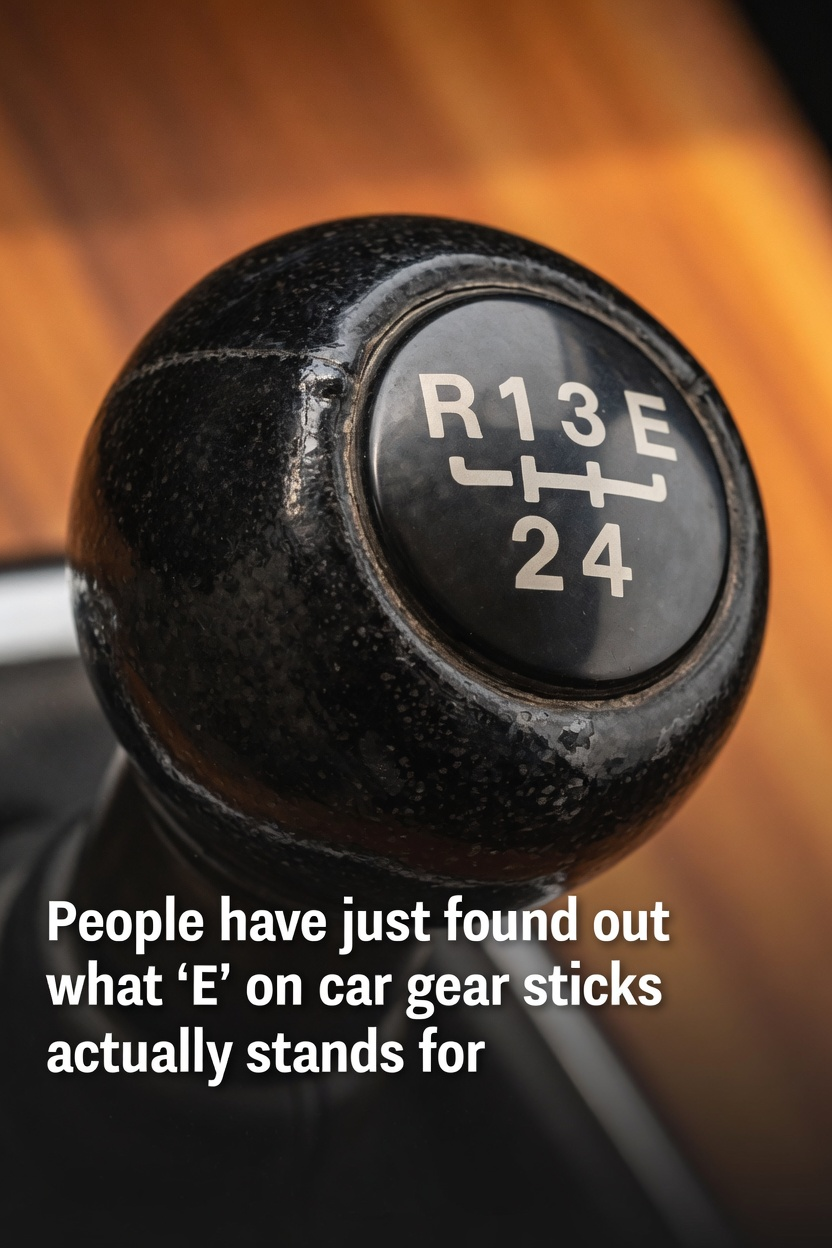
If you’ve ever looked down at your automatic gear selector and noticed an “E” position, you’re not alone in wondering what it actually does. Many drivers see it and assume it’s some kind of error mode or emergency setting. In reality, that little “E” is one of the smartest features in many automatic transmissions, especially in European and some Asian cars. It stands for Economy mode, and understanding how it works can save you money at the pump while making your daily drive smoother and more efficient.
The “E” mode first became popular in the late 1980s and 1990s as car manufacturers started focusing more seriously on fuel economy. Instead of always shifting at higher RPMs for maximum power, the transmission in Economy mode holds gears longer and shifts up earlier. This keeps the engine running at lower revolutions, reducing fuel consumption significantly during highway driving and stop-and-go traffic. It’s like telling your car to relax and cruise instead of constantly sprinting.
Many people are surprised to learn that the E setting doesn’t limit your car’s power. You can still accelerate normally when you need to. The system simply changes the shift points and throttle response to prioritize efficiency over sportiness. For example, in a BMW, Mercedes, or certain Toyota and Honda models, switching to E can improve fuel economy by 10-20% depending on your driving style and conditions. That adds up quickly over thousands of miles.
One of the biggest benefits of using Economy mode is how gentle it feels on the engine and transmission. By reducing harsh shifts and keeping RPMs lower, it creates less wear over time. This can lead to fewer trips to the mechanic and a longer lifespan for your vehicle. For daily commuters who spend hours on the highway, it makes a noticeable difference in both comfort and running costs.
However, there are situations where you shouldn’t use the E setting. When driving in heavy traffic, going up steep hills, or needing quick acceleration for merging or passing, Sport mode (often marked as “S”) or manual shifting gives you better response. Many drivers make the mistake of leaving their car in Economy mode all the time and then complain that the car feels sluggish. The key is learning when to use each mode.
Modern cars have made this even smarter. Many newer vehicles with “E” or Eco modes also adjust other systems like air conditioning, throttle sensitivity, and even transmission behavior automatically. Some hybrid and electric vehicles use similar settings to maximize range. The technology has evolved, but the core idea remains the same: give drivers control over how their car balances performance and efficiency.
If your car has an “E” on the gear selector, try using it on your next long drive. Pay attention to your fuel gauge and how the car behaves. Most people notice they don’t have to visit the gas station as often. It’s a simple change that requires no extra cost or special equipment — just a better understanding of what your car is capable of.
The “E” setting is also a great reminder of how far automotive technology has come. What used to be a purely mechanical decision is now managed by sophisticated computers that constantly monitor driving conditions. Manufacturers added this feature because they knew drivers wanted both performance and efficiency without having to think too much about it.
For new drivers or people who recently bought a used car with unfamiliar features, discovering the “E” mode can feel like unlocking a hidden level. Take time to read your owner’s manual — it usually explains exactly how the mode works in your specific model. Once you understand it, you’ll feel more in control behind the wheel.
In today’s world of rising fuel prices and environmental concerns, small features like Economy mode matter more than ever. They show how thoughtful engineering can make a real difference in our daily lives. The next time you see that “E” on your gear stick, don’t ignore it. Give it a try and see how much smoother and more efficient your drive can become.
Understanding little details like this turns you from just a driver into a more informed car owner. Your vehicle has more intelligence built into it than most people realize. The “E” is just one example of how manufacturers have tried to make our lives easier and our commutes more economical. Give it a chance on your next drive — your wallet and your engine will thank you.
Most Popular!
-
 Eggs, Cholesterol, and Timing: What Actually Matters for Most People
-
When a Partner Leaves With More Than a Suitcase: Protecting Yourself From Financial Betrayal
-
When Financial Support Meets Contempt: Recognizing Exploitation Inside a Marriage
-
Why Some Sensory Toys and Household “Hacks” Do Not Belong in the Microwave
-
When Grief Clouds Judgment: Misreading Silence and the Quiet Ways People Show Care
-
When One Partner Does All the Hosting: Recognizing Imbalance Before Resentment Takes Over
-
How Many Holes Are in a T-Shirt? What a Simple Puzzle Reveals About How We See
-
The Quiet Stories Inside Secondhand Objects: When a Thrift-Store Find Carries Someone Else’s History