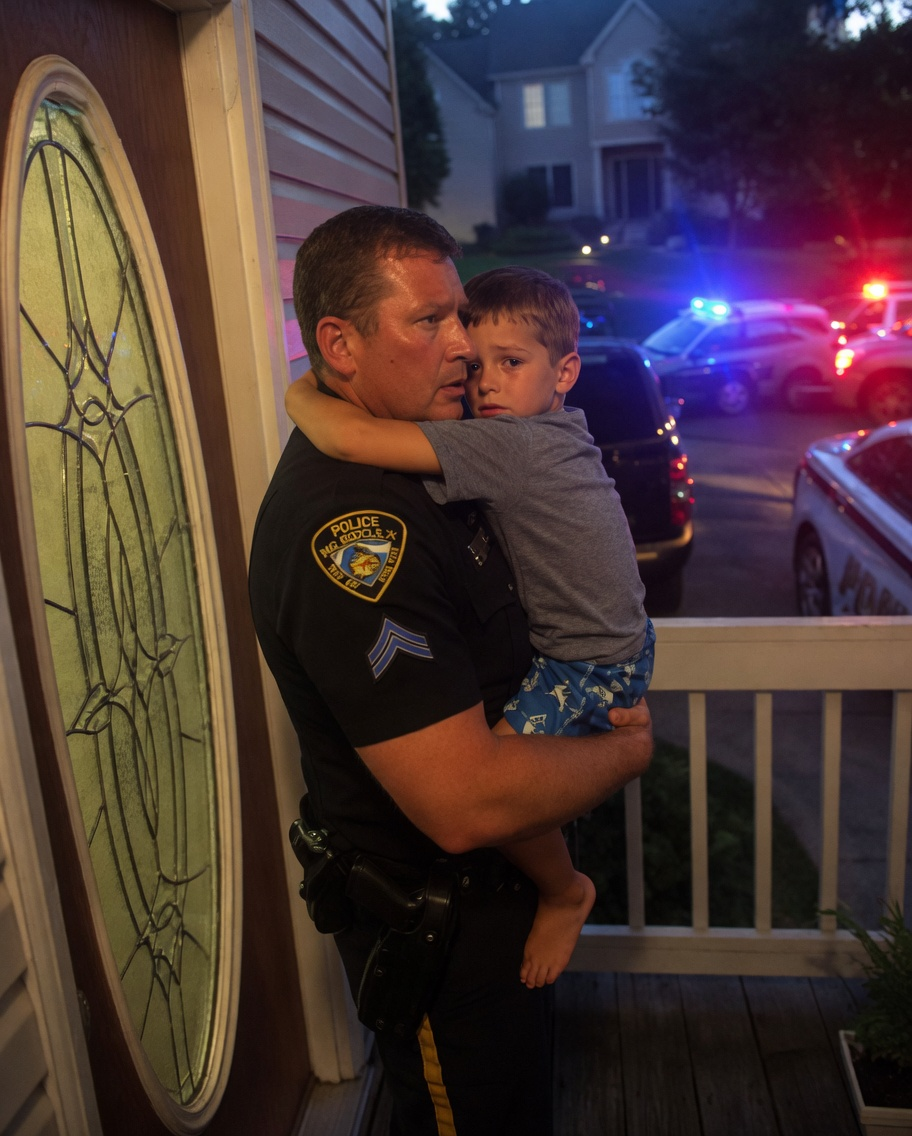
Exhaustion clung to me like a second skin as I pulled into the driveway after a brutal 14-hour shift in the ER. All I wanted was to hug my babies, take a hot shower, and collapse into bed. Instead, the flashing blue and red lights in front of my house made my stomach drop. A police officer stood on my porch holding my two-year-old son, who was sobbing uncontrollably. My legs nearly gave out as I ran toward them, mind racing with every worst-case scenario a mother can imagine.
“Ma’am, are you the mother?” the officer asked, his voice steady but serious. My son reached for me immediately, burying his tear-streaked face in my neck. The officer explained that a neighbor had called after hearing screaming from inside the house. When they arrived, they found my toddler alone in the living room, terrified and covered in bruises that weren’t there when I left for work. My 16-year-old daughter, Mia, was nowhere to be found.
I felt like the ground had been ripped out from under me. Mia had always been my reliable helper — the responsible big sister who watched her little brother while I worked nights. She had been through so much since her father left us five years ago, but she never complained. She got good grades, helped around the house, and promised me she understood why I had to work so much. How could this have happened? Where was she?
The next few hours were a blur of police questions, frantic phone calls, and holding my terrified toddler while trying to stay strong. Mia finally came home just before midnight, looking disheveled and defensive. When the officers asked where she had been, she gave vague answers about “hanging out with friends.” But something in her eyes — a coldness I had never seen before — made my blood run cold. The bruises on my son’s arms told a story she wasn’t ready to admit.
What followed was a nightmare I still struggle to process. After hours of questioning and a thorough investigation, the truth emerged in pieces that completely shattered the image I had of my daughter. Mia wasn’t just skipping responsibilities. She had been secretly resenting the responsibility of watching her brother. In her anger and rebellion, she had been physically rough with him when I wasn’t home — shaking him when he cried, leaving him alone for hours while she snuck out, and in some cases, hurting him out of frustration. The police found evidence on her phone — messages to friends complaining about being “stuck with the brat” and videos she had taken of my son crying that made my stomach turn.
The girl I had raised, the one I thought I knew better than anyone, had become someone I didn’t recognize. Years of unspoken resentment, the pressure of being the oldest, and the pain of her father’s abandonment had twisted into something dark and dangerous. She wasn’t just a stressed teenager. She had become a threat to her own brother.
The days that followed were some of the hardest of my life. Child protective services got involved. Mia was placed in a juvenile program while we sorted through the legal and emotional wreckage. I had to face the guilt of not seeing the signs sooner — the mood swings I had dismissed as teenage hormones, the times my son seemed afraid when she was around, the way she avoided being alone with him. I had been so focused on keeping our family afloat financially that I missed the storm brewing right under my roof.
But through the pain came a painful clarity. I realized I had been carrying too much alone for too long. I had tried to be everything — provider, mother, father, protector — and in doing so, I had left my children vulnerable in ways I never intended. The system that was supposed to support single mothers had failed us both. Mia needed help I couldn’t give her while working 60-hour weeks. My son needed safety I thought I was providing but clearly wasn’t.
Today, we’re all in therapy. Mia is getting the mental health support she desperately needs, and I’m learning to set boundaries and ask for help instead of trying to do it all myself. My son is healing, slowly but surely, surrounded by love and stability. We’re rebuilding as a family, not pretending the past didn’t happen, but choosing to move forward with honesty and professional support.
This nightmare taught me lessons I wish every parent knew. Never assume your teenager is okay just because they seem fine on the surface. Check in regularly, not just with words but with actions. Watch for changes in behavior, especially around younger siblings. And most importantly, don’t let pride or fear of judgment keep you from asking for help when you’re drowning. Single parenting is hard enough without carrying it all in silence.
If you’re a parent reading this and something feels off with your teenager — the withdrawal, the anger, the moments when they seem like a stranger — please don’t ignore it. Get them help. Talk to them. Watch them closely. The girl who once begged to hold her baby brother became someone who hurt him when no one was looking. But with intervention and love, we’re finding our way back to each other.
The police officer carrying my crying toddler that night didn’t just bring fear. He brought the truth I needed to see. And while the pain of that discovery nearly broke me, it also saved my son and gave my daughter a chance at real healing. Sometimes the worst moments force us to face what we’ve been avoiding — and in facing it, we find the strength to rebuild something better than before. Our family is different now. More honest. More supported. More aware. And for that painful awakening, I will always be grateful, even as I continue to heal from the night my world shattered in my own living room.
Most Popular!
-
 The Ultimate Wedding Revenge: When the Mother Who Abandoned Her Six Daughters Showed Up with Her Millionaire Boss, the Bride Opened a Box That Destroyed Lives Forever
-
The Beach Shaming Disaster: What My 8-Year-Old Said to the Prying Stranger Left Everyone Speechless
-
My Husband Abandoned Me With Twin Babies for a Luxury Fishing Trip — When He Returned, I Had Already Packed His Bags
-
The Three-Dollar Miracle: How a Dust-Covered Vase Revealed a Heartbreaking Decades-Old Secret
-
The $80,000 Battle to Erase a Birthmark: Why One Mother Risked Everything for Her Daughter’s Future
-
The Silent Thief: Why Millions of Men Are Living with a Time Bomb They Can’t See
-
The Final Curtain Falls: Beloved Sanford and Son Legend Hal Williams Gone at 91
-
Found at a Yard Sale: This “Useless” Vintage Contraption Is Actually a Forgotten Piece of Human History