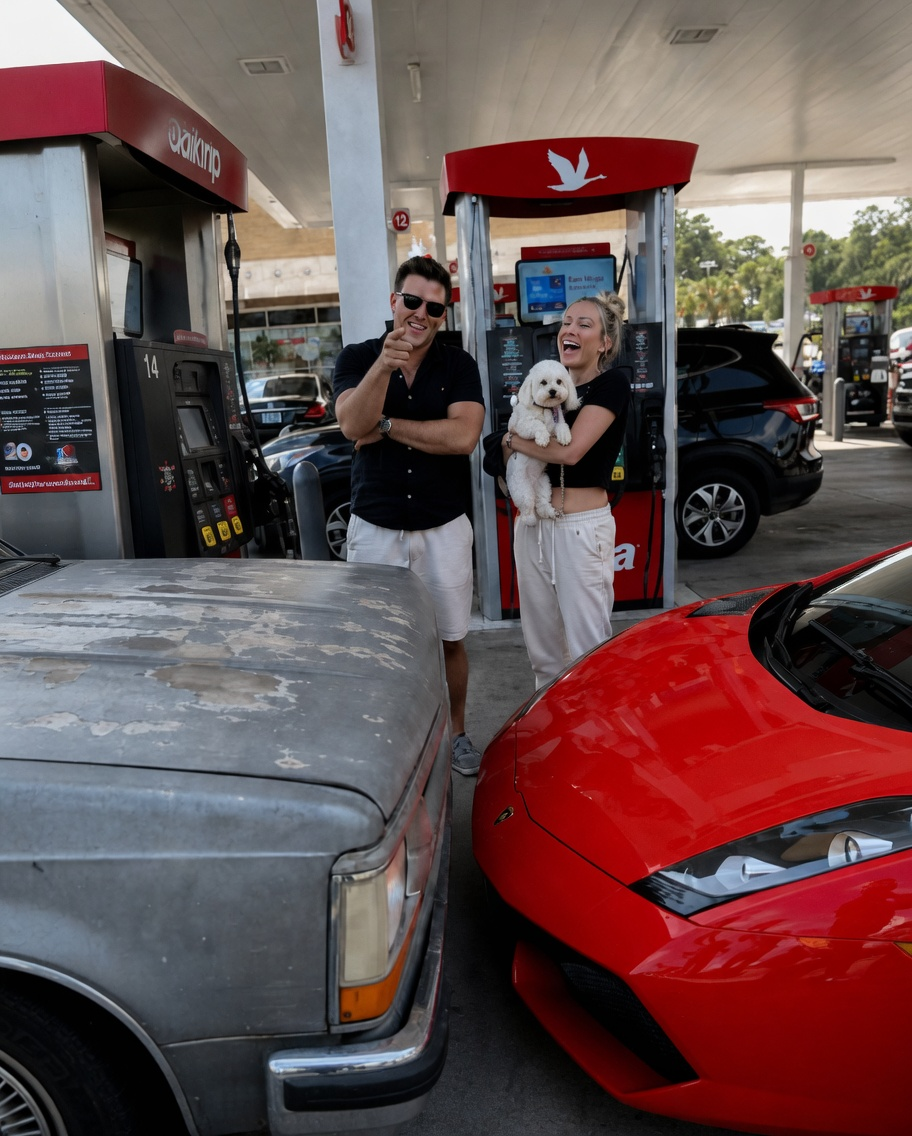
The gas station was busy that humid Friday evening. Luxury cars gleamed under the lights while everyday drivers filled up and hurried home. Then the sleek black Lamborghini pulled in, engine roaring like it owned the place. The driver, a sharply dressed man in his early forties named Victor Lang, stepped out with the confidence of someone who had never been told no. He glanced at the old, rusted pickup truck next to him and smirked. The man pumping gas into the truck looked exhausted — mid-fifties, worn clothes, eyes heavy with something deeper than tiredness. Victor couldn’t resist. “Nice ride,” he said loudly, loud enough for others to hear. “Bet it gets great mileage… for a museum piece.” The jab drew chuckles from a few onlookers. What Victor didn’t know was that this ordinary-looking father was carrying a hidden cargo that would turn the arrogant billionaire’s world upside down in the most heartbreaking way possible.
The father’s name was Thomas Reilly. He had just driven six hours straight from the hospital where his wife of thirty-two years had passed away that morning. Cancer had taken her quickly in the end. Thomas was bringing her favorite things home one last time — her worn quilt, her gardening tools, and most importantly, the small wooden box she had asked him to keep safe. Inside that box were letters she had written to their children over the years, a lock of hair from each of their babies, and the simple gold wedding band she had worn every day since their wedding. Thomas wasn’t in the mood for jokes. He was barely holding himself together.
When Victor’s mocking continued — “You know, some of us actually made it in life” — Thomas finally turned. His voice was quiet but steady. “My wife died this morning. I’m bringing her things home so our kids can say goodbye. I don’t have time for whatever this is.” The gas station fell silent. Victor’s smirk faltered for a second, but his ego quickly recovered. “That’s a nice story. Doesn’t change the fact that some people just stay stuck.” He turned to walk away, feeling satisfied with his dominance.
That’s when the wooden box slipped from Thomas’s tired hands and hit the pavement. The lid cracked open. Letters, photographs, and the gold ring spilled out. Victor froze. One of the photos was of a much younger Thomas and his wife on their wedding day — smiling, hopeful, full of life. Another showed their children as babies. A third was a recent hospital photo of his wife, thin but still smiling, holding Thomas’s hand. Victor stared at the images, the color draining from his face. The man he had mocked wasn’t just some poor stranger. He was a grieving husband doing the hardest thing a person can do — bringing his wife’s memory home to their children.
Victor stood there, Lamborghini keys in hand, suddenly looking small. The gas station attendant, who had watched the whole exchange, quietly said, “Sir, I think you owe this man an apology.” Victor didn’t argue. He knelt down, helped gather the scattered letters and photos, and handed them back to Thomas with shaking hands. Then he did something no one expected. He apologized. Not the polished, “sorry you feel that way” kind. A real, broken apology that came with tears he couldn’t hold back. “I’m sorry,” he whispered. “I’ve been so caught up in my own success that I forgot what it means to be human. Your wife… I’m so sorry for your loss.”
Thomas accepted the apology with quiet dignity. The two men stood there for a moment — one in a tailored suit next to a six-figure sports car, the other in work clothes next to a rusted pickup — connected by something deeper than money or status. Victor offered to pay for Thomas’s gas and even helped load the rest of his wife’s belongings into the truck. Before Thomas drove away, Victor handed him a business card. “If you or your kids ever need anything — anything at all — please call me. No strings. Just… let me try to be better.”
That night, Victor sat in his empty mansion and cried for the first time in years. The encounter forced him to look at his life — the expensive cars, the trophy relationships, the constant need to prove he was better than everyone else. He started making changes. He reached out to estranged family members. He began volunteering at a local hospice. He sold several of his flashy cars and donated the money to cancer research in Thomas’s wife’s name. The man who had mocked a grieving father became someone who showed up for others in their hardest moments.
Thomas and his children received the help Victor offered — not out of pity, but out of genuine friendship. The billionaire and the grieving widower stayed in touch, forming an unlikely bond that taught both of them what really matters in life.
This powerful gas station confrontation taught everyone who heard the story several important lessons:
- Never judge someone based on the car they drive or the clothes they wear.
- Grief doesn’t care about your bank account — it touches everyone.
- The most expensive things in life often cost nothing at all.
- Real change begins the moment you choose humility over ego.
- Sometimes the person you mock the most is the one who teaches you the most.
Victor still drives nice cars, but none of them are flashy anymore. He visits Thomas regularly, helps with the kids, and has become the kind of man who shows up when it matters. Thomas and his family are healing, supported by a friend they never expected to find at a gas pump on one of the worst days of their lives.
The wealthy sports car owner who humiliated a grieving father learned the hardest way possible that some moments strip away every illusion of superiority. The man who once mocked a rusted pickup truck now understands that the most valuable cargo isn’t under a hood — it’s in the hearts of the people carrying it.
Some encounters at the gas station end with full tanks and forgotten conversations. Others end with changed lives and a reminder that kindness costs nothing but can be worth everything.
I almost lost my humanity because I thought my money made me better. The grieving father with the rusted truck reminded me that real wealth has nothing to do with what you drive — and everything to do with how you treat people when they’re at their lowest.
Some lessons hit you at 4 a.m. on the highway. Others hit you under the fluorescent lights of a gas station when a stranger’s pain becomes impossible to ignore. I’m grateful every single day for the man who taught me that the most expensive cars don’t mean a thing if your heart is empty.
The arrogant billionaire who mocked a grieving father at the pump became the man who now shows up for others in their hardest moments. And the father who lost his wife that day gained a friend who proved that even the coldest hearts can thaw when faced with real human pain.
Some stories end at the gas pump. Others begin there — with a full tank, a broken heart, and the courage to choose kindness over ego.
Most Popular!
-
 https://mardinolay.com/princess-diana-inner-circle-breaks-silence-shocking-security-blunders-that-cost-the-peoples-princess-her-life-revealed-by-top-bodyguard/
-
The Heartbreaking Grocery Store Encounter: Little Girl Cries at Checkout Until a Stranger Discovers the Emotional Truth Behind Her Birthday Cake
-
Doctors Are Shocked: This Everyday Superfruit Is Changing Everything You Think You Know About Ultimate Longevity and Vibrant Health
-
Michelle Obama Internet Meltdown: The Shocking Reality Behind the Viral Frenzy That Blew Up Social Media Networks Overnight
-
The Heartbreaking Truth Hidden Inside a Missing Spider-Man Backpack That Completely Exposed a Schoolteacher’s Secret
-
The Heartbreaking Global Tributes as the Daytime Emmy-Nominated Soap Opera Legend and Broadway Icon Passes Away Peacefully at Eighty-Two
-
The Disturbing Late-Night Discovery Inside a Pediatric Ward That Exposed a Husband’s Secret Life and Devastated a Family
-
The Toxic Social Media Firestorm Blowing Up Over a High-Profile Hollywood Actor’s Controversial Mother’s Day Post