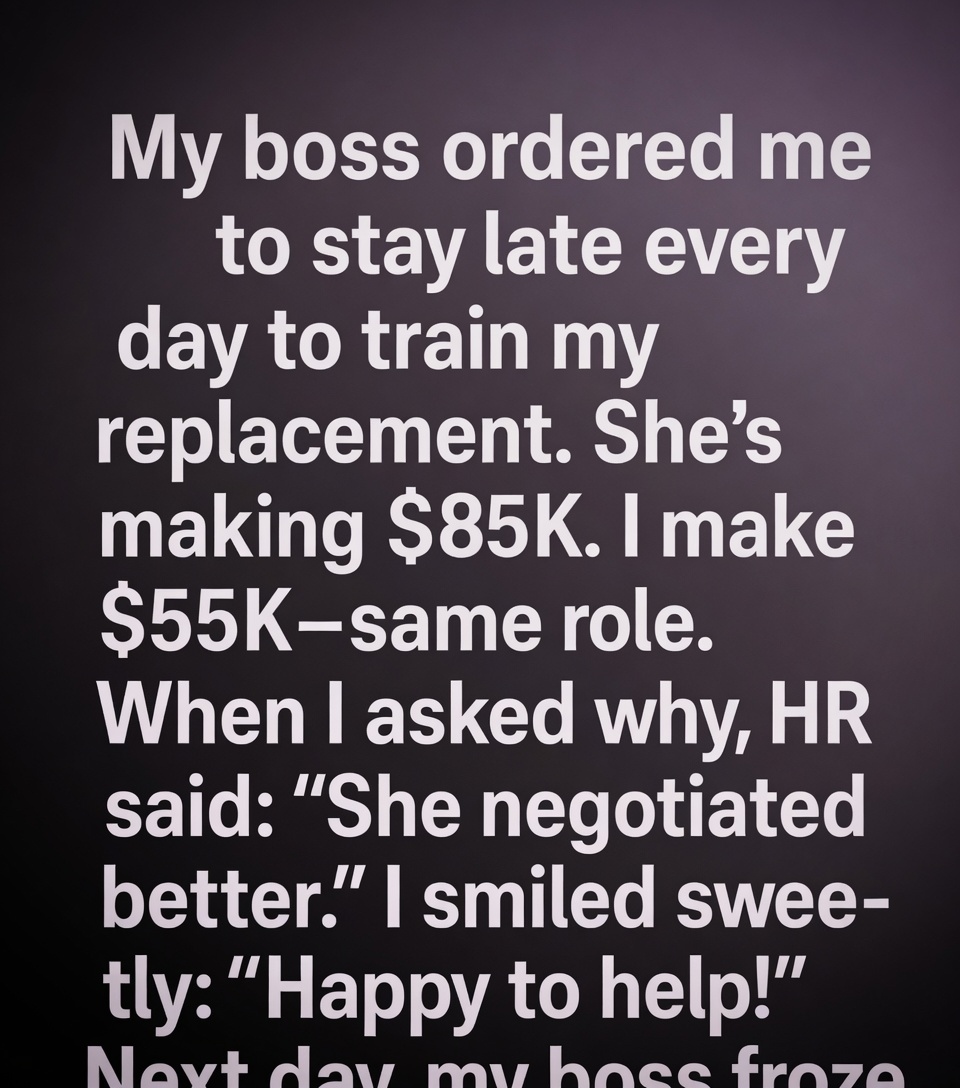
I stood in the conference room holding the training manual for a job I had done brilliantly for eight years, watching a 26-year-old fresh out of college with zero experience sit across from me. My boss, Mr. Harlan, smiled as he introduced us. “This is Alex. He’ll be taking over your role next month with a 40% higher salary. Show him everything you know.” The humiliation burned hotter than any firing ever could. I wasn’t being let go because I was bad at my job. I was being replaced because I had asked for the raise I deserved — and Harlan wanted to make me suffer for it. What he didn’t know was that I had spent the last two years quietly documenting every illegal thing happening in that office. By the time I finished training Alex, Harlan’s entire empire of unpaid labor and exploitation would come crashing down around him.
My name is Jordan. I started at Harlan & Associates as an eager 24-year-old marketing coordinator fresh out of grad school. I worked my way up to senior strategist through pure grit — late nights, weekends, and taking on projects no one else wanted. The company grew because of people like me. We were a tight team of twelve handling major clients, and I was proud of what we built. For years, I accepted the long hours and modest pay because I believed in the mission and trusted that hard work would eventually be rewarded. I was wrong.
The problems started subtly. Mandatory “team building” weekends that weren’t paid. Projects that required us to work through holidays without overtime. When I finally gathered the courage to ask for a raise after landing a major client that brought in six figures, Harlan laughed. “You’re lucky to have this job,” he said. Two weeks later, Alex was hired. My replacement. Younger, cheaper in the long run because he had no experience to demand more, and willing to work insane hours to prove himself. Harlan made me train him personally. It was pure psychological warfare.
I smiled through the training sessions while my blood boiled. Alex was nice enough — ambitious and a little naive. He had no idea he was being used as a pawn. While I walked him through client files and campaign strategies, I was also finalizing the folder I had been building for two years. Every unpaid overtime hour. Every employee who had been pressured into working off the clock. Every time Harlan had skimmed from project budgets. Every violation of labor laws I had carefully documented with dates, emails, and screenshots.
On my last day, I handed Alex the final report, shook his hand, and wished him luck. Then I walked straight to the Department of Labor office and filed a formal complaint with every piece of evidence I had collected. What followed was faster and more devastating than I could have imagined.
The investigation revealed a pattern of systemic abuse that went back more than a decade. Harlan had been running what amounted to a modern sweatshop disguised as a creative agency. Employees were routinely pressured to work 60–70 hours a week without proper overtime pay. Younger staff were told their jobs depended on “going the extra mile.” Several had been fired when they pushed back. The DOL uncovered hundreds of thousands of dollars in unpaid wages across the company. But the real bombshell was the tax fraud and client fund mismanagement they found while digging deeper.
Within six months, Harlan & Associates was under federal investigation. Clients started pulling out. Key employees left once the truth came out. Harlan tried to blame everything on “rogue staff” and “misunderstandings,” but the paper trail was ironclad. He eventually settled with the government for a massive fine and lost his business license. The company that once employed twelve people and brought in millions was reduced to nothing. Harlan declared bankruptcy and faded from the industry, his reputation in ruins.
I didn’t do it for revenge. I did it because no one should have to work in fear or be exploited while the person at the top lives luxuriously. I did it for the young assistants who cried in the bathroom after being yelled at for asking for overtime. I did it for the single parents who missed their kids’ events because they were too scared to say no. And I did it for myself — to finally stand up after years of being made to feel small.
Today, I run my own boutique marketing firm with five employees who are paid fairly, treated with respect, and never asked to work off the clock. I make sure everyone has a life outside the office. The work is still demanding, but it’s honest. My team knows they can speak up without fear. That feels better than any promotion or bonus ever could.
This experience taught me several hard but necessary lessons:
- Never stay silent when you see people being exploited — including yourself.
- Documentation is your strongest weapon against toxic workplaces.
- The people who humiliate you often do so because they’re afraid of your power.
- Walking away with integrity beats staying with resentment.
- Sometimes the best revenge is simply refusing to let someone else control your worth.
If you’re reading this and you’re in a workplace where you’re undervalued, overworked, or quietly abused, please hear me: you deserve better. Start documenting. Know your rights. And when the moment feels right, choose yourself. I spent years thinking I had to endure it. The day I decided I didn’t was the day everything changed.
My former boss tried to humiliate me by making me train my replacement. Instead, he gave me the time and motivation to bring his entire operation down. Some endings aren’t quiet resignations. Sometimes they’re the beginning of something much better — for you and for everyone who comes after you.
I lost a job I thought defined me. I gained a business, peace of mind, and the knowledge that standing up for what’s right is always worth it. The man who tried to break me ended up breaking himself. And I finally learned that the only person I need to prove anything to is the one looking back at me in the mirror every morning.
Some bosses think they can play God with people’s lives. The smart ones eventually learn that karma has a perfect memory — and excellent timing.
Most Popular!
-
 Star Wars Icon and Haven Star Richard Donat Dies at 84 After Brave Battle with Illness, Leaving Hollywood and a Galaxy Far, Far Away in Mourning
-
Devastating Truth Behind Little Girl’s Mysterious Camping Trip Disappearance Is Finally Exposed After Her Brave Young Nephew Breaks Four Years of Terrifying Silence
-
Generous Teen Boy Was the Only One Who Asked the Girl in a Wheelchair to Dance at Prom – Thirty Years Later She Stumbles Upon Him Working as a Penniless Waiter and Completely Changes His Destiny
-
My Wife and Three Daughters Disappeared Without a Trace – But Twelve Years Later My Son Finds a Hidden Disc in the Basement That Blows the Cold Case Wide Open
-
8 Secret Signs That Prove Angels Are Actively Protecting Your Home – And the Hidden Meaning Behind the Unexplained Moments That Reveal You Are Never Truly Alone
-
My Sister Called at Midnight and Whispered, “Turn Off Every Light. Go to the Attic. Don’t Tell Your Husband.” I Thought She Was Losing Her Mind — Until I Looked Through the Floorboards
-
My Sister-in-Law Stole My Credit Card While I Was Recovering From Surgery – But the Trap I Set at the Airport Turned Her Dream Vacation Into a Legal Nightmare She’ll Never Forget
-
Devoted Single Mother Sells Her Car and Works Exhausting Night Shifts to Pay for Daughter’s College Tuition – But Urgent Call from the Dean’s Office Days Before Graduation Changes Everything