For seven years, I brought meals to the grumpiest man on Maple Street. Mr. Harlan lived in the dilapidated blue house with the overgrown yard and the permanent scowl. Neighbors avoided him. Kids crossed the street. Even the mailman left packages at the curb rather than knock on his door. But every Sunday afternoon, I walked over with a warm plate of food anyway. I told myself it was the right thing to do. I had no idea that my small act of kindness would lead to the most shocking revelation of my life the day he passed away.
Mr. Harlan wasn’t just unfriendly — he was openly hostile. He yelled at kids playing too close to his property. He called the police on anyone who parked in front of his house. He once threw a neighbor’s dog’s tennis ball into the storm drain because it “barked too much.” Most people wrote him off as a bitter old recluse who wanted nothing to do with the world. I almost did too, until the day I saw him struggling to carry groceries up his broken front steps. Something in me wouldn’t let me walk past.
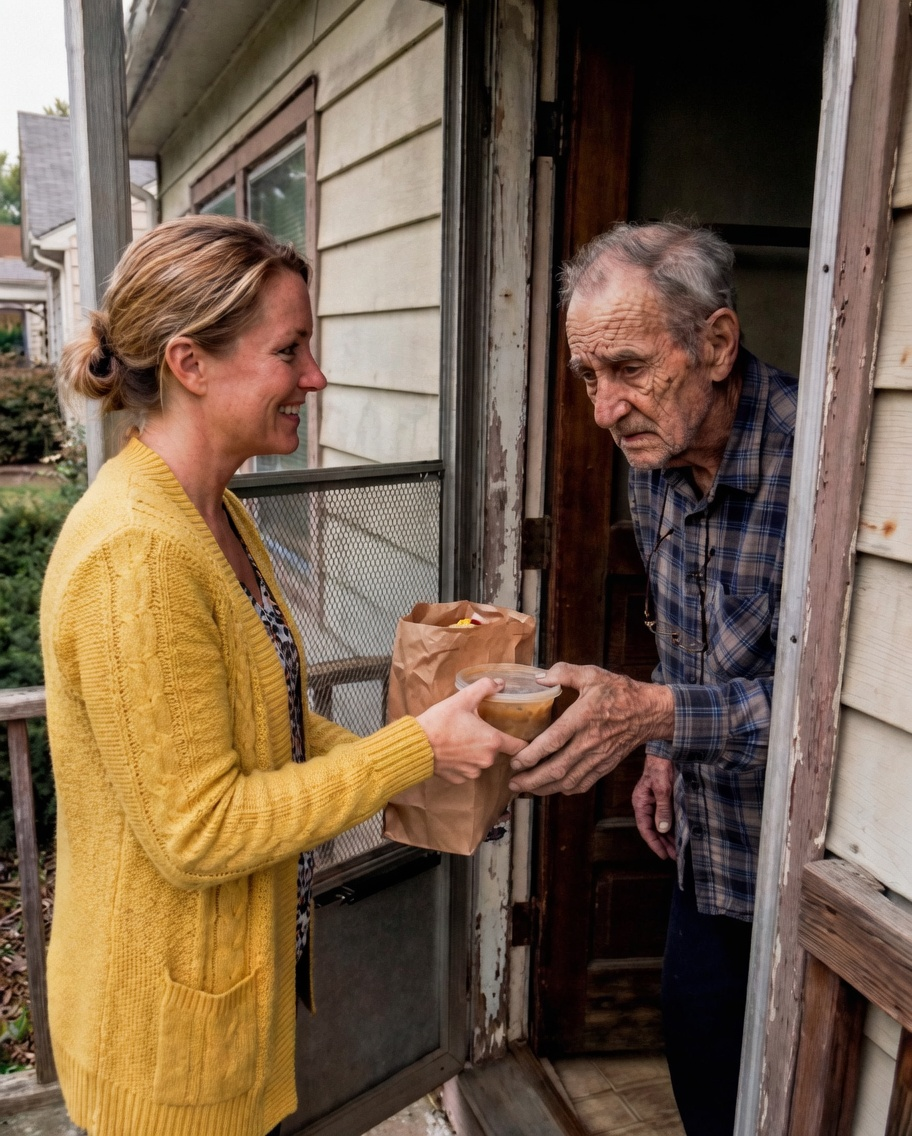
The first time I brought him dinner, he answered the door with a shotgun in his hands. “What do you want?” he barked. I held up the plate of pot roast and said, “Nothing. Just thought you might be hungry.” He stared at me like I had lost my mind, snatched the plate, and slammed the door without a thank you. I went home thinking that was the end of it. But the next Sunday, I went back anyway. And the Sunday after that. Slowly, a strange routine developed. I never stayed long. He rarely said more than a few gruff words. But he always took the food.
Over the years, our interactions evolved in tiny, almost imperceptible ways. He started leaving the porch light on for me. Once, he left a note on the door saying “Leave it on the chair” when he wasn’t feeling well. On particularly cold days, he would grunt something that almost sounded like thanks. I never pushed for more. I just kept showing up. My friends thought I was crazy. My family worried I was being taken advantage of. But something told me not to stop.
Then, one rainy Thursday morning, the ambulance came. Mr. Harlan had passed away in his sleep at the age of 87. The neighborhood breathed a collective sigh — some with relief, others with indifference. I felt a quiet sadness I couldn’t quite explain. A few days after the small funeral (which only four people attended), his lawyer called me. “Mr. Harlan left specific instructions,” he said. “You need to be present for the reading of the will.”
I sat in the lawyer’s office expecting nothing. Maybe a small token of appreciation or an old book. What I received instead left me speechless.
The lawyer cleared his throat and began reading. Mr. Harlan had left his entire estate — the house, the land, a substantial investment portfolio worth over $2.8 million, and a collection of rare coins — to me. But that wasn’t the real shock. Folded inside the will was a letter written in his shaky handwriting. In it, he explained everything.
Mr. Harlan had been a wealthy man his entire life, but after losing his wife and only daughter in a car accident decades earlier, he had withdrawn from the world. He pushed everyone away on purpose, believing that loneliness was safer than love. For years, he watched me from his window as I struggled as a single mother, working two jobs while raising my son after my own husband left. He saw me come home exhausted but still smiling. He saw me help neighbors even when I had little to give. And quietly, without ever telling me, he had been watching over me the entire time.
The “mean old man” had paid my son’s school tuition anonymously for years. He had covered medical bills I could never explain. He had even paid off the last of my mortgage without me knowing. The meals I brought him? He told the lawyer they were the only kindness he had allowed himself in thirty years. In his letter, he wrote: “You fed me when I didn’t deserve it. You showed me that goodness still exists. I hope this helps you the way you helped me.”
I sat in that lawyer’s office and cried harder than I had at my own mother’s funeral. The man everyone avoided, the man I had stubbornly fed for seven years despite his rudeness, had been my silent guardian angel the entire time. He hadn’t hated the world. He had been protecting his heart from losing anyone else.
The house he left me has become a community center for single parents. The money funds scholarships and emergency assistance for families in need. Every Sunday, I still cook extra meals — not just for those in need, but in memory of the man who taught me that sometimes the hardest hearts hide the deepest pain.
This experience changed how I see people. The angry cashier, the rude neighbor, the difficult coworker — they might all be carrying wounds we can’t see. Kindness isn’t always returned in the moment, but it rarely goes unnoticed. Mr. Harlan waited until he was gone to show his gratitude, but his final act proved that even the coldest exterior can hide a heart that was simply too hurt to show itself.
If you know someone who seems mean, unreachable, or bitter, consider showing up anyway. Not because you expect anything in return, but because everyone deserves to know they’re not invisible. My stubborn Sunday meals didn’t just feed an old man. They fed a broken heart that had forgotten how to trust. And in the end, that small act of persistence came back to me in ways I could never have imagined.
Mr. Harlan taught me that you never really know someone’s story until they choose to tell it — even if that choice comes after they’re gone. I still set an extra plate at Sunday dinner, just in case. Some habits are worth keeping, even when the person you started them for is no longer here.
The meanest old man on Maple Street wasn’t mean at all. He was just a father and husband who had lost everything and didn’t know how to ask for help. In feeding him, I didn’t just give him food. I gave him hope. And in return, he gave me and my son a future we never saw coming.
Sometimes the greatest gifts come from the people we least expect. And sometimes, the smallest acts of kindness echo far beyond our lifetimes.
Most Popular!
-
 Altar of Betrayal: My Sister Stole My Groom and My Wedding Dress — But I Left Her With a Debt That Will Haunt Her Forever
-
From Ruined Jacket to Masterpiece: How My Sister and I Turned Bullying Into Our Greatest Symbol of Strength
-
Middle East Meltdown: Why US Officials Are Urging Americans to Reconsider Travel Amid Dramatic Military Escalation
-
The Butter Battle Finally Settled: Why You’ve Been Storing Your Favorite Kitchen Staple All Wrong (And the Secret to Perfect Toast Every Single Time)
-
I Ate at Cracker Barrel for Years – Then I Finally Noticed These Hidden Details That Changed Everything
-
I Raised My Late Fiancée’s 10 Kids Alone for 12 Years – Then My Daughter Told Me the Truth About Her Mother and It Changed Everything
-
“We Cannot Keep Her,” My Husband Said During Our Baby’s First Bath – What I Saw Next Changed Everything
-
What You’re Really Eating: The Shocking Truth About Supermarket Meat Most Labels Won’t Tell You