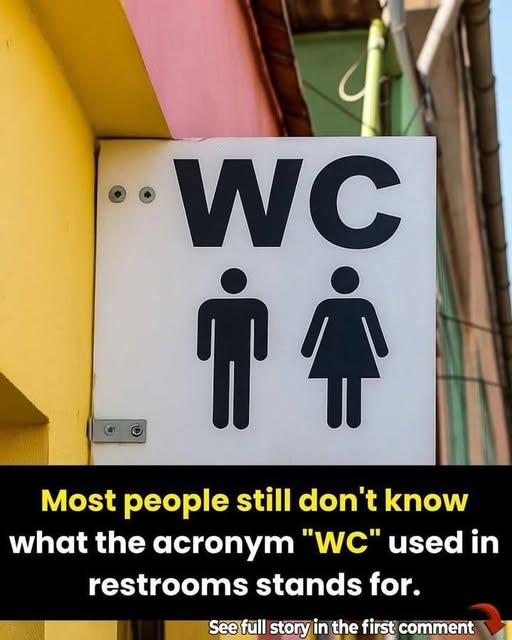
You’ve seen it a thousand times — that simple “WC” sign on restroom doors in hotels, restaurants, airports, and public buildings around the world. For many of us, it’s just another way of saying “toilet.” But have you ever stopped to wonder what those two letters actually stand for? The answer is more fascinating (and older) than most people realize. “WC” stands for Water Closet, a term that dates back to a time when indoor plumbing was still a luxury and bathrooms as we know them today didn’t exist.
The Origin of the Water Closet
Before modern plumbing became widespread in the 1800s, going to the bathroom was a very different experience. Most homes had outhouses or chamber pots. When indoor toilets finally started appearing, they were often installed in small, closet-like rooms separate from the bathing area. These early flush toilets used water to carry waste away, hence the name “water closet.”
The term became popular in Britain and spread across Europe as plumbing technology improved. By the late 19th century, “WC” was a common abbreviation on signs, especially in public buildings. It was practical, discreet, and universally understood in many countries. Even today, in places like France (where it’s “les WC”), Germany, and parts of Asia, you’ll still see the letters prominently displayed.
Why “WC” Persists in a Modern World
With terms like “restroom,” “bathroom,” “loo,” and “lavatory” in common use, you might wonder why “WC” hasn’t faded away. The reason is simple: tradition and clarity.
- Universality — “WC” is widely recognized across language barriers, making it useful in international travel and public spaces.
- Discretion — It’s a short, neutral abbreviation that doesn’t explicitly say “toilet,” which some cultures and older generations prefer.
- Historical Continuity — Many older buildings and establishments still use the original signage, preserving a piece of architectural and cultural history.
In the UK especially, “WC” remains extremely common. A recent viral TikTok video explaining the term received millions of views, with many younger people admitting they had no idea what it stood for despite seeing it their entire lives.
Fun Facts About the Humble Water Closet
- The first flushing toilet was invented in the 1590s by Sir John Harington, a godson of Queen Elizabeth I. He called his invention the “Ajax” (a play on “jakes,” an old slang term for toilet).
- The phrase “water closet” became popular in the 1800s as plumbing technology improved.
- In some older buildings, you can still find actual small closets that were converted into bathrooms — literal water closets.
- The abbreviation “WC” appears on signs in over 50 countries, making it one of the most internationally recognized bathroom symbols.
Cultural Differences in Bathroom Language
Different English-speaking countries have their own preferences:
- United States: Restroom or bathroom
- United Kingdom: Loo, toilet, or WC
- Australia: Dunny or toilet
- Canada: Washroom
These variations often reflect history, class, and regional humor. “WC” stands out as one of the few terms that feels both old-fashioned and globally understood.
Why This Little Detail Still Matters
In our fast-paced digital world, it’s easy to overlook small historical details like this. But understanding where everyday things come from connects us to the past and reminds us how far we’ve come. The next time you see a “WC” sign, take a second to appreciate the engineering marvel and social evolution it represents — from chamber pots and outhouses to clean, private facilities we often take for granted.
It’s also a fun conversation starter. Asking someone “Do you know what WC stands for?” often leads to surprised reactions and interesting discussions. Many younger people have never thought about it, while older generations remember when the term was even more common.
The Bottom Line
“WC” is more than just two letters on a door. It’s a quiet reminder of human ingenuity, changing social norms, and the journey toward better sanitation and privacy. The next time you’re traveling or visiting a public place, you’ll know exactly what it means — and you might even impress a few friends with your newfound knowledge.
So, did you already know what WC stood for, or was this a surprise? Drop your thoughts (and any funny stories about bathroom signage mishaps) in the comments below. And the next time you see that familiar sign, give a little mental nod to the history hiding behind those two simple letters.
Most Popular!
-
 I Ate at Cracker Barrel for Years – Then I Finally Noticed These Hidden Details That Changed Everything
-
I Raised My Late Fiancée’s 10 Kids Alone for 12 Years – Then My Daughter Told Me the Truth About Her Mother and It Changed Everything
-
I Fed the Meanest Old Man on My Street for Years – When He Died, His Will Exposed a Secret That Shocked Everyone
-
“We Cannot Keep Her,” My Husband Said During Our Baby’s First Bath – What I Saw Next Changed Everything
-
What You’re Really Eating: The Shocking Truth About Supermarket Meat Most Labels Won’t Tell You
-
My 12-Year-Old Built Wheelchairs for Stray Dogs – Then Our Neighbor Destroyed Everything. One Video Changed Her Life Overnight
-
I Caught My Husband With Our Daughter’s Nanny – But Instead of Screaming, I Let the Whole World Watch What Happened Next
-
She Dined and Dashed on a $112 Bill, Then Called the 72-Year-Old Waitress Rude – What Happened Next Left the Whole Town Talking