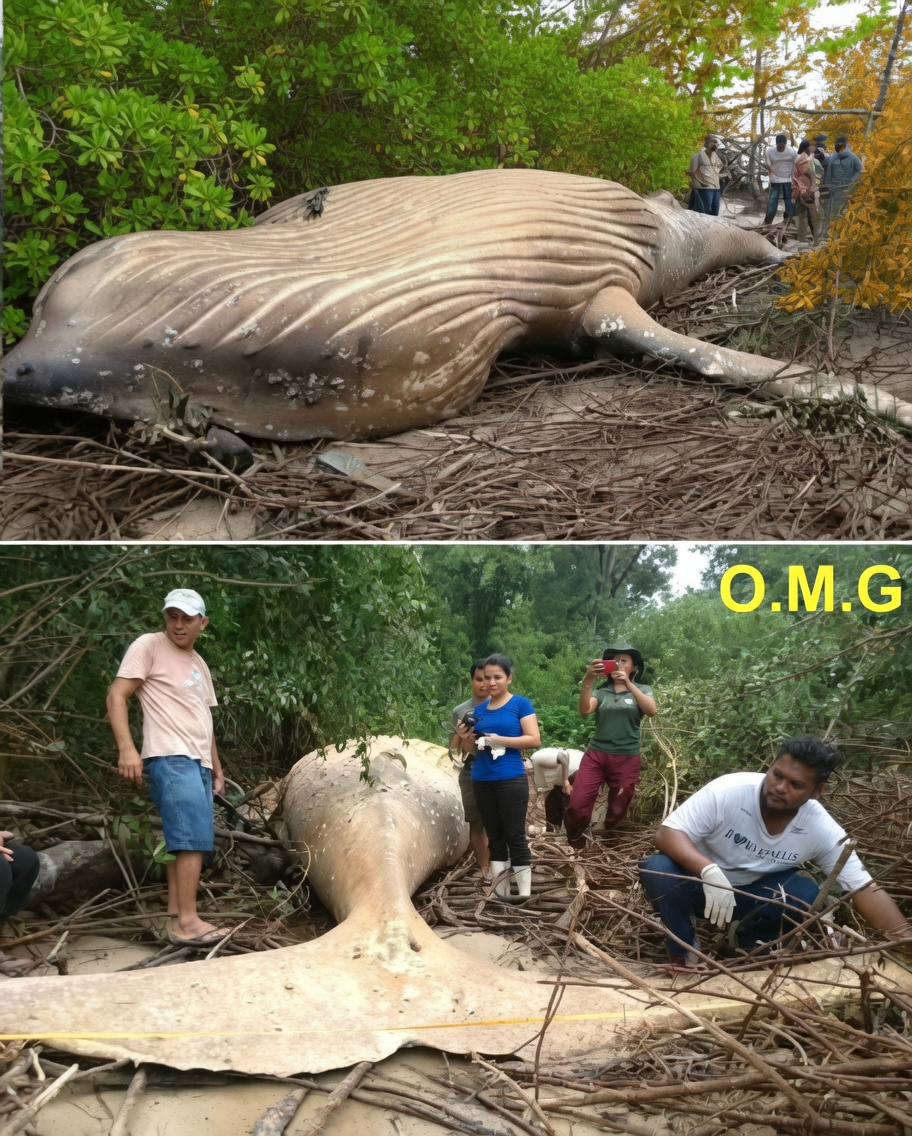
In the remote, windswept wilderness of Marajó Island at the mouth of the Amazon River, nature delivered one of its most surreal puzzles. Locals trekking through thick mangrove forests stumbled upon something impossible: the massive body of a young humpback whale resting among tangled roots and dense tropical foliage, far from any ocean. The discovery defied logic and sparked wild rumors of supernatural forces. How could a creature of the deep sea end up stranded deep in a jungle? What followed was a fascinating scientific investigation that revealed the raw, unpredictable power of one of Earth’s most extreme tidal zones.
Marajó Island is no ordinary place. It sits where the mighty Amazon River collides with the Atlantic Ocean, creating some of the most dramatic tidal movements on the planet. During certain seasons, the clash of these waters produces colossal surges that can dramatically alter the landscape. When researchers arrived at the scene, they found a young humpback whale calf, roughly eight meters long, lying intact among the mangroves. There were no signs of violent trauma—no propeller scars, no shark bites, no obvious injuries that would suggest a dramatic struggle. The absence of external wounds only deepened the mystery.
Initial theories ranged from the supernatural to the speculative. Some locals whispered about omens or cosmic anomalies. Others wondered if the whale had been chased inland by predators or carried by a ship. But marine biologists quickly focused on the most plausible explanation: the extreme tidal forces unique to this region. During periods of exceptionally high tides, massive volumes of water can surge far inland through the mangrove channels. A disoriented young calf, possibly separated from its mother, could have been swept deep into the flooded forest. When the tide receded rapidly, the whale was left stranded, too far from open water to escape.
Without the buoyancy of the ocean, the whale’s immense weight crushed its own internal organs. Combined with dehydration from the tropical heat and the inability to move, the calf succumbed quickly. It was a tragic but natural outcome of the powerful estuarine environment where river and sea constantly battle for dominance. The event, while rare, highlights how dynamic and sometimes unforgiving these transitional ecosystems can be.
Because of the difficult terrain and the desire to minimize further disturbance to the sensitive mangrove habitat, authorities made the decision to let nature take its course. The whale’s body was left in place to decompose naturally. In the grand cycle of the rainforest, this massive marine gift became a biological treasure trove. Scavengers, insects, and microorganisms feasted on the remains, while the nutrients enriched the soil and created a unique micro-habitat in the middle of the jungle. What began as a shocking discovery transformed into an ecological windfall.
Scientists continue to monitor the site, planning to collect the skeleton once decomposition is complete. The bones will be carefully cleaned, studied, and eventually displayed in a museum, serving as a permanent record of one of the most unusual marine strandings ever documented. This young humpback will continue to educate researchers and visitors long after its body has returned to the earth.
The story of the jungle whale captivates because it challenges our understanding of boundaries. We like to think of the ocean and the forest as separate worlds with clear lines between them. Events like this remind us that nature doesn’t always respect those lines. Extreme environmental forces can blur them dramatically, creating moments that feel almost magical or impossible. In reality, they are powerful demonstrations of the interconnectedness of Earth’s systems.
For the people of Marajó Island, the whale has become more than a scientific curiosity. It has sparked conversations about the power and unpredictability of their local environment. It has also drawn attention to the importance of protecting these unique mangrove ecosystems, which serve as nurseries for countless marine species and buffers against coastal erosion and climate impacts.
The image of a giant ocean creature resting peacefully in the shadows of a tropical forest remains hauntingly beautiful. It serves as a humbling reminder that truth is often stranger than fiction and that the natural world still holds mysteries capable of surprising even the most seasoned scientists. In an age where we feel we’ve mapped and explained so much, moments like this reconnect us with a sense of wonder and respect for the forces that shape our planet.
As researchers prepare to preserve the whale’s skeleton for future study, the story of this young humpback continues to inspire awe. It traveled farther inland than any marine biologist expected possible, leaving behind not just bones but a powerful lesson about nature’s complexity and resilience. The ocean and the jungle are more connected than we often realize—and sometimes, the boundaries between them disappear entirely.
If you ever find yourself walking through a remote mangrove forest and come across something that seems impossible, remember the whale of Marajó. Nature has a way of rewriting the rules when we least expect it, proving once again that the most extraordinary stories are often the truest ones.
Most Popular!
-
 FROM DOUBT TO TRUST: A HOUSEKEEPER’S UNEXPECTED MOMENT THAT CHANGED EVERYTHING
-
CHANGES IN THE SENSE OF SMELL AND THEIR POSSIBLE LINK TO BRAIN HEALTH
-
SUBTLE CHANGES IN BEHAVIOR THAT MAY SIGNAL RELATIONSHIP CHALLENGES
-
THE SMALL INHERITANCE I ALMOST THREW AWAY REVEALED A SIDE OF MY GRANDFATHER I NEVER TRULY UNDERSTOOD
-
UNDERSTANDING WHY YOUR HANDS GO NUMB AT NIGHT: CAUSES, SYMPTOMS, AND WHEN TO SEEK MEDICAL ADVICE
-
HE SHOT TO FAME AS JETHRO BODINE IN THE BEVERLY HILLBILLIES—TODAY, HE’S THE LAST SURVIVING CAST MEMBER
-
MY HUSBAND WENT ON A WORK TRIP—THEN I RECEIVED AN UNEXPECTED CALL
-
MEN BORN IN THESE MONTHS ARE OFTEN SAID TO BE THE MOST FAITHFUL HUSBANDS—BUT HERE’S WHAT REALLY BUILDS LASTING LOYALTY