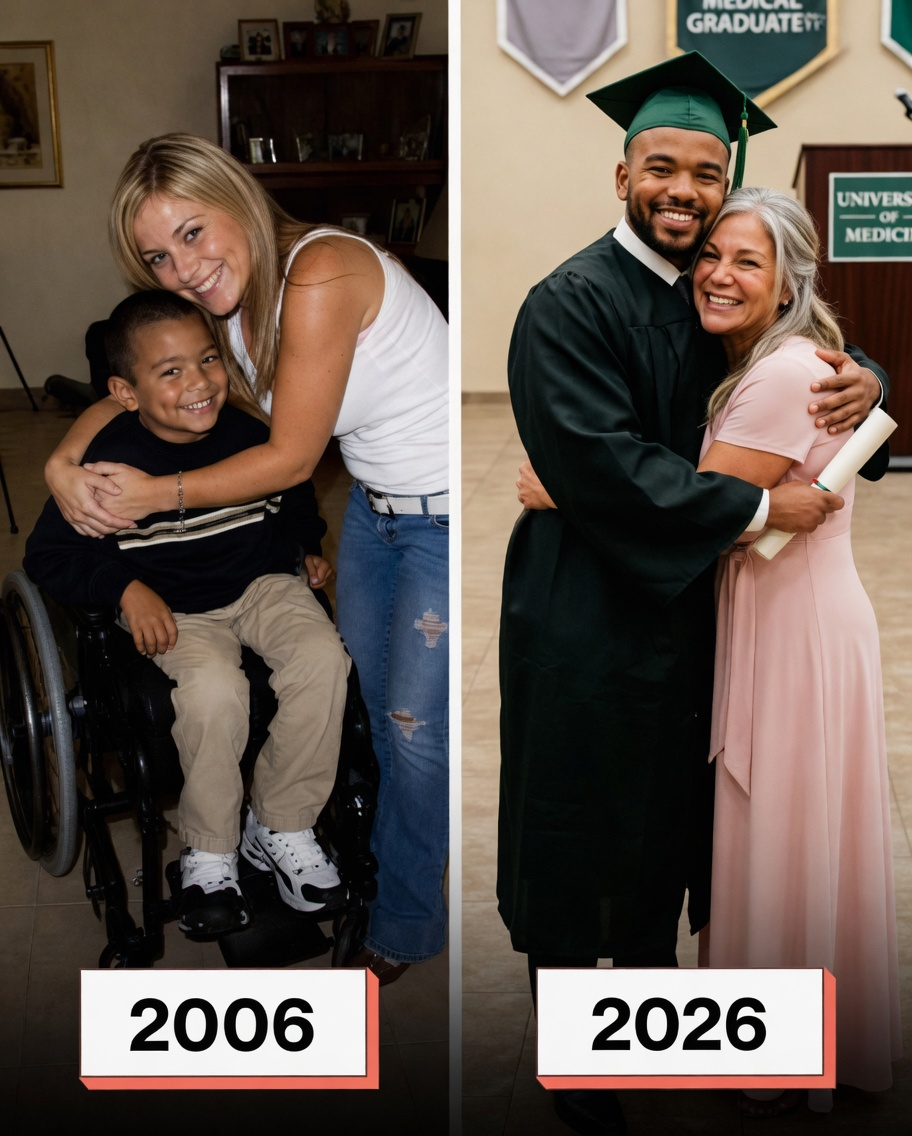
Some goodbyes happen with slammed doors and raised voices. Others are quieter — a man simply picking up his coat in a hospital room and disappearing before his newborn son even opens his eyes. That was the last time Ethan’s father was part of his life. No cards on birthdays. No calls on Father’s Day. Just silence for a quarter of a century. Then, on the day Ethan stood on stage to accept his medical school diploma, the man who had left reappeared, smiling like he belonged there. What happened next wasn’t dramatic revenge or a tearful reunion. It was something far more powerful: a son finally speaking the truth his mother had carried alone for twenty-five years.
The story begins in a sterile delivery room where joy should have filled the air. Moments after Ethan entered the world, doctors explained he had a congenital condition that would require years of therapy, surgeries, and constant care. His father listened without emotion, then uttered the words that would echo through the family forever: “This isn’t what I signed up for.” He kissed his wife on the forehead, told her he needed air, and never came back. She left the hospital two days later carrying their son and the crushing weight of single parenthood with no explanation, no support, and no promise of help.
What followed was not the stuff of inspirational movies. It was grinding, exhausting reality. Late-night therapy sessions after long workdays. Insurance battles that drained their savings. Sleepless nights when Ethan’s pain kept them both awake. His mother worked two jobs while learning to navigate special education meetings, medical equipment, and the constant fear that one missed appointment could set her son back months. She never complained in front of him. Instead, she taught Ethan that limitations were facts, not definitions. When teachers suggested “realistic expectations,” she quietly pushed for excellence. When doctors warned of lifelong challenges, she focused on possibilities.
Ethan absorbed every lesson. He grew up refusing to be defined by pity or lowered bars. In middle school, when an administrator gently suggested he might not keep up academically, Ethan looked her in the eye and asked, “Are you talking about my body or my brain?” The room went silent. He wasn’t rude — he was clear. He wanted to be the one asking questions, not the one being discussed. That mindset carried him through grueling physical therapy, endless medical appointments, and the ordinary struggles of growing up without a father. By high school, he had decided his future: he would become a doctor so he could be the one doing the talking in those exam rooms.
Medical school tested every ounce of resilience he and his mother possessed. The physical demands were doubled by his condition. Study sessions stretched into mornings after painful nights. Yet he graduated near the top of his class, earning the respect of professors who had watched him fight for every inch of progress. His mother sat in the audience that day, exhausted but radiant, knowing every sacrifice had been worth it. She had stayed — every single day — when the man who helped create their son had chosen to walk away.
Then came the surprise no one expected. Days before graduation, Ethan received a message from his father. After twenty-five years of silence, he had followed his son’s accomplishments from afar and wanted to attend the ceremony. He expressed pride and asked if he could be there to celebrate. Ethan’s mother was stunned when her son agreed. “I don’t want him leaving with the wrong version of the story,” Ethan told her quietly. She attended with a knot in her stomach, bracing for whatever might unfold.
When Ethan’s name was called, he walked across the stage with the slight limp that had defined so much of his journey. The applause was thunderous. Then came his speech. What the audience expected was a standard inspirational address about overcoming adversity. What they got was something far more honest. Ethan looked out at the crowd, found his mother’s eyes, and began to speak from the heart.
“People love stories like mine,” he said. “They want to hear how I triumphed despite everything. But I’m not standing here because I was extraordinary. I’m standing here because my mother stayed.” He described the years of therapy, the financial strain, the nights she went without sleep so he could have what he needed. Then, without raising his voice, he turned toward the section where his father sat. “My father left on the first day. My mother stayed every day after that.” The room fell completely silent. “You saw the beginning of my story and walked away. She saw the same beginning and chose to stay. Everything good in me learned her name first.”
The applause that followed was deafening. Tears streamed down his mother’s face as years of suppressed emotion finally broke free. Ethan had not shouted or shamed. He had simply told the truth — a truth his father had spent twenty-five years avoiding. When the ceremony ended and his father approached expecting a warm reunion or at least a photo opportunity, Ethan looked him in the eye and spoke the final words his mother had waited a lifetime to hear: “You left at the beginning. You don’t get to come back just because you like the ending.”
There was no dramatic shouting match. No revenge. Just calm, final clarity. The father stood frozen as the weight of his choices settled over him. Ethan and his mother walked away together, heads high, surrounded by the people who had actually shown up for every hard day.
This story isn’t about hatred or payback. It’s about the quiet power of someone who stays. It’s about the difference between the parent who walks out when things get difficult and the one who chooses to remain, day after exhausting day. In a world quick to celebrate dramatic redemptions, Ethan’s speech reminds us that some endings are better left honest. Not every absent parent deserves a seat at the graduation.
For anyone carrying the weight of abandonment — whether as the child left behind or the parent who stayed — this tale offers both validation and hope. You don’t need revenge to find peace. Sometimes the most powerful response is simply speaking the truth out loud after years of silence. Ethan didn’t erase his father’s absence. He simply refused to let it define the ending of his own story.
His mother still keeps the graduation program on her nightstand. Next to it is a small note Ethan wrote her that night: “Everything good in me learned your name first.” In those words lives the real victory — not the confrontation, but the life they built together when the easier choice would have been to walk away.
Most Popular!
-
 THE RISE AND TRAGIC LEGACY OF A BELOVED CHILD STAR: A STORY OF FAME, TALENT, AND RESILIENCE
-
DO YOU KNOW WHY A MAN TURNS HIS BACK ON YOU WHEN HE SLEEPS?
-
THE MOST POPULAR GIRL IN SCHOOL ASKED MY MISTREATED SON TO DANCE AT PROM—IT TURNED OUT TO BE A MEAN JOKE, BUT WHAT HE DID NEXT MADE MY KNEES SHAKE
-
WHAT I FOUND IN MY GIRLFRIEND’S BATHROOM TURNED OUT TO BE COMPLETELY HARMLESS
-
THE LATE-NIGHT HABIT THAT COULD BE SILENTLY SABOTAGING YOUR SLEEP, FOCUS, AND WELL-BEING
-
THE VINTAGE LAUNDRY WRINGER AT A YARD SALE AND THE STORY IT CARRIED
-
MY WEALTHY GRANDMOTHER LEFT ME NOTHING IN HER WILL—BUT A HIDDEN GARAGE HELD A SECRET THAT CHANGED MY LIFE FOREVER
-
IS IT SAFE TO LEAVE BUTTER ON THE COUNTER? A COMPLETE GUIDE TO BUTTER STORAGE AND FRESHNESS