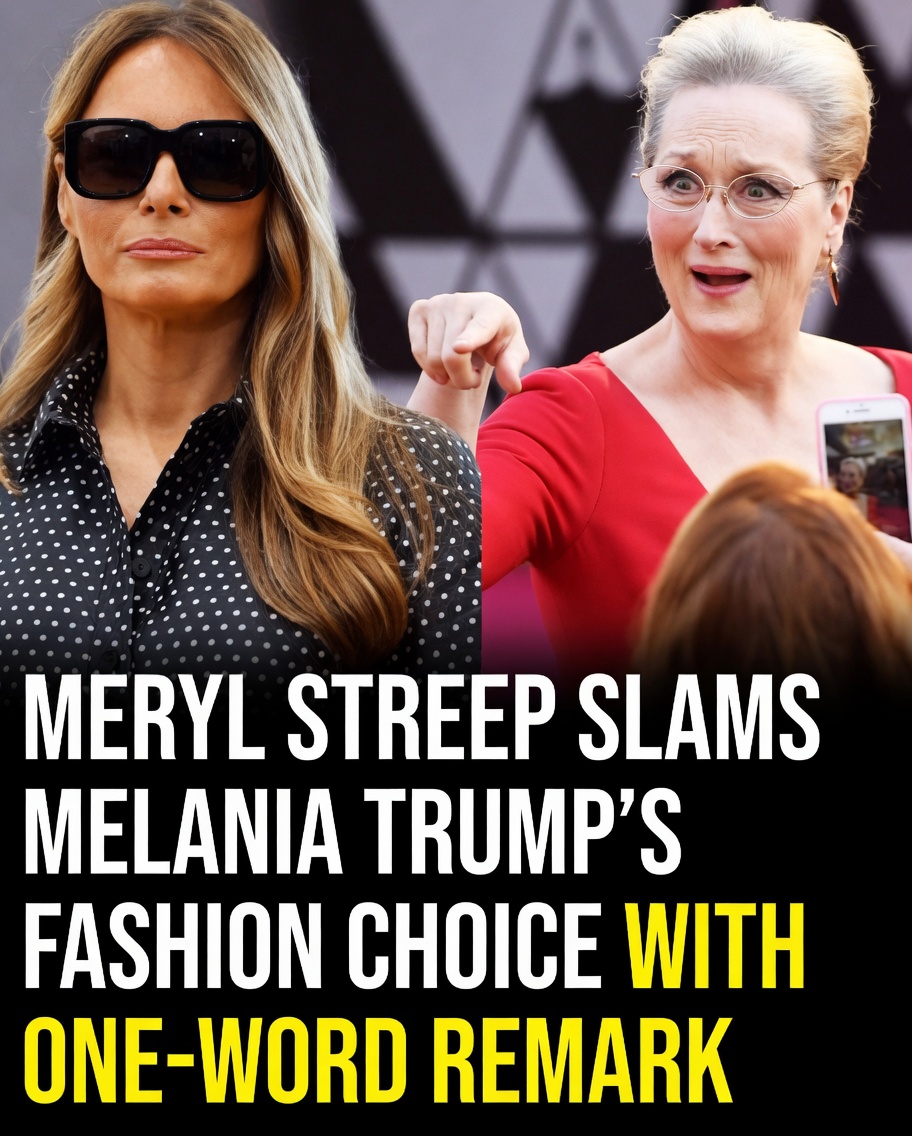
When Meryl Streep speaks, the world listens. The three-time Oscar winner has never been one to shy away from using her platform for pointed cultural commentary, but her recent remarks about Melania Trump’s infamous green Zara jacket have struck a particularly raw nerve. In a candid new interview, Streep revisited the 2018 moment that stunned the nation and reignited debates about symbolism, empathy, and the power of fashion in the political arena. What she described wasn’t just a questionable wardrobe choice—it was, in her words, a deliberate and chilling message from the highest levels of power.
The jacket in question needs little introduction. In June 2018, as then-First Lady Melania Trump boarded a plane to visit detained migrant children at the U.S.-Mexico border, she was photographed wearing a $39 olive-green Zara jacket emblazoned with the stark white message: “I Really Don’t Care. Do U?” The image spread like wildfire. Critics called it tone-deaf at best and deliberately cruel at worst, especially given the context of family separations and children held in detention centers. Supporters dismissed it as a meaningless fashion statement or even a subtle jab at the media. Melania’s team later claimed the jacket was simply a personal favorite with no deeper meaning, but the damage to her public image was already done.
Years later, Meryl Streep has broken her long silence on the matter with a sharpness that feels freshly relevant. In the interview, she didn’t mince words. Streep argued that the jacket was never an innocent slip-up or a stylist’s oversight. Instead, she called it “perhaps the most honest message Melania Trump ever sent to the American public”—a visual declaration of indifference worn while heading into a situation defined by human suffering. For Streep, the choice of clothing wasn’t neutral. It was a calculated performance of detachment, one that revealed far more about priorities than any carefully scripted speech ever could.
What makes Streep’s critique particularly powerful is how she connects the jacket to a larger pattern. She drew a direct line between that single garment and the broader tone set by the Trump administration, referencing moments like Donald Trump’s public mocking of a disabled reporter during the 2016 campaign. In Streep’s view, these weren’t isolated incidents of poor taste. They formed an ecosystem where cruelty or apathy was normalized from the top down. When those in power broadcast a lack of concern, she suggested, it quietly gives permission for everyday indifference throughout society. Fashion, in this context, becomes more than fabric—it becomes a tool of communication that can either humanize or harden those who wear it.
The reaction to Streep’s comments has been predictably divided. Supporters hailed her as a voice of moral clarity, praising the way she used her immense cultural capital to call attention to what she sees as a failure of empathy at the highest level. Others accused her of being part of an out-of-touch Hollywood elite obsessed with rehashing old grievances. Social media exploded with both praise and backlash, turning the interview into yet another flashpoint in the endless culture war between entertainment figures and conservative politics. Yet even some who disagree with Streep’s politics admit the moment still lingers in the collective memory precisely because of how visually striking and symbolically loaded it was.
Melania Trump herself has always maintained a carefully curated public image as a poised, elegant First Lady who preferred to let her actions speak louder than her words. The jacket incident was one of the rare moments when that image cracked in a way that felt impossible to spin. For many observers, it highlighted the tension between Melania’s personal style and the weight of her role. As someone who had access to the world’s top designers, the choice of an affordable high-street item with such a provocative slogan felt intentional to critics. Streep’s analysis reframes that choice not as a mistake but as a revealing glimpse behind the polished facade.
Beyond the politics, the conversation Streep sparked touches on something deeper about the language of clothing. Fashion has always been political, from suffragette white to protest pins to the power suits of the 1980s. In the age of social media and instant global scrutiny, every outfit worn by a public figure is dissected for meaning. Streep’s comments serve as a reminder that when you occupy a position of immense visibility, nothing is truly neutral—especially not a message literally written across your back. The jacket became more than clothing; it became a symbol that people are still debating nearly eight years later.
What Streep ultimately seems to be challenging is the idea that those in power can ever truly separate their personal choices from their public responsibilities. Whether one agrees with her assessment or not, her willingness to revisit the moment forces a necessary conversation about empathy, accountability, and the messages we send—intentionally or otherwise—when the world is watching. In an era where image often feels more important than substance, her critique cuts through the noise with the precision and moral weight she has brought to so many of her iconic roles.
As the interview continues to trend and spark fresh debates across platforms, one thing is clear: Meryl Streep remains unafraid to use her voice, even on topics that many in Hollywood have long since moved on from. Her words about Melania Trump’s jacket aren’t just about fashion or a single moment in time. They’re about the responsibility that comes with power and the ways in which even the smallest choices can reveal the largest truths about character and priorities.
The conversation she reignited reminds us that symbols matter. A single sentence on the back of a coat can speak volumes when the context is human suffering. Whether history will ultimately judge that moment as a careless error or something more deliberate remains open to interpretation. What Streep has done, once again, is ensure that we don’t simply forget—or worse, normalize—the images and messages that once stunned the world.
In the end, perhaps the most lasting impact of Streep’s comments is the way they force us to look again at that now-infamous green jacket and ask ourselves what it really represented. For Meryl Streep, the answer seems clear. For the rest of us, the debate continues.
Most Popular!
-
 I THOUGHT THEY WERE JUST CURIOUS DEER—UNTIL I SAW WHAT THE LITTLE ONE WAS CARRYING
-
BENEDITA, THE FIGHTER FROM VASSOURAS
-
A TEACHER’S CALL AFTER MY DAUGHTER’S TRAGIC DAYCARE INCIDENT CHANGED EVERYTHING WE THOUGHT WE KNEW
-
I ALMOST WALKED OUT ON MY NEWBORN DAUGHTER—THEN MY WIFE REVEALED A SECRET THAT SHATTERED MY REALITY
-
TERROR IN THE SKY: MASSIVE CATEGORY 5 HURRICANE RAPIDLY INTENSIFIES TOWARD COASTLINE AS CHAOS ERUPTS NATIONWIDE
-
THE SECRET LOVE HE HID FOR 39 YEARS: THE HIDDEN LIFE OF A POP ICON FINALLY EXPOSED
-
THE BIKER AT MY DYING MOTHER’S BEDSIDE: THE HEARTBREAKING SECRET THAT SHATTERED MY WORLD
-
THE HOUSE THAT REFUSES TO BE SEEN: INSIDE THE MYSTERY OF THE EAST SAINT LOUIS STONE RANCH