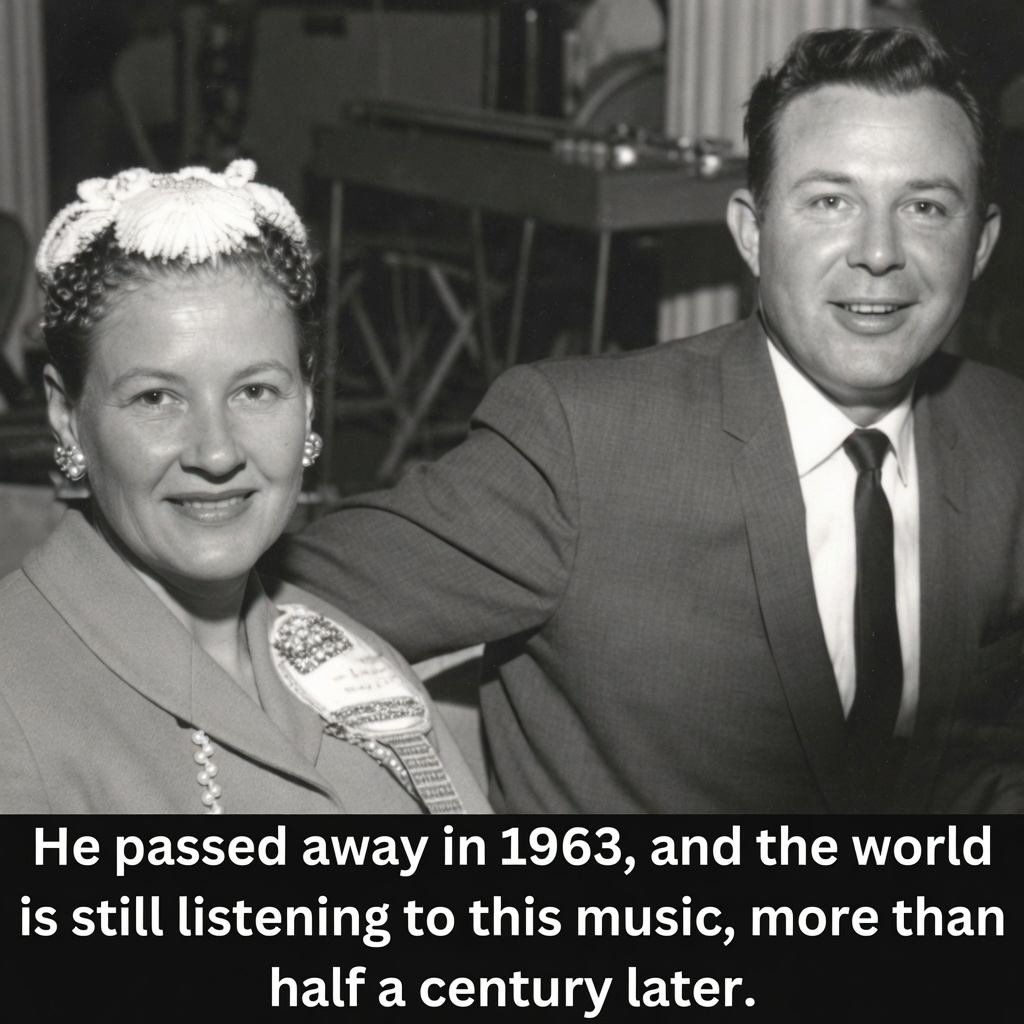
Some songs don’t just play on the radio — they whisper straight into your soul and stay there for decades. That’s exactly what happened with Jim Reeves’ “He’ll Have to Go,” a quiet 1960 hit that transformed a desperate late-night phone call into one of country music’s most enduring emotional touchstones. Known as “Gentleman Jim” for his smooth, velvet voice and polished stage presence, Reeves created a sound that felt like a private conversation rather than a performance. Yet the story behind the song — and the shocking plane crash that cut his life short at age 40 — reveals a haunting legacy that still echoes through modern country music today.
Jim Reeves didn’t fit the rough-and-tumble image of traditional country stars. Where honky-tonk legends sang about heartbreak with raw grit and loud guitars, Reeves brought a refined, almost conversational style that made listeners feel like he was singing only to them. His background in radio taught him the power of microphone technique and silence. He understood that sometimes the space between the notes carries more feeling than the words themselves. By the late 1950s, he was already a respected artist, but “He’ll Have to Go” would elevate him to legend status and help define the smoother “Nashville Sound” that brought country to mainstream audiences.
The song’s origin story is almost too perfect to be real. Songwriter Joe Allison was sitting in a bar one night when he overheard a man struggling with a bad phone connection. The man kept repeating a simple, vulnerable plea: “Put your sweet lips a little closer to the phone.” Allison instantly recognized the universal ache in those words — the pain of distance, the longing for connection, the quiet desperation of trying to hold onto someone across miles and static. He took that overheard moment and turned it into a song that captured the loneliness of separation in the most intimate way possible.
When Reeves recorded “He’ll Have to Go” in 1960 with legendary producer Chet Atkins, they made a deliberate choice to keep the arrangement minimal. No big orchestral swells or dramatic flourishes. Just Reeves’ rich baritone, gentle guitar, and carefully placed pauses that let the emotion breathe. The result was pure magic. The song climbed to the top of the country charts and crossed over to number two on the Billboard Hot 100, proving that country music could touch the mainstream without losing its heart. Listeners felt like they were eavesdropping on a deeply personal conversation, and that intimacy changed how future artists approached emotional storytelling.
Tragically, Reeves’ story didn’t get a happy ending. On July 31, 1964, at the height of his career and creative evolution, the small plane he was piloting crashed near Nashville in bad weather. He was only 40 years old. The music world was stunned. Fans lost not just a beloved voice but an artist who was still growing, still pushing boundaries between traditional country and sophisticated pop. In the aftermath of the crash, “He’ll Have to Go” took on an even deeper, almost prophetic resonance — as if the song itself had always known something about longing and final goodbyes.
What makes Reeves’ legacy so haunting is how that single late-night phone call moment became the blueprint for an entire era of country music. The Nashville Sound — with its lush yet restrained production — owed much to the success of records like his. Artists from Elvis Presley to modern superstars like Taylor Swift and Keith Urban have cited Reeves’ influence, whether directly covering his songs or absorbing the lesson that quiet vulnerability can be more powerful than volume. Even today, when listeners discover “He’ll Have to Go” for the first time, they often describe it as strangely current, a reminder that the deepest human emotions never really go out of style.
The unfinished feeling around Reeves’ death adds another layer to the story. At the time of the crash, he was experimenting with new sounds and directions, bridging the gap between classic country and the evolving pop landscape. Many believe he had more masterpieces in him — songs that might have continued reshaping the genre. Instead, “He’ll Have to Go” stands as both a high point and a poignant symbol of what might have been. It’s the kind of track that feels like it’s still waiting for the next generation to pick up where he left off.
Beyond the music itself, Reeves’ life offers timeless lessons about authenticity and connection. In an industry that often rewards flash and volume, he proved that speaking softly and honestly could create the loudest emotional impact. He treated every listener as if they were the only person in the room, and that respect for the audience is something modern artists still strive for. His radio background taught him that the spaces between words matter as much as the words themselves — a principle that applies to life as much as to music.
Today, more than sixty years after its release, “He’ll Have to Go” continues to find new fans who discover it through playlists, documentaries, or random late-night radio spins. It feels less like a vintage artifact and more like a living conversation across time. The late-night phone call that inspired it captured something universal about love, distance, and the ache of wanting to be closer. In a world of constant digital connection, that simple human longing still resonates powerfully.
The tragic plane crash that ended Jim Reeves’ life too soon only deepened the song’s emotional weight. It turned a beautiful recording into something almost prophetic — a final, intimate message from an artist who understood the fragility of life and connection. His unfinished masterpiece became a gift that keeps giving, influencing generations of musicians who learned that sometimes the quietest voice carries the heaviest emotional truth.
If you’ve never heard “He’ll Have to Go,” take a moment to listen with fresh ears. Let the song whisper its story to you the way it has to millions before. In that gentle, velvet voice and those carefully placed pauses, you’ll hear why Gentleman Jim Reeves remains one of country music’s most enduring legends — and why a single late-night phone call changed everything.
Most Popular!
-
 THE SILENCE SURROUNDING RFK JR.: WHAT IS BEING HIDDEN BEHIND CLOSED DOORS?
-
THE HELICOPTER IN THE BACKYARD: WHY MY PARENTS DISMISSED MY ORDINARY HUSBAND UNTIL HE SAVED MY LIFE DURING A TERRIFYING LABOR EMERGENCY
-
A DEADLY TREND: THE SILENT KILLER LURKING IN A TEEN’S PURSUIT OF BEAUTY
-
A DEADLY TREND: THE SILENT KILLER LURKING IN A TEEN’S PURSUIT OF BEAUTY
-
MY WIFE SOLD MY PRICELESS INHERITANCE BEHIND MY BACK—THEN THE BUYER CALLED IN ABSOLUTE TERROR!
-
THE FORTUNE I DIDN’T EXPECT: MY ELDERLY HUSBAND’S FINAL ACT OF REVENGE AGAINST HIS VULTURES
-
THE BILLIONAIRE IN THE TRAILER: TWO BOYS THOUGHT THEY WERE HELPING A DESTITUTE OLD MAN, BUT THE SECRET IN HIS FINAL WILL SHOCKED EVERYONE
-
THE INHERITANCE TRAP: MY SISTER STOLE THE PENTHOUSE, BUT I STOLE THE EMPIRE