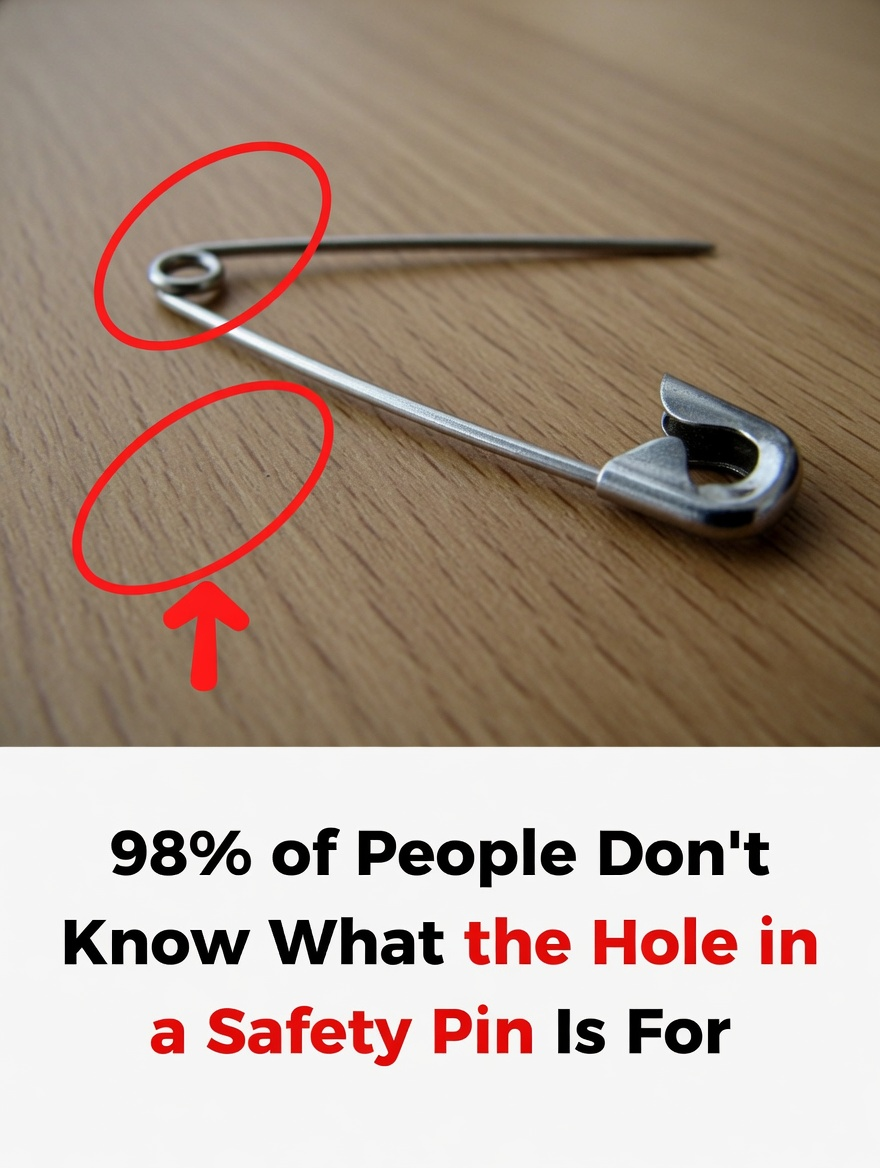
Safety pins are one of those everyday objects we grab without a second thought. Whether you’re fixing a hem in a hurry, securing a diaper, or attaching a name tag, they’ve been quietly solving small problems for over 180 years. But if you look closely at almost any standard safety pin, you’ll notice a small hole drilled into the head or clasp area. Most people assume it’s just a manufacturing leftover or a place to hang the pin on a display card. The truth is far more clever. That tiny hole is an intentional piece of smart engineering that makes the humble safety pin far more versatile than it first appears.
The hole exists primarily so you can thread a string, thin cord, or piece of thread through it. Once threaded, the pin can be anchored securely to fabric or material. This simple addition prevents the pin from rotating, twisting, or slipping out of place — a common frustration when using safety pins on lightweight, silky, or smooth surfaces. Instead of the pin shifting around or poking through at the wrong angle, the thread acts like a tiny anchor, holding everything exactly where you want it. It’s a low-tech solution that turns a basic fastener into something much more reliable for temporary repairs or adjustments.
This feature shines brightest in sewing and crafting. Tailors and DIY enthusiasts have long used the hole to “lock” a safety pin in position while working on delicate fabrics or during fittings. By running thread through the hole and into the garment, the pin stays perfectly aligned and won’t migrate or cause uneven puckering. It’s especially useful for holding pleats, securing zippers temporarily, or even creating quick button replacements. The hole adds stability without adding bulk or cost, which is why it has survived in the design for generations.
Beyond sewing, the hole makes safety pins surprisingly useful for organization. Thread a piece of string or fishing line through several pins and you instantly create a neat chain or bundle. This keeps loose pins from scattering in your sewing kit, travel bag, or junk drawer — and it prevents accidental pricks when you reach in. Crafters often string them together by color or size, turning a chaotic collection into an easy-to-grab system. It’s a small detail that turns ordinary pins into something far more practical for long-term storage.
Travelers and outdoor enthusiasts have discovered another clever use. Loop a cord or lanyard through the hole and you can attach a safety pin to your keychain, backpack strap, or emergency kit. Suddenly you have quick-access fasteners ready for ripped seams, broken zippers, or missing buttons while on the go. In survival or camping scenarios, the hole lets you secure the pin to gear so it doesn’t get lost in the bottom of a pack. It’s the kind of thoughtful touch that makes a simple tool feel surprisingly well-designed for real life.
The history of the safety pin adds even more appreciation for this tiny feature. Walter Hunt patented the modern safety pin in 1849 after twisting a piece of brass wire into its now-familiar shape. His original design already included the coiled spring and clasp for safety, but later manufacturers added the hole as production scaled. It was a quiet evolution driven by practical feedback from users who wanted the pin to stay put better. What started as a basic invention for holding fabric has been refined over decades into a more capable tool — all thanks to one small, often-overlooked hole.
In an age of high-tech gadgets and complicated fasteners, the safety pin’s design feels refreshingly elegant. It requires no batteries, no instructions, and almost zero maintenance. The hole exemplifies minimalism done right: one tiny addition that multiplies usefulness without complicating the product. Compare it to modern alternatives like adhesive hooks or magnetic closures, and the safety pin still wins for reliability and cost. It’s proof that sometimes the simplest solutions are the most enduring.
Parents, nurses, and caregivers especially appreciate the hole when using safety pins for diapers, bandages, or clothing adjustments on active kids. The extra security means fewer wardrobe malfunctions and less frustration during busy days. Even in emergency medical kits, the hole lets first responders or hikers quickly attach pins to clothing or gear for fast fixes without worrying about them coming loose.
Of course, the hole isn’t the only brilliant part of a safety pin. The coiled spring provides just the right tension, and the clasp keeps the sharp point safely tucked away. Together with the hole, these features create a tool that’s safe, strong, and surprisingly adaptable. It’s no wonder safety pins have remained virtually unchanged for so long — they already solve problems so effectively.
Next time you pick up a safety pin, take a second to notice that little hole. It’s a reminder that great design often hides in plain sight. Whether you’re using it for its classic purpose or discovering new ways to thread and anchor it, you’re benefiting from over a century of quiet innovation. Small details like this are what make ordinary objects quietly extraordinary.
If you’ve ever used the hole on a safety pin for a clever hack, share your favorite trick in the comments below. Sometimes the most useful solutions are the ones we’ve been carrying around in our drawers all along.
Most Popular!
-
 THE SILENCE SURROUNDING RFK JR.: WHAT IS BEING HIDDEN BEHIND CLOSED DOORS?
-
THE HELICOPTER IN THE BACKYARD: WHY MY PARENTS DISMISSED MY ORDINARY HUSBAND UNTIL HE SAVED MY LIFE DURING A TERRIFYING LABOR EMERGENCY
-
A DEADLY TREND: THE SILENT KILLER LURKING IN A TEEN’S PURSUIT OF BEAUTY
-
A DEADLY TREND: THE SILENT KILLER LURKING IN A TEEN’S PURSUIT OF BEAUTY
-
MY WIFE SOLD MY PRICELESS INHERITANCE BEHIND MY BACK—THEN THE BUYER CALLED IN ABSOLUTE TERROR!
-
THE FORTUNE I DIDN’T EXPECT: MY ELDERLY HUSBAND’S FINAL ACT OF REVENGE AGAINST HIS VULTURES
-
THE BILLIONAIRE IN THE TRAILER: TWO BOYS THOUGHT THEY WERE HELPING A DESTITUTE OLD MAN, BUT THE SECRET IN HIS FINAL WILL SHOCKED EVERYONE
-
THE INHERITANCE TRAP: MY SISTER STOLE THE PENTHOUSE, BUT I STOLE THE EMPIRE