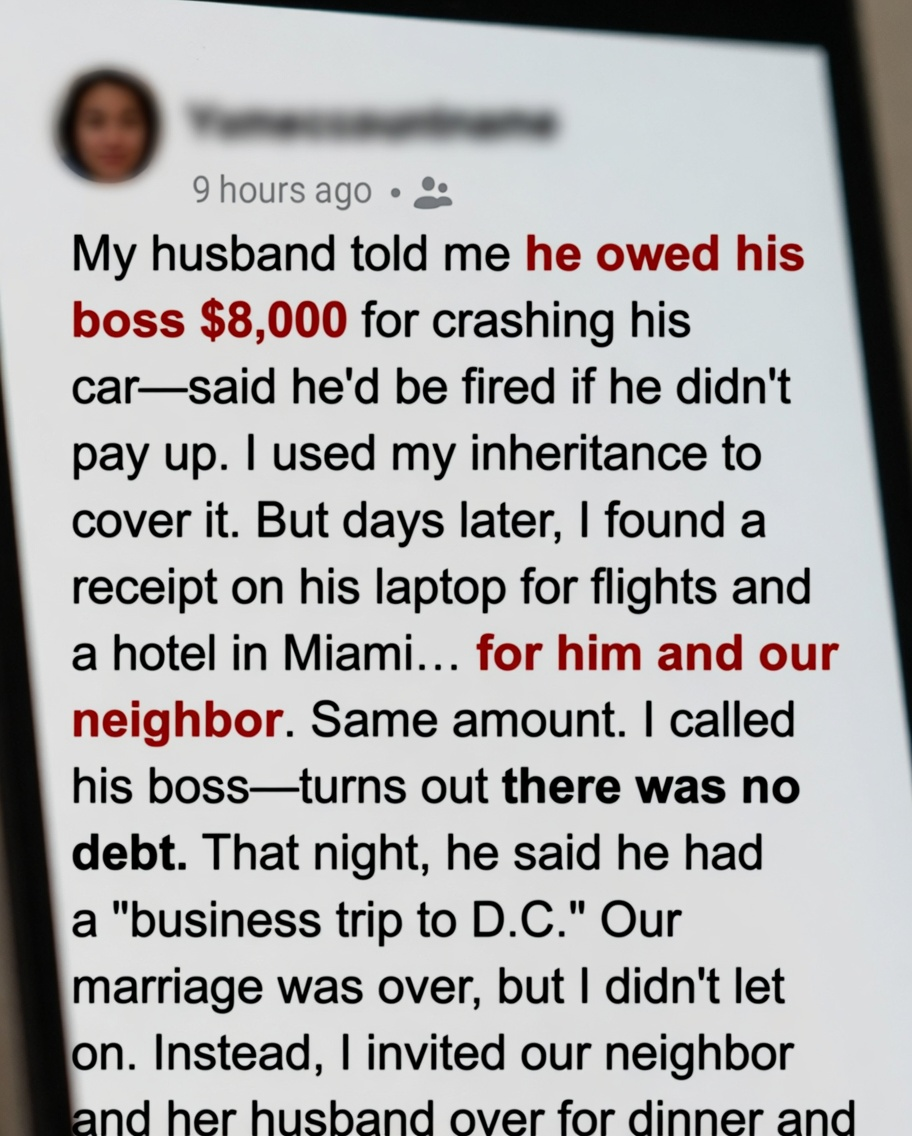
The letter arrived on a Tuesday morning while I was sorting through the mail at the kitchen counter. It was from our insurance company, and the subject line made my stomach drop: “Claim Denied – Inconsistent Statements.” My husband, Richard, had been in what he called a “minor fender bender” three weeks earlier. He had come home with a neck brace, a dramatic limp, and a story about a distracted driver who had rear-ended him at a stoplight. He had filed a claim immediately, talking about how the pain was “unbearable” and how we might need to dip into our savings for medical bills.
I had believed him. I had rubbed his back every night, made his favorite meals, and even offered to drive him to doctor appointments. But the letter in my hands told a different story. The insurance investigator had reviewed security footage from a nearby gas station. There was no accident. Richard’s car had never been hit. The neck brace was a prop. The limp disappeared the moment he thought no one was watching.
My hands shook as I read the rest of the letter. Not only had the claim been denied, but the company was investigating possible fraud. They had already flagged our policy. If they proved Richard had lied, we could lose our coverage entirely — and with it, the financial security we had spent thirty-two years building.
That evening, after Richard went to bed early (still “in pain”), I went through his desk. I found the truth buried in a folder labeled “Old Tax Documents.” There it was: an $8,000 withdrawal from our joint savings account made the day after the supposed accident. The money had been transferred to a separate account I didn’t even know existed — an account in his name only. Further digging revealed he had been moving money for months, small amounts at first, then larger ones. He had also taken out a secret loan against our home equity line of credit, the same line we had agreed would only be used for emergencies or our grandchildren’s college funds.
The pieces clicked together with horrifying clarity. Richard had been planning this for a long time. He had faked the accident to create a paper trail for an insurance payout. The $8,000 was just the beginning. He was slowly draining our retirement savings and home equity so he could leave me with nothing when he eventually filed for divorce. I later learned he had been having an affair with a woman from his office for over a year. She was younger, ambitious, and apparently eager to start a new life with my husband — and my money.
I felt sick. We had raised two children together. We had a paid-off home, solid retirement accounts, and plans to help our three grandchildren with college. I had worked as a teacher for twenty-eight years while Richard built his career in sales. We had sacrificed vacations, driven older cars, and lived below our means so we could retire comfortably and leave something meaningful behind. Now, in one night, I discovered that everything I thought was secure was being quietly stolen from under me.
The next morning, I didn’t confront him. I didn’t scream or cry. I simply packed a small bag, told Richard I was going to visit my sister for a few days, and drove straight to our neighbors’ house instead. Tom and Linda had been our closest friends for twenty years. They knew our family history, our financial situation, and most importantly, they knew how to keep a secret.
I told them everything. Tom, a retired accountant, helped me pull together all the evidence — bank statements, the fake accident documents, the secret loan against our home equity. Linda, a former paralegal, helped me draft a plan. We decided the best revenge wasn’t public humiliation or a messy divorce. It was quiet, calculated protection of everything Richard was trying to steal.
Three nights later, we invited Richard to dinner at Tom and Linda’s house. I told him it was a surprise “thank you” dinner for being such a good husband during his “recovery.” He arrived wearing his neck brace, playing the part of the injured victim perfectly. Tom greeted him warmly, poured him a glass of wine, and led him into the dining room where Linda had set a beautiful table.
Halfway through the meal, Tom casually mentioned that he had been reviewing our finances as a favor. Richard’s face went white when Tom slid a folder across the table containing every piece of evidence — the fake accident report, the $8,000 secret transfer, the home equity loan, and the affair. Tom had even contacted our insurance company and confirmed they were preparing to press fraud charges.
Richard tried to deny it at first. Then he tried to blame me. Finally, he broke down and admitted everything. He had planned to divorce me after the insurance payout came through, take half of our assets, and start over with his mistress. The $8,000 was just the first installment of what he hoped would be a much larger windfall.
What happened next was the ultimate revenge — and the ultimate protection of our family’s future.
Tom had already contacted our attorney that afternoon. While Richard sat at the dinner table, papers were being filed to freeze all joint accounts, cancel the home equity loan, and place our home and retirement savings into an irrevocable trust that Richard could never touch. By the time dessert was served, Richard had lost access to everything. He was left with nothing but the clothes on his back and whatever personal savings he had hidden.
The divorce was swift and one-sided. Richard’s mistress left him the moment she realized there was no money coming. He moved into a small apartment and eventually lost his job when the fraud investigation became public. I kept the house, the retirement savings, and — most importantly — the ability to help our grandchildren the way we had always planned.
For many grandparents reading this, the lesson is both heartbreaking and essential. We spend decades building retirement savings and home equity, making quiet sacrifices so our children and grandchildren will have more than we ever did. But sometimes the greatest threat to that legacy comes from the person sleeping beside us. Hidden affairs, secret debts, and calculated betrayals can quietly drain everything we have worked for — often right under our noses.
The practical truth is this: trust must be verified. Joint accounts should be monitored. Major financial decisions should never be made in isolation. And when red flags appear — sudden “accidents,” mysterious withdrawals, or unexplained behavior — we must act quickly and decisively to protect what we have built. Richard’s fake accident and $8,000 secret nearly cost me everything. Only because I discovered the truth in time and had trusted neighbors who helped me act fast was I able to turn the tables and save our family’s future.
Today, I am remarried to a kind, honest man who values transparency as much as I do. Our grandchildren visit often, and they know the story of how their grandmother protected their future when it mattered most. Richard still lives alone in that small apartment. He calls occasionally, but I have nothing left to say to him.
The quiet truth behind the inheritance trap that nearly destroyed everything is this: the people we trust most can sometimes become the greatest threat to the legacy we want to leave behind. Protecting retirement savings and home equity requires more than smart investing. It requires vigilance, courage, and the willingness to act — even when it means turning the tables on someone we once loved.
As you finish reading this, ask yourself: what financial secrets or red flags have you been ignoring in your own life? What steps can you take today to protect not just your retirement savings and home equity, but the future you want your grandchildren to inherit? Sometimes the most important decisions we make are the ones that happen quietly, behind closed doors, when we finally choose to stop the betrayal before it destroys everything we have spent a lifetime building.
Most Popular!
-
 The Secret Wedding of the Century: Ryan Seacrest’s Shocking Engagement Reveal That Has Hollywood Trembling
-
The Secret Language of Your Cat: Why That Persistent Head Butt Might Actually Be a Life-Altering Declaration
-
The Million-Dollar Secret: My Ex-Fiancé’s Mother Sabotaged My Life But a 20-Year-Old Trust Proved She Didn’t Own My Future
-
The House Stealing Trap: My Husband and Mother-in-Law Thought I Was Their Perfect Mark Until I Revealed My Secret
-
The Unforgivable Betrayal: Why This Father’s Choice to End His Own Son’s Life Has Destroyed a Community
-
The Great Erasure: Brad Pitt’s Worst Nightmare Comes True as His Last Son Finally Abandons the Family Name
-
The Final Curtain Call: The Heartbreaking Truth Behind Daytime TV Legend Phil Donahue’s Passing
-
The Silent Killer on Your Breakfast Table: Are You Eating Your Way to a Diabetic Crisis?