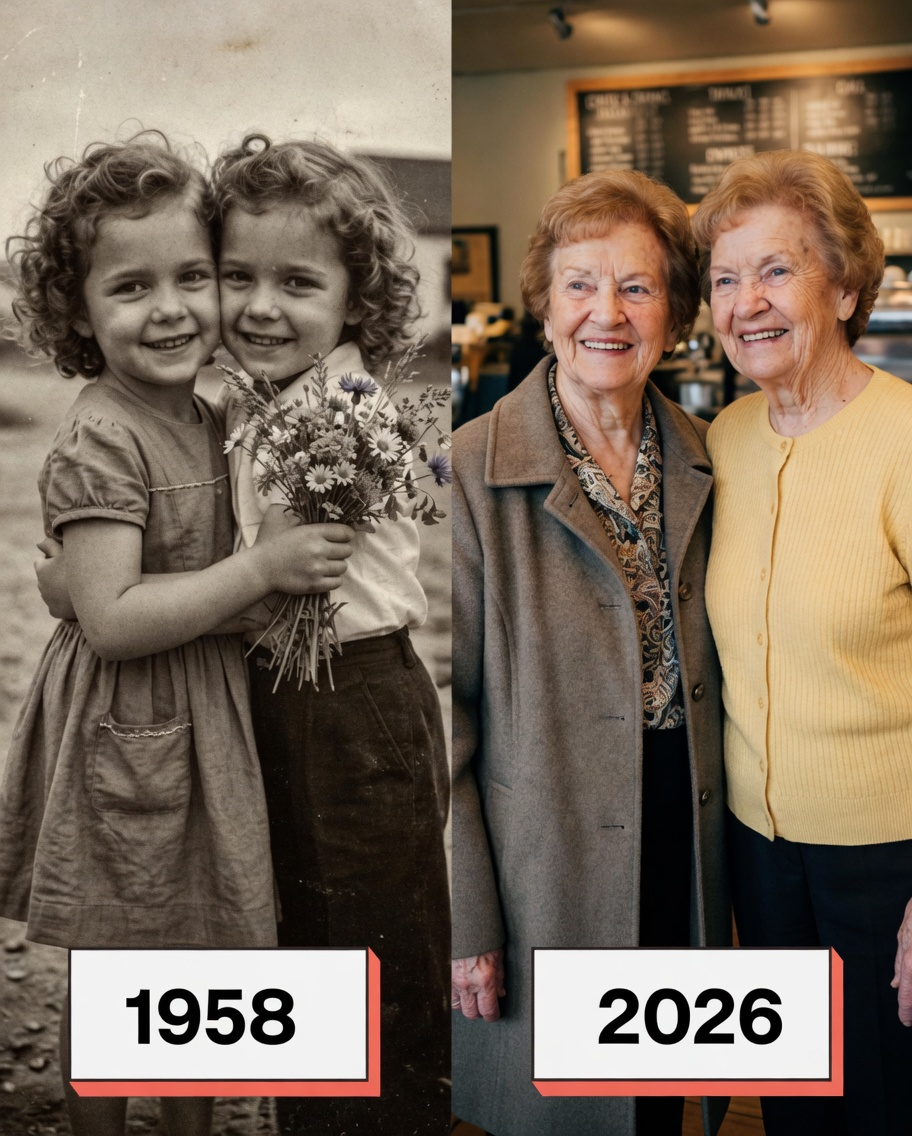
Margaret Ellis was seventy-three years old and had spent the last four decades telling herself the past was finally buried. She lived in a modest three-bedroom ranch house on the edge of town, the same home she had bought with her late husband’s life insurance money after he died in 1987. Her retirement savings were modest but steady — enough to cover her medications, her weekly bingo nights, and small gifts for her three grandchildren. She had learned long ago how to stretch every dollar and how to keep painful memories locked away in the same drawer where she kept her husband’s old medals.
On a rainy Tuesday afternoon in April, Margaret stopped at the new café that had opened downtown. She ordered her usual black coffee and blueberry muffin, then chose a small table by the window. As she sipped her coffee and watched the rain streak the glass, her eyes drifted to the wall beside her. There, in a simple black frame, hung a faded newspaper clipping from 1958. The headline read: “Local Man Cleared in Robbery After New Evidence Emerges.” Below it was a grainy black-and-white photo of a young man in handcuffs — and standing just behind him, barely visible in the shadows, was a much younger version of Margaret herself.
Her coffee cup froze halfway to her lips. The face staring back at her from the old photograph was not just familiar. It was hers.
The memories she had spent a lifetime burying came rushing back like a flood she could no longer hold back. In 1958, Margaret had been twenty-one years old and newly married to Thomas Ellis, a quiet factory worker with gentle eyes and big dreams. One cold November night, a local bank was robbed. The police, under pressure to solve the case quickly, arrested Thomas based on a single eyewitness who later admitted she had been pressured by detectives. Margaret had been in the courtroom the day the prosecutor presented “evidence” that everyone in town later learned had been fabricated — a planted wallet, a false timeline, and a coerced statement. She had watched her husband sentenced to eight years in prison for a crime he did not commit.
The lie had destroyed everything. Thomas lost his job, his reputation, and eventually his health. Margaret had been forced to raise their infant son alone while working two jobs and facing constant whispers from neighbors who believed the police version of events. She had spent years quietly paying off debts Thomas never knew existed and rebuilding a life from the ashes of that single night in 1958. When Thomas finally came home, broken and bitter, their marriage never recovered. He died of a heart attack at forty-nine, leaving Margaret with nothing but a small insurance policy and a lifetime of unspoken pain.
Now, at seventy-three, staring at that old newspaper clipping in a café she had never visited before, Margaret felt something shift deep inside her chest. The police lie that had stolen her husband’s freedom and her family’s future had been quietly corrected decades ago — yet no one had ever told her. The real robber had confessed on his deathbed in 1974. The charges against Thomas had been quietly dropped. But the damage had already been done. Margaret had spent the next forty-nine years living as the wife of a convicted man, never knowing the truth had been sitting in a dusty file all along.
She left the café without finishing her coffee. That night she couldn’t sleep. The next morning she drove to the county courthouse and requested every document related to the 1958 case. What she found made her hands shake. Not only had Thomas been fully exonerated in 1974, but the police department had quietly paid a settlement to the family — money that had been placed in a trust account under Margaret’s name. Because she had never come forward to claim it, the funds had grown with interest for nearly five decades. The account now held just over $287,000.
Margaret sat in her car in the courthouse parking lot and wept. All those years of stretching every dollar, of skipping doctor visits to save money, of worrying whether her grandchildren would have enough for college — it had all been unnecessary. The police lie had not only stolen her husband’s life. It had quietly stolen her financial security for decades.
She immediately contacted a lawyer. Within three months, the trust was released to her. She used part of it to pay off the remaining mortgage on her home, protecting the equity she had spent a lifetime building. She placed another portion into a new college fund for her three grandchildren. And she set aside a generous emergency fund so she would never again have to choose between medication and groceries.
But the money was not the most important part.
Margaret gathered her adult children and grandchildren around her kitchen table one Sunday afternoon and told them the entire story — the arrest, the fabricated evidence, the years of silence, and the quiet betrayal by the very system that was supposed to protect them. She showed them the old newspaper clipping she had taken from the café wall. She told them how the lie had shaped every financial decision she had made since 1958.
Her oldest granddaughter, a twenty-two-year-old college senior, looked at her with tears in her eyes and said, “Grandma, you protected us even when you didn’t have to. Now it’s our turn to protect your story.”
The family decided together to donate a portion of the recovered funds to a local innocence project that helps wrongfully convicted people. They also created a small scholarship in Thomas Ellis’s name for students studying criminal justice. Margaret felt something she hadn’t felt in decades — peace.
The practical lesson in Margaret’s story is one every grandparent needs to hear. Sometimes the greatest threats to our retirement savings and home equity are not market crashes or unexpected medical bills. They are the old lies and secrets we carry in silence — the things we are too afraid or too tired to confront. Those buried truths can quietly drain our resources for years without us ever knowing why.
Margaret had spent nearly five decades living smaller than she needed to because of a police lie from 1958. The moment she finally faced that truth, everything changed. Her home equity became truly hers again. Her grandchildren’s future became more secure. And her own remaining years became lighter.
Many grandparents reading this will recognize pieces of their own lives — the old family stories that were never fully told, the financial decisions made in the shadow of long-buried pain, the quiet sacrifices that protected everyone except themselves. Margaret’s story is a reminder that it is never too late to seek the truth, even when that truth is painful. Sometimes the very thing we have been afraid to face for decades is the key that finally unlocks the security and peace we have been working toward our entire lives.
The quiet truth behind the face in the mirror that changed everything for a seventy-three-year-old woman is this: the lies we inherit or carry can steal from us for a lifetime — but the courage to finally look them in the eye can return more than we ever lost. Margaret’s grandchildren will grow up knowing their grandmother not only protected their future with her savings, but also protected their family’s dignity by refusing to let an old injustice remain buried.
As you finish reading this, ask yourself: what old lie or unspoken truth in your own family might still be quietly affecting your retirement savings, your home equity, or the legacy you want to leave your grandchildren? The moment you find the courage to face it may be the moment everything finally begins to heal — just as it did for Margaret when she looked at her own face in that faded newspaper clipping and decided the silence had lasted long enough.
Most Popular!
-
 The Secret Wedding of the Century: Ryan Seacrest’s Shocking Engagement Reveal That Has Hollywood Trembling
-
The Secret Language of Your Cat: Why That Persistent Head Butt Might Actually Be a Life-Altering Declaration
-
The Million-Dollar Secret: My Ex-Fiancé’s Mother Sabotaged My Life But a 20-Year-Old Trust Proved She Didn’t Own My Future
-
The House Stealing Trap: My Husband and Mother-in-Law Thought I Was Their Perfect Mark Until I Revealed My Secret
-
The Unforgivable Betrayal: Why This Father’s Choice to End His Own Son’s Life Has Destroyed a Community
-
The Great Erasure: Brad Pitt’s Worst Nightmare Comes True as His Last Son Finally Abandons the Family Name
-
The Final Curtain Call: The Heartbreaking Truth Behind Daytime TV Legend Phil Donahue’s Passing
-
The Silent Killer on Your Breakfast Table: Are You Eating Your Way to a Diabetic Crisis?